Paleontologists working in northeastern Thailand have identified a new species of mamenchisaurid sauropod dinosaur, offering fresh evidence that a group of giant sauropods once thought to be almost exclusively East Asian also roamed mainland Southeast Asia.
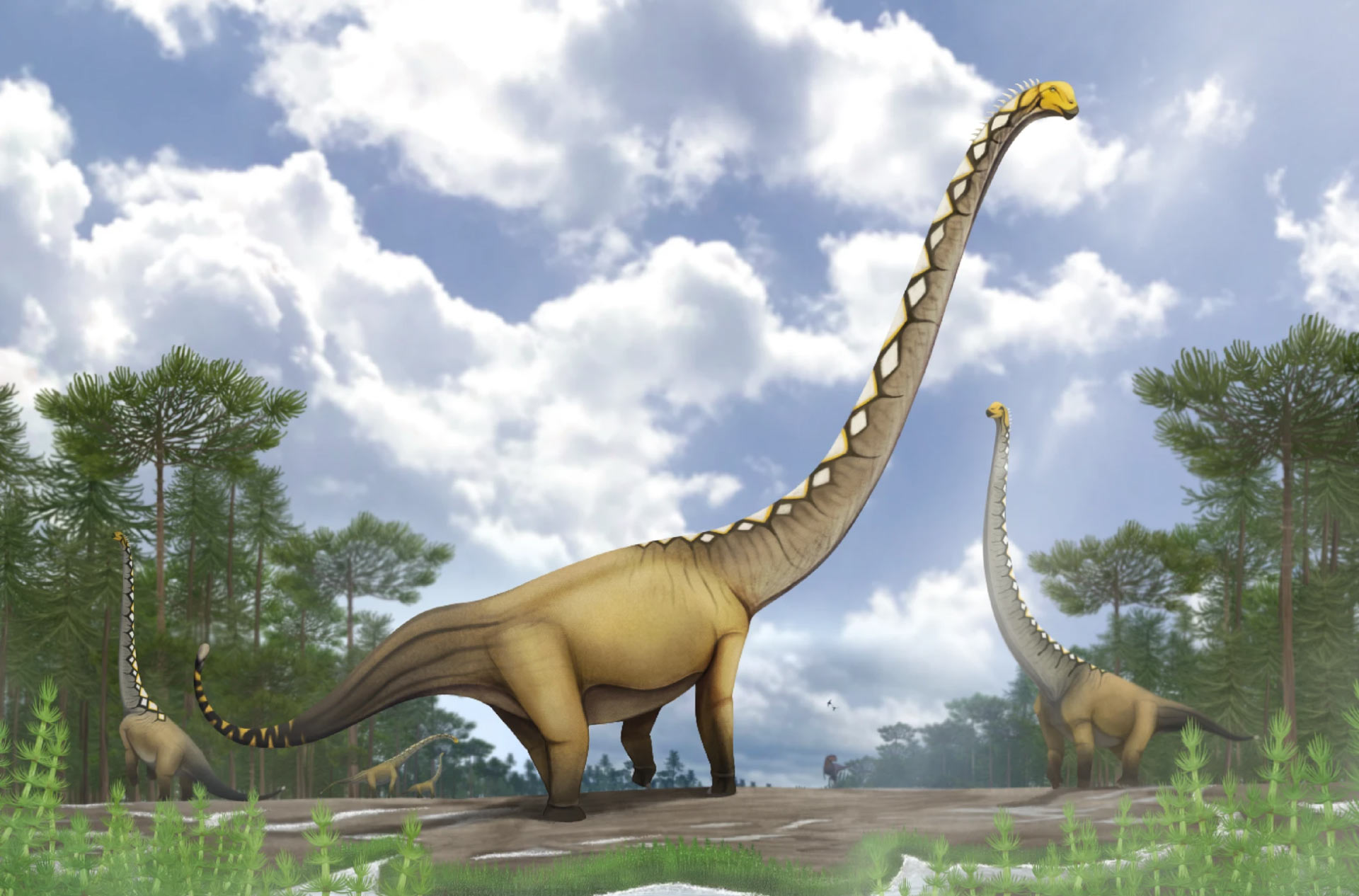
Life reconstruction of a herd of five individuals of Uragasaurus kalasinensis inhabiting a Late Jurassic forest in Thailand, accompanied by a pair of rhamphorhynchoid pterosaurs and a metriacanthosaurid theropod. Image credit: Pakorn Chotchaiyaporn.
Dubbed Uragasaurus kalasinensis, the newly-identified dinosaur species lived in what is now Thailand during the latest Jurassic, between 150 and 145 million years ago.
It belonged to Mamenchisauridae, a family of non-neosauropod sauropods famous for their extraordinarily elongated necks.
Mamenchisaurids were common across China during the Middle to Late Jurassic period, but their presence beyond China has been documented only rarely.
“Mamenchisauridae represents the predominant non-neosauropodan eusauropod clade throughout the Middle to Late Jurassic of East Asia,” said Mahasarakham University’s Dr. Apirut Nilpanapan and colleagues from Thailand.
“Members of the clade are characterized by extremely elongated cervical vertebrae with highly developed pneumatic structures, and in derived taxa by procoelous anterior caudal vertebrae, distinct them from other eusauropods.”
“These features, although convergently evolved in several Cretaceous neosauropod lineages — including Euhelopodidae, Somphospondyli, and Titanosauria — have complicated interpretations of mamenchisaurid relationships and contributed to ongoing uncertainty regarding their phylogenetic position among sauropods.”
“The fossil record of mamenchisaurids is most abundant in China, particularly within the Sichuan Basin, where the Middle to Upper Jurassic deposits of the Shaximiao Formation have yielded various well-known taxa.”
Uragasaurus kalasinensis is known from a single, remarkably well-preserved anterior dorsal vertebra — a bone from just behind the animal’s neck.
The fossil came from the Phu Noi fossil site of the Phu Kradung Formation, a sequence of river-deposited rocks that has yielded one of Southeast Asia’s richest assemblages of Jurassic vertebrate fossils.
Catalogued as PRC 460, the specimen was excavated alongside several other sauropod bone fragments, though those pieces could not be confidently linked to the same individual.
The team’s phylogenetic analysis places Uragasaurus kalasinensis near the base of the mamenchisaurid family tree, suggesting it represents one of the group’s earlier-diverging members.
The discovery adds to a small but growing list of mamenchisaurid finds outside China, suggesting the family’s geographic range was broader — and its evolutionary story more complex — than previously understood.
“The discovery of Uragasaurus kalasinensis represents the first formally named mamenchisaurid from Thailand,” the paleontologists said.
“It also expands the geographic distribution of Mamenchisauridae into mainland Southeast Asia and provides additional evidence that this clade was widespread across eastern Asia during the Late Jurassic.”
“The presence of closely related taxa in China suggests possible faunal connections across the East Asian landmass during this time.”
“Comparisons with more distantly distributed taxa highlight the complex paleobiogeographic patterns of sauropods during the Jurassic-Cretaceous transition, although the limited fossil record currently prevents a detailed reconstruction of dispersal routes.”
“The phylogenetic placement of Uragasaurus kalasinensis near the base of Mamenchisauridae further highlights the morphological variability present among early-diverging members of the clade.”
“Continued discoveries from the Phu Kradung Formation and other Jurassic deposits in Southeast Asia may therefore provide important insights into the early evolutionary history and biogeographic dispersal of mamenchisaurid sauropods.”
The discovery of Uragasaurus kalasinensis is reported in a paper in the journal Scientific Reports.
_____
A. Nilpanapan et al. 2026. A new mamenchisaurid sauropod from the Lower Phu Kradung Formation, Upper Jurassic of northeastern Thailand. Sci Rep 16, 21205; doi: 10.1038/s41598-026-49822-3