Tenuicruris piscanexum is only the second Cretaceous bird species named from the Australian continent.
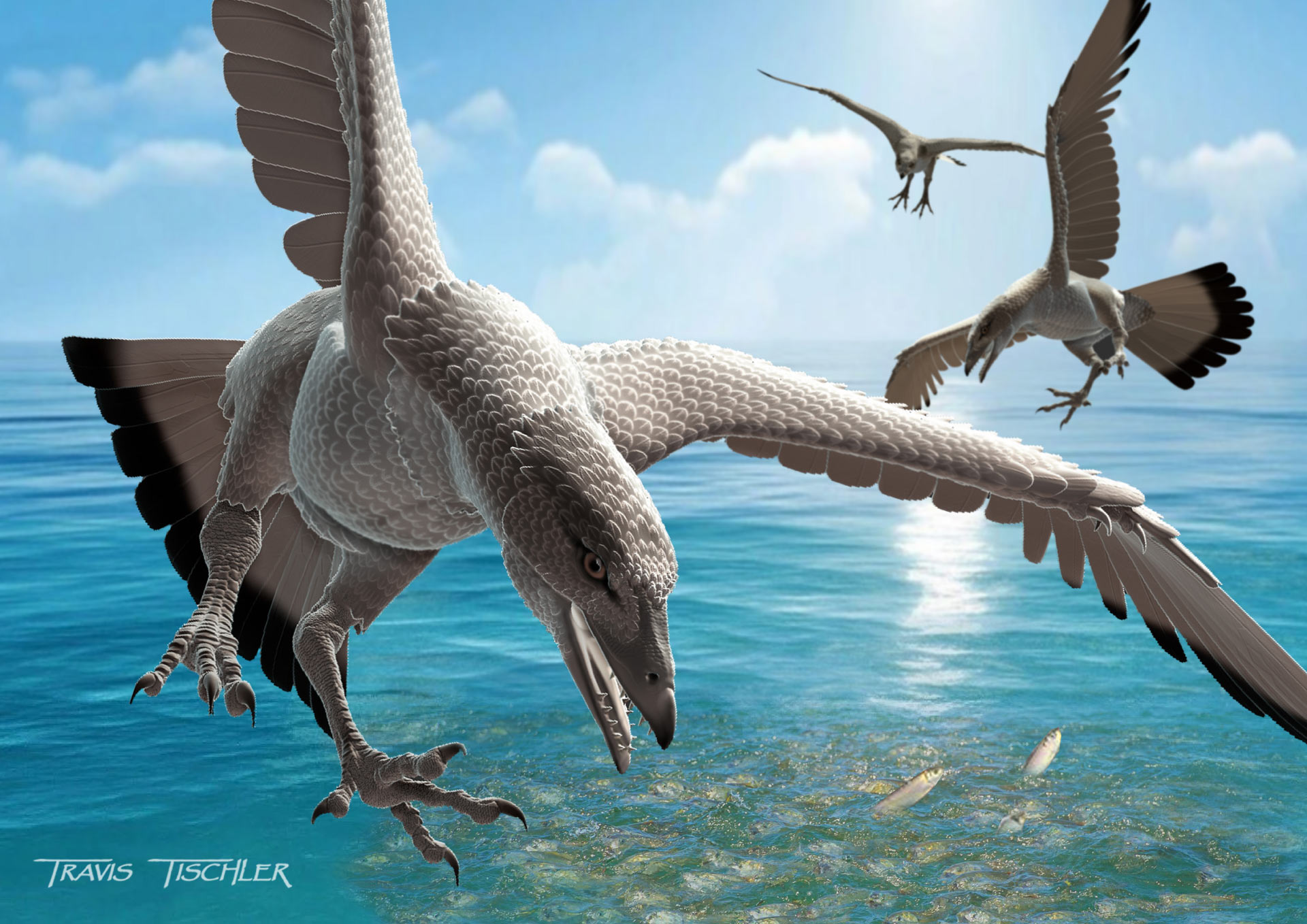
Life restoration of Tenuicruris piscanexum. Image credit: Travis Tischler.
“Fossil evidence of birds from the Cretaceous period in Australia is notably scarce, consisting mostly of isolated bones,” said University of New England’s Dr. Matt White and his colleagues.
“The oldest recorded Australian bird fossil is a partial furcular (wishbone) from Victoria, dating to approximately 128-120 million years ago.”
“Additionally, feathers of a similar age have also been discovered near Koonwarra in Victoria, attributed to both dinosaurs and early birds.”
“Until now, the only Cretaceous bird named from Australia was Nanantius eos, represented by a nearly complete left tibiotarsus (shin bone) discovered within marine deposits of the 105-million-year-old Toolebuc Formation.”
The new Cretaceous species, Tenuicruris piscanexum, is also based on a well-preserved tibiotarsus.
The 6.5-cm bone was found at a public fossicking site about 12 km northwest of Richmond, in the same geological formation.
“Although the newly discovered remains represent isolated bones, they are exceptionally rare — the second named Cretaceous bird from Australia,” University of Bristol’s Dr. Dean Lomax, who was not involved in the study.
“This find provides exciting new information about the ancient environment and diversity of animals around what is now Richmond.”
The paleontologists also unearthed a second specimen — a complete tarsometatarsus (lower-leg bone) — at a separate site near Richmond.
Notably, this is the first tarsometatarsus reported from Australian Cretaceous deposits.
“I recognized them immediately as bird bones,” Dr. White said.
“These specimens are especially significant because so few have been found in Australia, and none were directly comparable until now.”
The authors place both Tenuicruris piscanexum and the second specimen among the Enantiornithes, a diverse group of early birds that lived during the Cretaceous.
“Tenuicruris piscanexum increases the number of comparable named Cretaceous bird taxa from Australia from one to two, improving our ability to assess avian diversity and ecology in the region,” they said.
“The find also adds birds to the growing faunal list from the Toolebuc Formation, alongside ichthyosaurs, pliosaurs, plesiosaurs, turtles, sharks, chimaeroids, bony fish and pterosaurs — evidence of a rich inland‑sea ecosystem.”
The discovery is reported in a paper in the Journal of Vertebrate Paleontology.
_____
Matt A. White et al. Tenuicruris piscanexum, a new addition to Australia’s rare Cretaceous bird fossils. Journal of Vertebrate Paleontology, published online September 28, 2026; doi: 10.1080/02724634.2026.2703151