Physicists from the LHCb experiment at CERN’s Large Hadron Collider (LHC) have discovered a new kind of heavy proton-like particle. Known as Ξcc⁺, this particle contains two charm quarks and one down quark, giving scientists a rare new way to probe the strong force that binds the building blocks of matter.
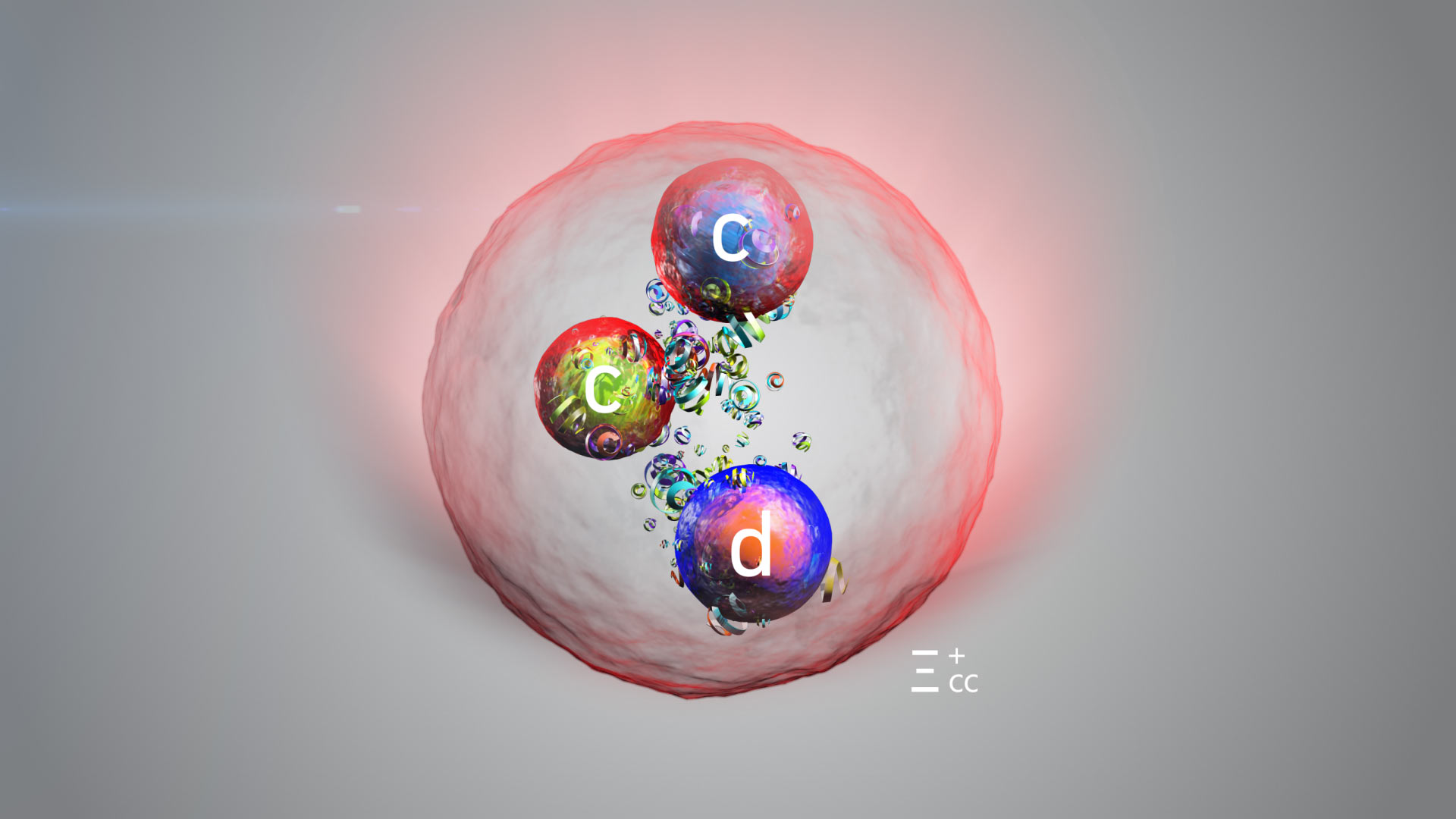
An artist’s impression of the doubly charmed baryon Ξcc⁺, which contains two charm quarks and one down quark. Image credit: CERN.
Quarks are the fundamental building blocks of matter, coming in six flavors: up, down, charm, strange, top and bottom.
They typically combine in pairs or trios to form mesons and baryons. But unlike the stable proton, most hadrons — the collective term for mesons and baryons — are unstable and vanish almost as soon as they appear, making them difficult to detect.
Producing them requires smashing together high-energy particles in a machine such as the LHC.
These unstable hadrons will quickly decay, but the more stable particles that are produced as a result of this decay can be detected and the properties of the original particle can therefore be deduced.
The newly-discovered particle brings the total number of hadrons discovered by LHC experiments up to 80.
“This is the first new particle identified after the upgrades to the LHCb detector that were completed in 2023, and only the second time a baryon with two heavy quarks has been observed, the first having being observed by LHCb almost 10 years ago,” said LHCb spokesperson Dr. Vincenzo Vagnoni.
“The result will help theorists test models of quantum chromodynamics, the theory of the strong force that binds quarks into not only conventional baryons and mesons but also more exotic hadrons such as tetraquarks and pentaquarks.”
In 2017, the LHCb team reported the discovery of a very similar particle, which consists of two charm quarks and one up quark.
This up quark is the only difference between this particle and the new one, which has a down quark in its place.
Despite the similarity, the new particle has a predicted lifetime that is up to six times shorter than its counterpart, due to complex quantum effects. This makes it even more challenging to observe.
By analyzing data from proton-proton collisions recorded by the LHCb detector during the third run of the LHC, the physicists observed the new baryon with a statistical significance of 7 sigma, well above the threshold of 5 sigma required to claim a discovery.
“This major result is a fantastic example of how LHCb’s unique capabilities play a vital role in the success of the LHC,” said CERN director-general Mark Thomson.
“It highlights how experimental upgrades at CERN directly lead to new discoveries, setting the stage for the transformative science we expect from the High-Luminosity LHC.”
“These achievements are only possible thanks to the exceptional performance of CERN’s accelerator complex and the teams who make it all work and to the commitment of the scientists on the LHCb experiment.”