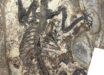
Known from a single skull discovered in South Africa in 1952, Cistecynodon parvus has been shuffled across the evolutionary tree: described at various times as a close relative of advanced cynodonts, a juvenile of another species and even something outside the group altogether. Now, a new study using computed tomography (CT) scans to digitally reconstruct the fossil concludes that this Triassic creature was its own valid species and a much more primitive cynodont than some paleontologists had thought.
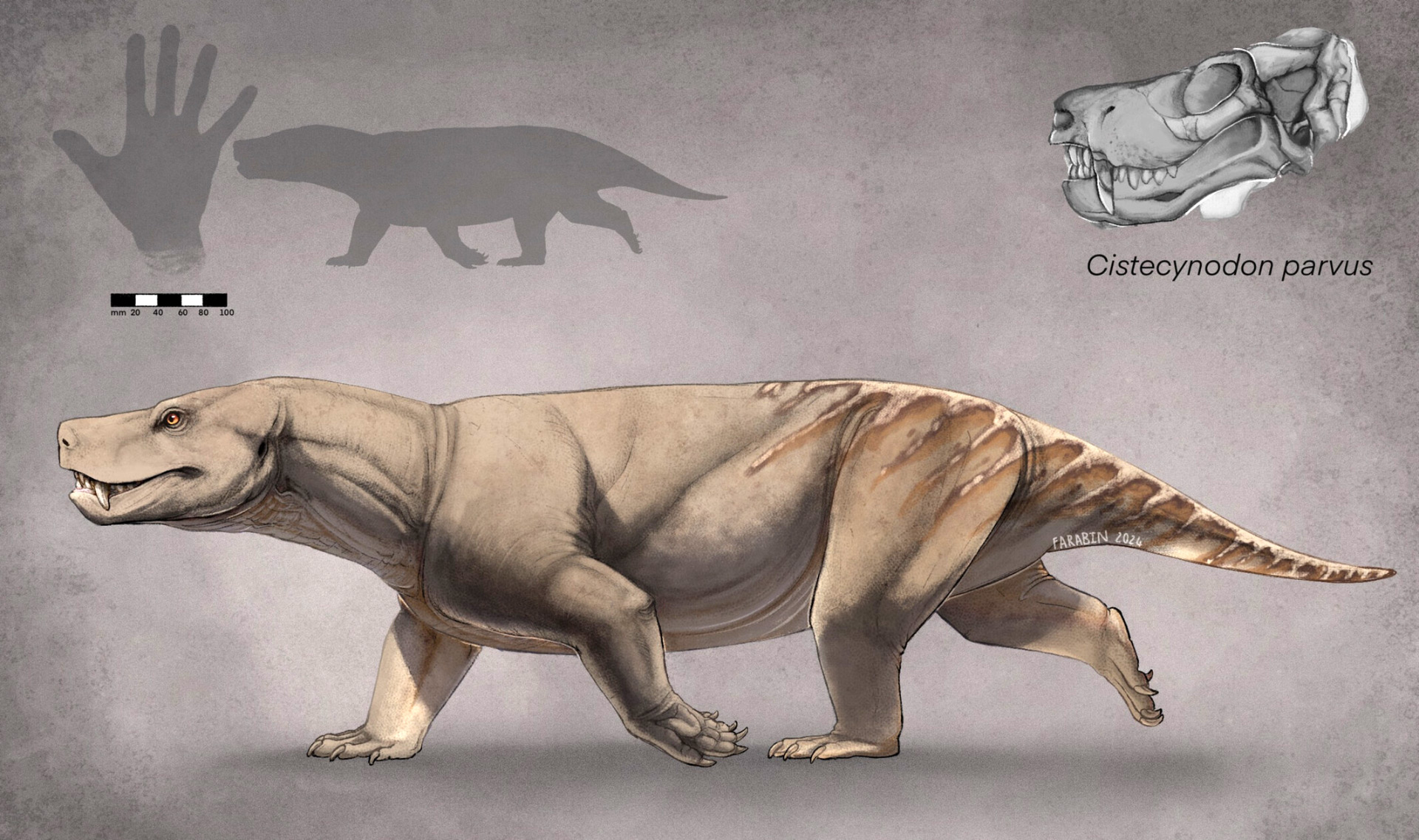
Life reconstruction of Cistecynodon parvus. Image credit: Morgan Hopf.
“Cynodontia is one of the six major subclades of Therapsida appearing during the Late Permian and comprising a substantial and diverse quantity of the tetrapod fauna during the Triassic,” said Dr. Erin Lund from the University of the Witwatersrand and colleagues.
“This group is comprised of non-mammaliaform cynodonts and Mammaliaformes, including crown mammals, making it crucial for evaluating the origin of mammals.”
“The major Triassic radiation of cynodonts is represented by the Eucynodontia, which consists of two monophyletic subclades: Cynognathia and Probainognathia.”
In a new study, the paleontologists reexamined the skull of Cistecynodon parvus, a cynodont species that lived during the Middle Triassic, between 247 and 237 million years ago.
The 5.72-cm-long specimen was found in 1952 at Luiperdkop (or Luiperdskop), located west of the town Maletswai in the Eastern Cape province of South Africa.
The researchers used CT to peer inside the fossil and reconstruct details of the skull, jaw and internal anatomy.
Their analysis places Cistecynodon parvus among basal, or non-eucynodont, cynodonts rather than within the more advanced eucynodont group.
At the same time, the fossil appears to have had an unusual combination of traits: a highly enlarged vestibule in the inner ear, a small and pinched parietal foramen, a relatively simple maxillary canal and the absence of carotid foramina.
Together, these features distinguish Cistecynodon parvus from other cynodonts and support its status as a separate genus and species.
According to the researchers, some of these features point to a subterranean way of life.
In particular, they interpret the inflated vestibule of the inner ear as evidence of enhanced sensitivity to low-frequency sound, a trait associated in modern animals with fossorial, or burrowing, habits.
They conclude that Cistecynodon parvus was likely an obligate fossorial animal.
“Over the past century Cistecynodon parvus has been variously referred to different clades of non-mammalian cynodont without any emerging consensus,” the scientists said.
“The data from this research firmly support that Cistecynodon parvus is a valid taxon of basal non-eucynodont Cynodontia (i.e., a non-eucynodont epicynodont).”
“Its position is supported by the secondary palate, which is open along the midline, despite it being a sub-adult to adult age specimen.”
“Lastly, its unique inner ear and endocast anatomy supports that Cistecynodon parvus was a fossorial animal.”
“Cistecynodon parvus is reconstructed as a basal lineage of cynodonts in Southern Africa that survived the end Permian mass extinction and persisted as a relict fauna through to the early Middle Triassic,” they concluded.
Their paper was published this month in The Anatomical Record.
_____
Erin S. Lund et al. Redescription of the Triassic cynodont Cistecynodon parvus and reassessment of its phylogeny. The Anatomical Record, published online March 19, 2026; doi: 10.1002/ar.70179