Physicists at the University of Oxford have engineered a new class of ‘cat states’ — quantum superpositions constructed not from ordinary wave packets, but from deeply exotic, nonclassical components — opening unexpected paths toward more resilient quantum computers.
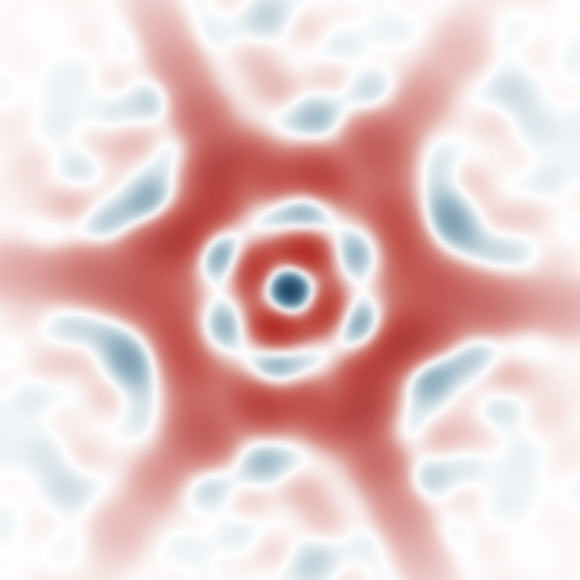
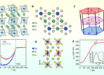
Quantum mechanics defies classical intuition, most famously through Schrödinger’s cat, where systems exist in superpositions of opposing states. Such superpositions are central to quantum technologies. Quantum ‘cat’ states have been realized in harmonic oscillators, but implementations were largely limited to Fock, displaced, or Gottesman-Kitaev-Preskill states. A different class of macroscopic superpositions, where an oscillator is squeezed along orthogonal axes so that its positional variance is simultaneously larger and smaller than the Heisenberg limit, was proposed previously but remained unrealized. Saner et al. introduce a trapped-ion hybrid spin-oscillator system enabling an experimental realization of these ‘siblings’ of Schrödinger’s cat. Image credit: Saner et al., doi: 10.1103/k1xk-yt42.
“Unlike classical physics, quantum mechanics allows objects to exist in more than one state at the same time,” said University of Oxford’s Dr. Sebastian Saner and his colleagues.
“This idea is often illustrated by Schrödinger’s cat, imagined as being both alive and dead until it is observed.”
“In a lab, physicists can create less dramatic but very real versions of this effect by placing atoms, light, or motion into two distinct quantum states at once.”
“Creating and controlling these superpositions is essential for applications ranging from quantum computing to precision timekeeping.”
“A simple example is a quantum bit, or qubit, in a superposition of both 0 and 1. But quantum systems are not limited to just two states.”
“In a quantum harmonic oscillator, which can occupy many different energy levels, there is a much richer set of possibilities.”
“Quantum harmonic oscillators describe many physical systems, including light, vibrations and the motion of trapped particles, and have been used to create a wide variety of quantum superpositions.”
“One well-known example is a cat state, in which an oscillator is placed in a superposition of two wave packets displaced in opposite directions.”
“These wave packets, known as coherent states, resemble classical motion as closely as quantum mechanics allows.”
In their new research, Dr. Saner and co-authors demonstrated a new family of quantum superpositions.
Instead of building cat-like states from coherent-state wave packets, they developed a method for creating superpositions from a broad range of components that are themselves highly nonclassical.
In examples such as squeezed-state superpositions, quantum uncertainty is redistributed differently in each part of the state.
“The experiment used the motion of a single trapped ion,” the physicists said.
“A trapped ion combines two different kinds of quantum system: its internal state acts like a qubit, while its motion behaves like a quantum harmonic oscillator capable of occupying many different motional states.”
“This makes it a powerful platform for engineering quantum states that go beyond ordinary qubits.”
To create these states, the researchers first used engineered interactions to entangle the ion’s internal state with different possible states of motion.
A mid-circuit quantum measurement of the internal state then projected the ion’s motion into the chosen superposition of nonclassical components.
“This approach gave us a tool to sculpt the quantum superposition into almost any shape,” Dr. Saner said.
The method gave the researchers programmable control over the states they produced.
By changing the experimental settings, they could tune the relative size, rotation and separation of the components, allowing a wide range of exotic motional superpositions to be generated within the same trapped-ion system.
The scientists also directly reconstructed the quantum states they created.
The reconstructions revealed interference patterns and regions of Wigner negativity — signatures that the states could not be described as ordinary classical mixtures.
These features confirmed that the experiment had produced true quantum superpositions of genuinely nonclassical motional states.
The authors are now collaborating with theorists to determine more precisely how ‘quantum’ these states are.
“We were really encouraged by our colleagues’ reaction when we showed them what we had made,” said Dr. Raghavendra Srinivas, also from the University of Oxford.
“We believe we’re still scratching the surface of what’s possible, both for practical applications and for understanding these states at a more fundamental level.”
The team’s paper was published this month in the journal Physical Review X.
_____
S. Saner et al. 2026. Generating Arbitrary Superpositions of Nonclassical Quantum Harmonic Oscillator States. Phys. Rev. X 16, 021049; doi: 10.1103/k1xk-yt42