Europa’s subsurface ocean has long topped astrobiologists’ wish lists as a place to search for life beyond Earth. But new research led by a Rutgers University scientist suggests reaching that ocean — or even glimpsing evidence of it near the icy surface — may be far harder than expected.

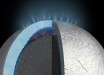
Artist’s concept of ocean on Jupiter’s moon Europa. Image credit: NASA / JPL-Caltech.
“Numerous icy moons, including Europa, possess subsurface oceans beneath their icy exteriors,” said Rutgers University researcher Lujendra Ojha and colleagues from Johns Hopkins University and Dartmouth College.
“Liquid water from Europa’s deep ocean has been proposed to rise through dykes and form shallow sills.”
“Such reservoirs could create transient habitable environments and may be directly linked to the formation of various surface features on Europa.”
“However, whether dykes can transport enough water from Europa’s deep ocean to form these shallow reservoirs remains poorly constrained.”
In the study, the researchers used computer simulations to test whether liquid water from Europa’s deep, global ocean could rise through cracks in the moon’s icy shell and pool in shallower reservoirs — pockets that future spacecraft could more plausibly detect or sample than the ocean itself, which may sit tens of kilometers underground.
“The mystery we wanted to solve was whether this journey is actually possible,” Dr. Ojha said.
“Can liquid water rise from Europa’s deep ocean toward the surface without freezing along the way?”
The scientists found that water rising through fractures in the ice would move turbulently rather than smoothly, swirling and churning against the cold walls of the cracks and losing heat rapidly in the process.
This rapid cooling can push the water below its normal freezing point while it remains liquid, allowing tiny ice crystals called frazil ice to form and clog the pathway.
The simulations showed narrow fractures could seal shut within hours, and even wider ones would need to be unrealistically long, or extremely numerous, to ferry enough water upward to explain some of Europa’s surface features.
The findings challenge comparisons often drawn to volcanic activity on Earth.
While cryovolcanism — the movement of water and ice rather than molten rock — has been likened to terrestrial volcanism, the physics don’t map neatly onto each other, since ice and liquid water behave very differently than lava.
“Ice and liquid water are fundamentally different than lava and the volcanoes that we see here on Earth,” Dr. Ojha said.
“I think there’s some fundamental physics that’s missing here, and so I wanted to explore that.”
The implications extend beyond theory. If shallow pockets of liquid water do exist beneath Europa’s surface, they may not be directly connected to the deep ocean at all — instead forming locally as ice melts within the shell.
That would complicate efforts to use any shallow water as a proxy for the ocean’s chemistry and habitability.
“Our work suggests that Europa’s ice shell may be a stronger barrier between the ocean and the surface than previously assumed,” Dr. Ojha said.
“This helps future missions interpret what they find and better understand where to look for signs of habitability.”
The study appears in the journal Nature Astronomy.
_____
L. Ojha et al. Limited direct fluid exchange between the deep subsurface ocean and the shallow subsurface environment of Europa. Nat Astron, published online July 23, 2026; doi: 10.1038/s41550-026-02918-2