The Solar System’s smallest planet has contracted by nearly 19 km (12 miles) across, as crater debris masked telltale wrinkles on its surface, according to new research led by the German Aerospace Center’s Institute of Space Research.
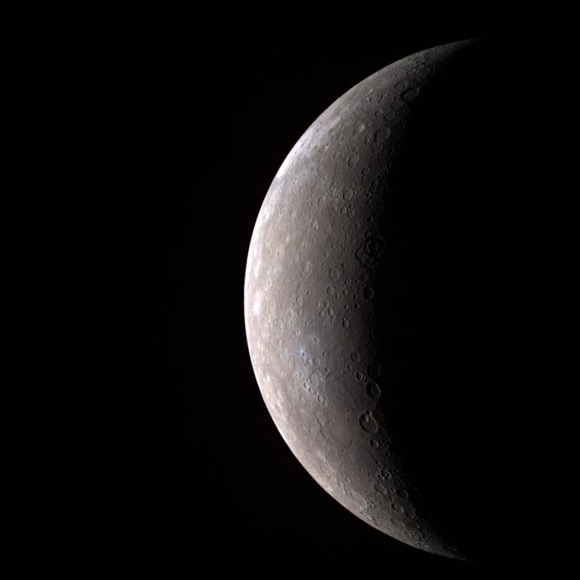
This color image of Mercury was generated from three MESSENGER images taken through filters sensitive to light in different wavelengths. Image credit: NASA / Johns Hopkins University Applied Physics Laboratory / Carnegie Institution of Washington.
Like the other rocky planets in our Solar System, Mercury formed through a flurry of violent collisions between rocks and asteroids orbiting the Sun around 4.5 billion years ago.
The energy from these impacts generated huge amounts of heat, which Mercury has been losing ever since.
Like a balloon left out in the cold, Mercury’s interior shrank as it cooled, and the outermost rocky layers compensated for the planet’s changing size by crumpling and cracking to form tectonic features such as scarps and ridges.
“Determining how much Mercury’s radius has decreased over time upon planetary cooling is essential for understanding the planet’s geodynamic evolution,” said lead author Dr. Gaku Nishiyama and colleagues.
“This decrease is estimated by analyzing shortening structures, which are the tectonic expression of faults that have accommodated the planet’s global contraction.”
“Interestingly, the observed heterogeneous distribution of these landforms does not match the isotropic pattern expected from global cooling.”
“One possibility is that some structures have been obscured by resurfacing events, such as impact ejecta deposition.”
“To test this hypothesis, we use surface roughness as a proxy for geological freshness.”
In the study, the researchers combined earlier maps of geologic evidence for contraction with new maps of surface roughness for the entire planet’s surface.
They showed that the roughest areas on Mercury have fewer visible wrinkles.
Next, they used the contraction required to form shrinkage ridges and scarps in less disrupted areas to estimate how much contraction likely occurred planet wide, including under rough patches.
They found that missing features in rough areas could amount to 10-30% more shrinkage over Mercury’s lifetime — a total change of up to 23 km (14.5 miles) in the planet’s diameter rather than the currently estimated 4-16 km (2.5-10 miles).
“Around 30% is a little bit surprising, but the corrected amount of contraction actually makes sense to me,” Dr. Nishiyama said.
“With his updated shrinkage estimate, observations of how much Mercury has cooled and shrunk are now more in step with predictions based on physics, suggesting we are closer to understanding what is going on inside the solar system’s smallest rocky planet.”
The results appear in the journal Geophysical Research Letters.
_____
G. Nishiyama et al. 2026. Underestimation of Planetary Contraction Due To Obscuration by Surface Roughness: The Case of Mercury. Geophysical Research Letters 53 (17): e2026GL124067; doi: 10.1029/2026GL124067