Described in a paper that appears today in the journal Nature Astronomy, the discovery means habitable exoplanets could have started forming much earlier...
WASP-132 is a unique multi-planet system in that both an inner rocky planet and the newly-discovered outer giant planet are in a system with a hot-Jupiter...
In 2003, Hubble provided evidence of a massive exoplanet around a very old star. Such stars possess only small amounts of heavier elements that are the...
The newly-discovered exoplanet orbits TOI-3261 (also known as TIC 358070912), an inactive main-sequence star located 300 parsecs (978.5 light-years) away...
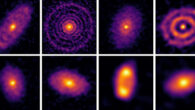
Using the Atacama Large Millimeter/submillimeter Array (ALMA), astronomers have captured high-resolution images of eight protoplanetary disks in Sigma...
The Moon may have been captured during a close encounter between a young Earth and a terrestrial binary (a system of the Moon and another rocky object),...
Using the Near-Infrared Imager and Slitless Spectrograph (NIRISS) instrument on the NASA/ESA/CSA James Webb Space Telescope, astronomers have discovered...
Gas giant exoplanets around bright nearby stars provide crucial insights into planetary system formation and evolution mechanisms. Most of these planets...
New observations of 86 planet-forming disks provide astronomers with a wealth of data and unique insights into how planets arise in different regions of...
Astronomers using the NASA/ESA/CSA James Webb Space Telescope have detected abundant water, carbon monoxide, carbon dioxide, hydrogen cyanide and acetylene...
Current theories predict that low-mass stars should rarely host planets with masses exceeding that of Neptune (17 Earth masses).
An artist’s impression...
Astronomers have long puzzled over why all of the planets in our Solar System have slightly slanted orbits around the Sun. But Yale University planetary...
Astronomers using the Atacama Large Millimeter/submillimeter Array (ALMA) have captured a high-resolution image of HL Tauri, a young star in the constellation...
Young moving stellar groups are the best targets for direct imaging of exoplanets and four massive Jupiter-like planets have been already discovered in...
Astronomers believe the peculiar composition of the Neptune-sized planet TOI-1853b is the result of a giant planetary clash.
Heavy elements dominate the...
The formation of giant planets has traditionally been divided into two pathways: core accretion and gravitational instability. However, in recent years,...
PDS 70, a young K7-type star some 370 light-years away from Earth in the constellation of Centaurus, is a unique target for planetary formation studies...