A tiny copper-alloy object long dismissed as a simple awl has been reclassified as the earliest known rotary metal drill from ancient Egypt.
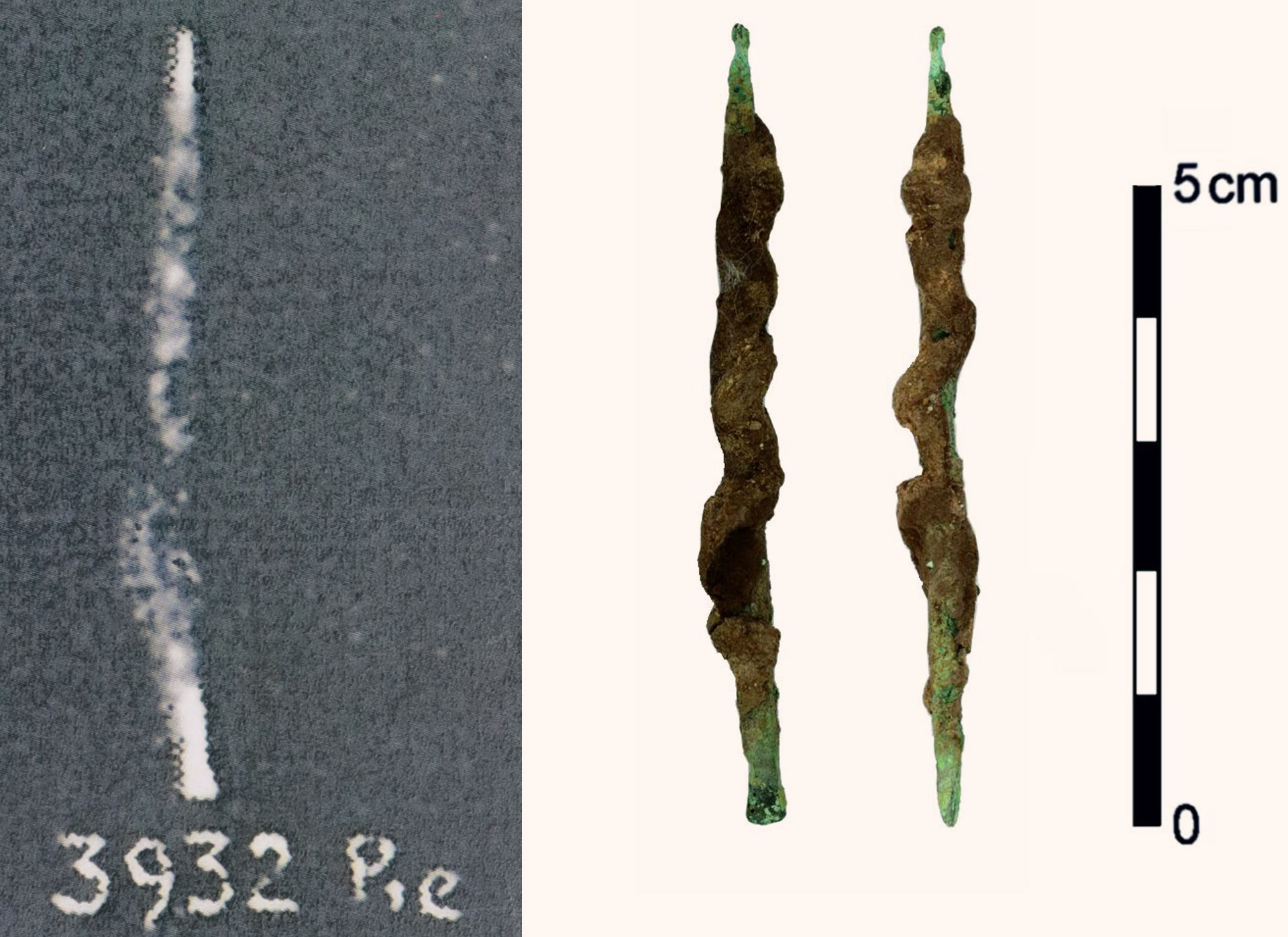
Original photograph of the Badari drill published in 1927 by Guy Brunton (left) and the actual artifact. Image credit: Martin Odler & Jiří Kmošek, doi: 10.1553/AEundL35s289.
The ancient drill is only 6.3 cm (2.5 inches) long and weighs about 1.5 grams.
Dating from the Predynastic period (4th millennium BCE), before the first pharaohs ruled, the artifact was found at Badari in Upper Egypt.
“The ancient Egyptians are famous for stone temples, painted tombs, and dazzling jewelry, but behind those achievements lay practical, everyday technologies that rarely survive in the archaeological record,” said Dr. Martin Odler, an archaeologist at Newcastle University.
“One of the most important was the drill: a tool used to pierce wood, stone, and beads, enabling everything from furniture-making to ornament production.”
When first published in the 1920s, the Badari drill was described as ‘a little awl of copper, with some leather thong wound round it.’
That brief note proved easy to overlook, and the object attracted little attention for decades.
However, Dr. Odler and his colleague, Dr. Jiří Kmošek, found that the tool shows distinctive wear consistent with drilling: fine striations, rounded edges, and a slight curvature at the working end, all features that point to rotary motion, not simple puncturing.
They also found six coils of an extremely fragile leather thong — a remnant of the bowstring used to power a bow drill, an ancient equivalent of a hand drill, where a string wrapped around a shaft is moved back and forth by a bow to spin the drill rapidly.
“This re-analysis has provided strong evidence that this object was used as a bow drill — which would have produced a faster, more controlled drilling action than simply pushing or twisting an awl-like tool by hand,” Dr. Odler said.
“This suggests that Egyptian craftspeople mastered reliable rotary drilling more than two millennia before some of the best-preserved drill sets.”
Using the portable X-ray fluorescence (pXRF) technique, the researchers found that the Badari drill was made from an unusual copper alloy.
“The drill contains arsenic and nickel, with notable amounts of lead and silver,” said Dr. Kmošek, a researcher with the Institute of Science and Technology in Art at the Academy of Fine Arts Vienna and the Nuclear Physics Institute at the Academy of Sciences of the Czech Republic.
“Such a recipe would have produced a harder, and visually distinctive, metal compared with standard copper.”
“The presence of silver and lead may hint at deliberate alloying choices and, potentially, wider networks of materials or know-how linking Egypt to the broader ancient Eastern Mediterranean in the 4th millennium BCE.”
The team’s paper was published in the journal Ägypten und Levante.
_____
Martin Odler & Jiří Kmošek. 2025. The earliest metal drill of Naqada IID Dating. Ägypten und Levante 35: 289-306; doi: 10.1553/AEundL35s289