At Leang Bulu Bettue, a rock-shelter in the Maros-Pangkep karst region on the Indonesian island of Sulawesi, paleoanthropologists have uncovered one of the most complete records of early human occupation ever found in Wallacea — a key crossroads between Asia and Australia. Their discovery sheds new light on how early Homo sapiens lived, adapted and possibly encountered archaic hominin species tens of thousands of years ago.
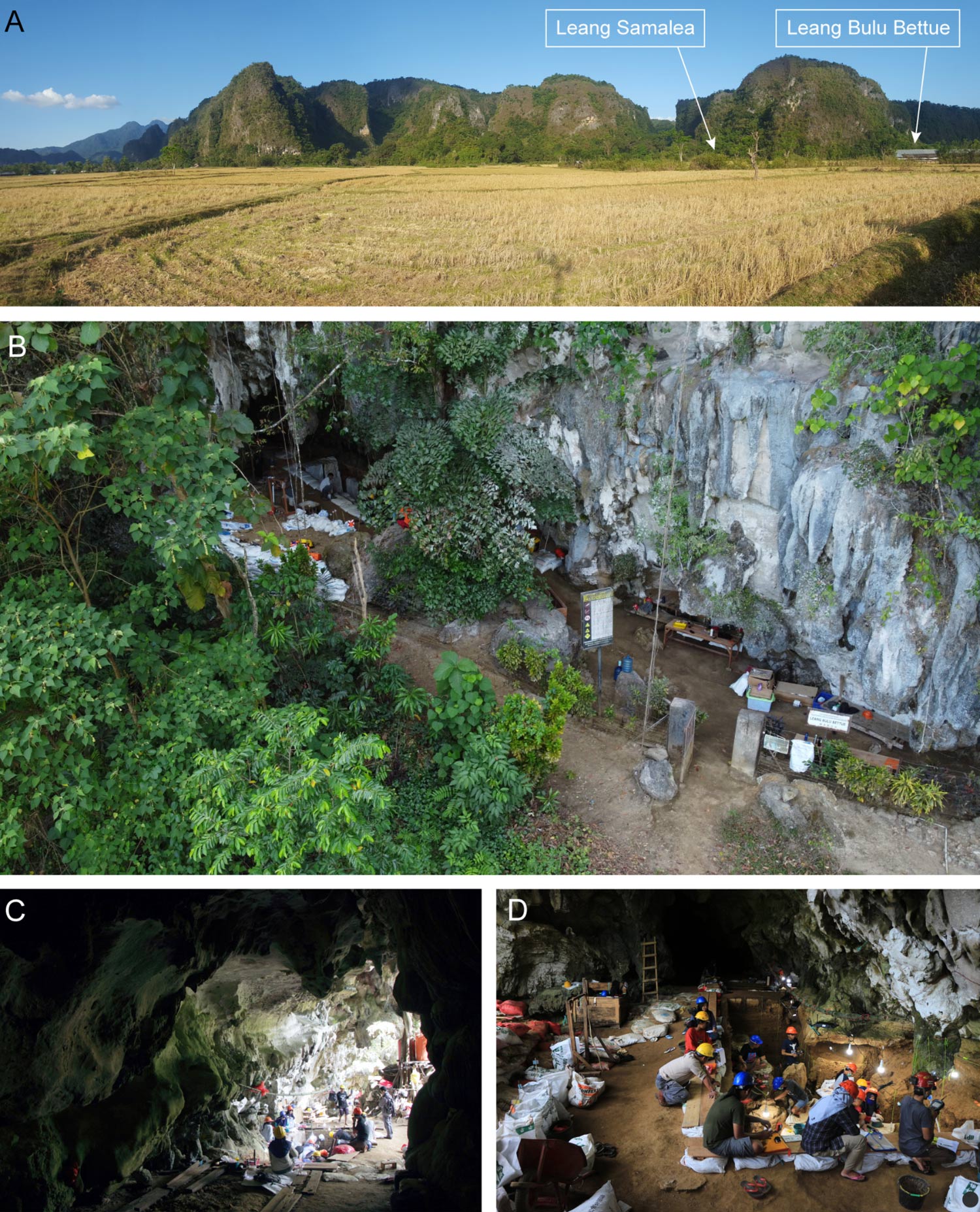
Leang Bulu Bettue in the Maros-Pangkep karst area of South Sulawesi. Image credit: Burhan et al., doi: 10.1371/journal.pone.0337993.
At Leang Bulu Bettue, Griffith University Ph.D. candidate Basran Burhan and colleagues unearthed a rich sequence of artifacts, stone tools and animal bones covering much of the Pleistocene epoch.
“The depth and continuity of the cultural sequence at Leang Bulu Bettue now positions this cave as a flagship site for investigating whether these two human lineages overlapped in time,” Burhan explained.
According to the study, the earliest phase of occupation — dated as far back as about 208,000 years ago — is defined by relatively simple stone tools and traces of animal butchery.
Among the most striking early evidence were heavy-duty stone tools known as picks, suggesting an established cultural tradition of archaic hominins long before modern humans arrived.
“These activities appear to represent an archaic hominin cultural tradition that persisted on Sulawesi well into the Late Pleistocene,” said Griffith University’s Professor Adam Brumm.
The archaeologists found evidence for a striking shift around 40,000 years ago: a new suite of stone technologies and evidence of symbolic behavior — hallmarks associated with Homo sapiens.
“This later phase featured a distinct technological toolkit, and the earliest known evidence for artistic expression and symbolic behavior on the island,” Burhan said.
“The dramatic break may reflect a major demographic and cultural transition on Sulawesi, specifically the arrival of our species in the local environment and the replacement of the earlier hominin population.”
The island of Sulawesi has long been recognized as a pivotal region in the story of human evolution.
Its position between continental Asia and the Sahul landmass that once linked Australia and New Guinea made it a critical waypoint for early human dispersals.
Yet the region’s thick forests, rugged terrain and deep seas have left surprisingly sparse archaeological data — until now.
One of the most tantalizing implications of this new research is the possibility that Homo sapiens and earlier, now-extinct human relatives may have lived on Sulawesi at the same time.
The researchers suggested that Leang Bulu Bettue could provide the first direct archaeological evidence for this chronological overlap and possible interaction.
Among the most intriguing aspects of the later layers are signs of symbolic and cultural behavior, echoing discoveries at other Sulawesi sites that have also yielded ancient rock art and sophisticated tools.
These developments — once considered unique to Homo sapiens — hint that modern humans brought not only new technologies but new cognitive and cultural practices to the island when they arrived.
“That is why doing archaeological research in Sulawesi is so exciting,” Professor Brumm said.
“For example, you could dig as deep as you like at an Australian site and you’ll never find evidence for human occupation prior to the arrival of our species, because Australia was only ever inhabited by Homo sapiens.”
“But there were hominins in Sulawesi for a million years before we showed up, so if you dig deep enough, you might go back in time to the point where two human species came face-to-face.”
“There may be several more meters of archaeological layers below the deepest level we have excavated at Leang Bulu Bettue thus far,” Basran said.
“Further work at this site could therefore reveal new discoveries that will change our understanding of the early human story on this island, and perhaps more widely.”
The findings were published in December 2025 in the journal PLoS ONE.
_____
B. Burhan et al. 2025. A near-continuous archaeological record of Pleistocene human occupation at Leang Bulu Bettue, Sulawesi, Indonesia. PLoS One 20 (12): e0337993; doi: 10.1371/journal.pone.0337993