New research suggests that the first widespread human cultures in the Americas were not opportunistic foragers who ate whatever they could find, but specialized big-game hunters who built their lives around killing the largest animals on the landscape: mammoths, elephant-like gomphotheres, giant ground sloths, and other Ice Age giants.

Paleo-Indians hunting a glyptodont, a relative of the armadillo that lived during the Pleistocene epoch. By Heinrich Harder, 1920.
For decades, archaeologists have debated whether these early Paleoindians were megafauna specialists, focused on hunting massive animals, or dietary generalists who ate a broad mix of small game, fish, plants, and shellfish depending on their local environment.
Over the past ten years, many scientists had drifted toward the generalist view.
However, a new study led by the University of Alaska Fairbanks pushes back hard against that trend.
“One of two competing ideas is dietary generalization: exploiting a wide variety of resources that would differ based on region,” explained University of Alaska Fairbanks Professor Ben Potter.
“The other is megafaunal specialization: focusing on just a few large-bodied prey.”
In the study, the researchers examined 50 archaeological sites across three regions: Eastern Beringia (ancient Alaska, roughly 14,000 to 13,300 years ago), the Clovis culture of North America (about 13,400 to 12,800 years ago), and the Fishtail Projectile Point culture of South America (roughly 12,900 to 11,600 years ago).
Together, these represent the earliest continent-spanning human societies in the western hemisphere.
Analyzing measures such as species abundance, minimum number of individuals, and edible biomass, the scientists found that megafauna accounted for 83% to 88% of the meat and fat these groups likely consumed.
Woolly mammoths dominated diets in Beringia, Columbian mammoths in North America, and giant ground sloths and gomphotheres in South America.
Smaller animals were present at many sites but contributed almost nothing nutritionally.
“The test of dietary specialization isn’t just how many of a given animal you find at an ancient campsite,” Professor Potter said.
“It’s what the record looks like relative to natural abundance. If early people were dietary generalists, you’d expect to find the most common animals would be more common in peoples’ campsites.”
“Animals like mammoths and ground sloths, which were actually quite rare in the landscape, completely dominate the archaeological record.”
“Rabbits and mice, which would have been everywhere, barely register.”
The authors also point to independent evidence: a chemical analysis of a Clovis-era child called Anzick-1 found that roughly 96% of his mother’s protein came from megafauna, mostly mammoth.
Beyond diet, these early groups shared other hallmarks of specialized hunters: highly efficient, well-maintained toolkits carried over long distances; extremely mobile, far-ranging lifestyles instead of settled home territories; and little to no evidence of plant-processing tools like grinding stones.
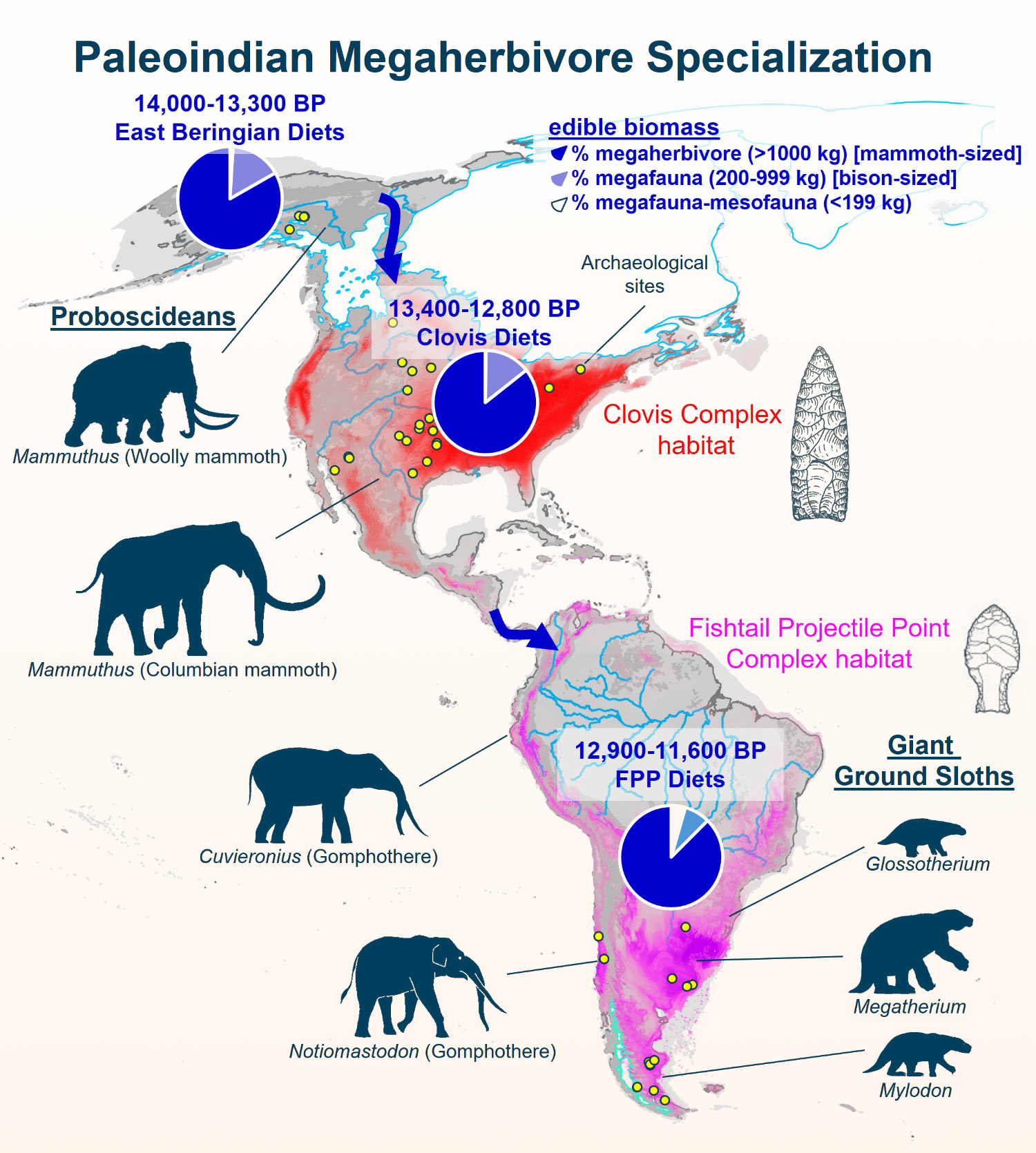
A map and dietary analysis showing how three Paleoindian cultures — East Beringian, Clovis and Fishtail Projectile Point — specialized in hunting megaherbivores across the western hemisphere between roughly 14,000 and 11,600 years ago. Image credit: Ben Potter.
“The focus on large herbivores for food also explains why the early toolkits appear very similar from California to Maine to Florida, and at sites in South America,” Professor Potter said.
“People hunting the same kind of animal across radically different landscapes had no need to adapt their technology to local conditions.”
“The tools found at the archaeological sites included implements for hunting large game, such as large fluted projectile points and specialized butchering implements.”
“Fishing gear and plant-processing tools were notably absent.”
The focus on hunting large prey also explains the rapid expansion of humans from Alaska through South America.
When hunter-gatherers move into unfamiliar territory, they typically need generations to learn the new landscape, how to effectively hunt local small and medium-sized game, and which local plants are edible. Building a diet around large mammals changes that dynamic.
“Mammoths, for example, can cover a tremendous range and occupy vast territories,” said University of Alaska Fairbanks Professor Mat Wooller.
“In effect, specialist hunter-gatherers used their knowledge of megaherbivores, like mammoths, to expand successfully across the continents rather than learning about each localized ecosystem they encountered.”
The researchers suggest human specialization in hunting the largest herbivores may have helped destabilize broader ecological networks, contributing to the wave of extinctions that swept through Ice Age megafauna as these cultures expanded southward down the continents.
In Alaska, mammoths and horses disappeared around 13,300 years ago, at the end of the earliest known human occupation there.
Clovis-era megafauna in North America were gone by 12,800 years ago, and gomphotheres and giant ground sloths survived in South America until about 11,600 years ago.
“The same sequence of arrival, overlap and extinction played out again and again, each time a little further south, making a strong circumstantial case for human hunting as a major contributing factor to megafauna extinction, compounded by climate change, which could have reduced their habitat, making them more susceptible to hunting pressure,” Professor Potter said.
“Megaherbivores reproduce slowly, space births widely and, as adults, have no natural predators.”
“They would have had no learned wariness of new, technologically sophisticated human hunter-gatherer populations.”
The results were published July 1, 2026 in the journal Science Advances.
_____
Ben A. Potter et al. 2026. Hemisphere-wide evidence of Early Paleoindian megaherbivore specialization. Science Advances 12 (27); doi: 10.1126/sciadv.aef9628