For decades, the discovery of stone spear points lying next to proboscidean (mammoth, mastodon, and gomphothere) bones has been treated as archaeology’s version of a smoking gun: proof that America’s first well-documented culture, the Clovis people, were megafauna hunters who helped drive the great beasts to extinction roughly 13,000 years ago. A new study argues that conclusion has never actually been tested and that the evidence just as easily supports a very different picture.

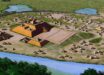
An artist’s reconstruction of Clovis life 13,000 years ago shows the Anzick-1 infant with his mother consuming mammoth meat near a hearth. Another individual crafts tools, including dart projectile points and atlatls. A mammoth butchery area is visible nearby. Image credit: Eric Carlson / Ben Potter / Jim Chatters.
“There are currently 15 well-documented Late Pleistocene localities in North America in which Clovis points are found associated with proboscidean remains,” said Kent State University’s Dr. Metin Eren and colleagues.
“Archaeologists routinely assume these localities represent evidence that Clovis people hunted these multi-tone animals, and in turn invoke that evidence to claim humans had a role in the extinction of these large mammals.”
“Yet, archaeologists have not thoroughly tested their assumption, nor fully considered the possibility that Clovis foragers were facultative scavengers, which might as readily account for the association of artifacts with proboscidean remains at some or even all these localities.”
In the study, the researchers examined all 15 sites where Clovis stone tools have been found alongside the remains of mammoths, mastodons or gomphotheres.
Their conclusion: none of the sites contain evidence that rules out scavenging, and archaeologists have rarely even tried to rule it out.
The problem is a phenomenon called equifinality — different processes can leave identical traces.
A broken spear point, a butchered carcass, cut marks on bone: all of these can result either from killing an animal or from finding it already dead and processing the meat, hide, bone and sinew that remained.
Clovis points can snap during butchery in ways indistinguishable from breaks caused by using them as weapons, and that the microscopic wear patterns once thought to be ‘direct evidence’ of hunting can also form when a tool strikes the ground, is used to butcher a mud-caked hide, or is simply mishandled.
Notably, not a single Clovis point or point fragment has ever been found embedded in a proboscidean bone — the kind of unambiguous ‘murder weapon’ evidence documented at several mammoth sites in Eurasia, where spear tips remain lodged in animal bones dating back tens of thousands of years.
In 2024, an isotope study of the ‘Anzick child,’ a Clovis-era infant from Montana, concluded that his mother’s diet placed her at the very top of the food chain — comparable to an extinct hypercarnivorous cat — implying she ate enormous quantities of mammoth meat.
Dr. Eren and co-authors argue that result is not biologically plausible for a human, since humans cannot safely digest that much protein.
A more likely explanation is that the mother’s diet included maggots harvested from decaying carcasses, which studies show carry extremely high nitrogen values of their own.
The researchers are not claiming Clovis people never hunted mammoths — only that the current evidence cannot distinguish hunting from scavenging at any individual site, and therefore cannot support the claim that Clovis megafauna hunters were responsible for driving mammoths and other Ice Age giants to extinction.
“Researchers cannot currently distinguish the two archaeologically and thus cannot reliably show how many Clovis proboscidean sites represent hunting versus scavenging events,” Dr. Eren said.
“While Clovis foragers likely hunted mammoths, it would be odd indeed if Clovis foragers — alone among ethnohistoric and ethnographic human groups and nearly all omnivores and carnivores — did not scavenge,” added Dr. David Meltzer, a researcher at Southern Methodist University.
“Scavenging also could possibly explain the high δ15N values recently reported for the Anzick child, which could readily result from his mother eating maggots and not mammoth meat.”
“If we cannot definitively conclude that proboscidean killing took place at any single Clovis site because there is archaeological equifinality with scavenging, then proboscidean overkilling is not supported either,” Dr. Eren said.
“Despite some archaeologists’ and other scientists’ long-standing beliefs, there is just no definitive scientific evidence for a human role in the North American Late Pleistocene extinction of proboscideans.”
The study was published July 1 in the Journal of Archaeological Science: Reports.
_____
Metin I. Eren et al. Did Clovis foragers hunt megafauna, scavenge their carrion, or both – And can we tell the difference? Journal of Archaeological Science: Reports, published July 1, 2026; doi: 10.1016/j.jasrep.2026.105896