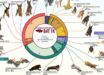
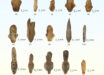
Ancient DNA from brightly colored feathers found in Peru shows that at least four distinct species of Amazonian parrots — the scarlet macaw (Ara macao), the blue-and-yellow macaw (Ara ararauna), the red-and-green macaw (Ara chloropterus) and mealy amazon (Amazona farinosa) — were transported alive over the Andes centuries before the Inca Empire, evidence of sophisticated long-distance exchange linking Amazonia, highland passes and Pacific communities.
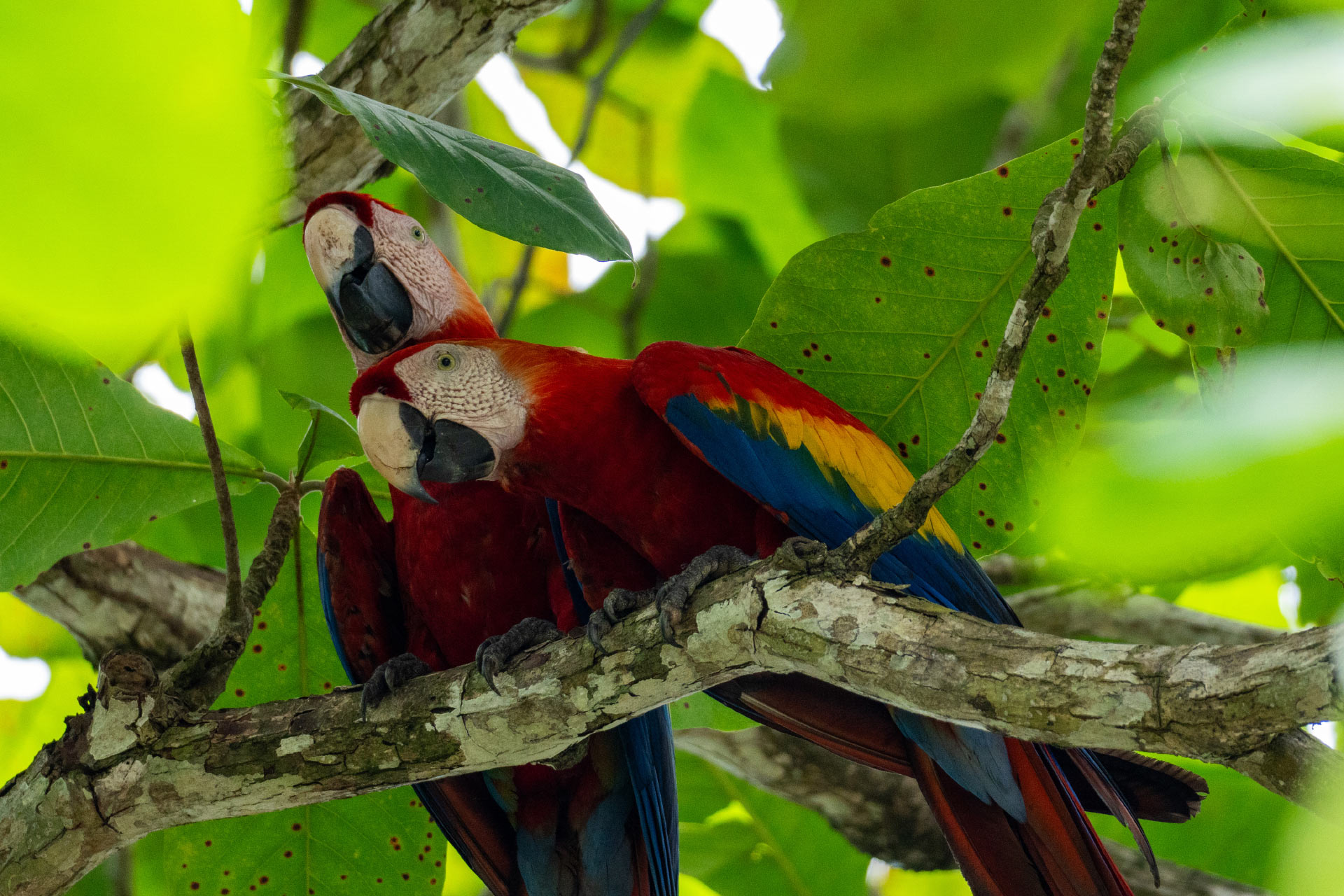
A pair of scarlet macaws (Ara macao) in Costa Rica. Image credit: Julio-César Chávez / CC BY 4.0.
The ancient parrot feathers that were discovered at Pachacamac, Peru — one of the preeminent religious centers of the Andean civilization — far outside the birds’ native rainforest range.
“Through combining ancient DNA sequencing, isotope chemistry and computational landscape modeling, we have been able to trace how and where these birds were moved across the landscape,” said Dr. George Olah, a researcher at the Australian National University and King’s College London.
“Our ancient habitat modelling confirmed that the western side of the Andes was just as inhospitable to these species one thousand years ago as it is today. These parrots are strictly rainforest dwellers with a natural home range of around 150 km.”
“The fact that they ended up more than 500 km away, on the other side of South America’s highest mountain range, proves human intervention. They do not naturally fly over the Andes.”
“The findings show that several species of Amazonian parrots were captured in the wild, carried high over mountain passes and kept alive on the coast long enough to grow new feathers in their new environment.”
In a genomic analysis, the authors identified four Amazonian species in the feather assemblage — the scarlet macaw, the blue-and-yellow macaw, the red-and-green macaw and mealy amazon — all native to rainforest habitat hundreds of km from the Pacific coast.
Transport likely took weeks or even months, as travelers navigated rugged mountain passes and steep plateaus.
“We can now demonstrate with genetic and isotopic evidence that these parrots weren’t just traded as feathers — they were transported alive, across dramatic terrain, into coastal ritual contexts,” Dr. Olah said.
By analyzing the chemical signatures contained in the feathers, the researchers discovered that the birds’ diets shifted to C4 plants, such as maize, and marine protein, showing they were kept alive after crossing the Andes.
“Our analysis reveals the parrots were fed the same nitrogen-enriched diet consumed by their captors — a clear sign of prolonged care after their removal from the rainforest,” Dr. Olah said.
Landscape modeling further identified likely trans-Andean corridors and river routes used to transport the birds, revealing sophisticated overland and fluvial exchange networks.
The birds were prized for their vibrant feathers, which held deep cultural value across pre-Hispanic societies and were often used in ritual and high-status burial contexts.
“This discovery challenges long-held assumptions that pre-Inca societies were isolated or fragmented,” Dr. Olah said.
“Instead, we see evidence of organized exchange, ecological knowledge and logistical planning that connected vastly different environments long before imperial roads formalized these connections.”
The results were published today in the journal Nature Communications.
_____
G. Olah et al. 2026. Ancient DNA and spatial modeling reveal a pre-Inca trans-Andean parrot trade. Nat Commun 17, 2117; doi: 10.1038/s41467-026-69167-9