New research from the University of Oxford and the University of Reading suggests bipedalism and expanding brain size helped drive the overwhelming dominance of right-handedness in humans.
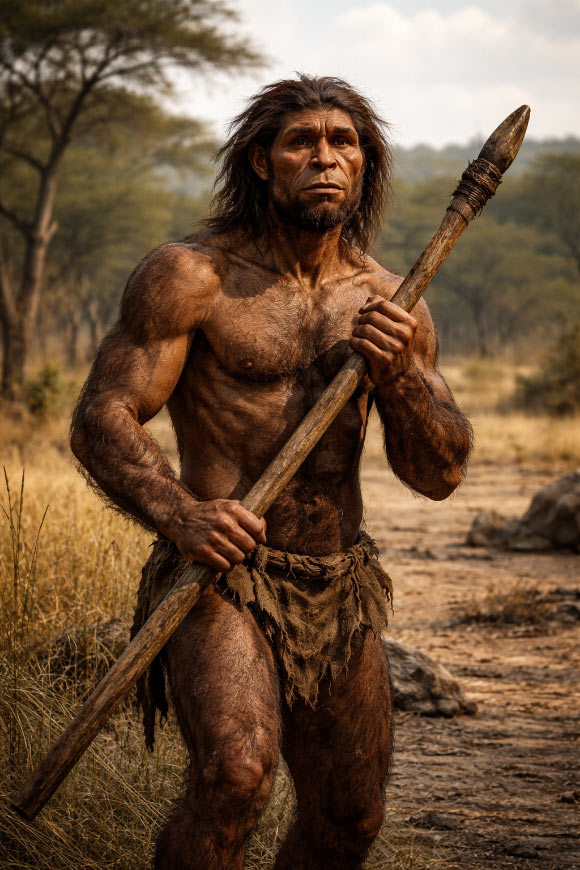
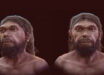
Reconstruction of Homo erectus.
“In all human cultures across every corner of the globe about 90% of people favor their right hand,” said University of Oxford researcher Thomas Püschel and his colleagues.
“Based on archeological evidence, some have argued that this has been true since the Neolithic, whilst others contend that it has been constant through the entire Homo lineage.”
“Furthermore, individual human’s strong manual lateralization means that ambiguous hand preferences, or forms of ambidexterity, are extremely rare, which appears unusual when compared to other primate species.”
“Still, some level of directional manual lateralization is present in sub-populations of various primate species, but the level and consistency of handedness in humans is unmatched, and despite much interest, still represents an unexplained evolutionary singularity.”
In their study, the authors analyzed data on 2,025 individuals across 41 species of monkeys and apes.
Using Bayesian modelling that accounts for evolutionary relationships between species, they tested the major existing hypotheses for why handedness evolved: including tool use, diet, habitat, body mass, social organization, brain size and locomotion.
Humans sat conspicuously outside the pattern that explained every other primate, but when the researchers added two factors into the model — brain size and the relative length of our arms versus our legs (a standard anatomical marker of bipedal locomotion) — that exceptional status disappeared.
In other words, once you account for upright walking and a large brain, humans stop looking like an evolutionary anomaly.
Using the same models, the scientists were also able to estimate likely handedness in extinct human ancestors.
The picture that emerges is a gradient: early hominins such as Ardipithecus and Australopithecus probably had only mild rightward preferences, broadly similar to modern great apes.
With the appearance of the genus Homo, the bias strengthens markedly — through Homo ergaster, Homo erectus and Neanderthals — reaching its modern extreme in Homo sapiens.
There is one striking exception: Homo floresiensis, the small-brained species from Indonesia, shows a much weaker predicted preference.
This fits the wider pattern: Homo floresiensis had a small brain and a body adapted to a mix of upright walking and climbing, rather than full bipedalism.
According to team, the findings point to a two-stage story.
Walking upright came first, freeing the hands from the work of locomotion and creating new selective pressure for fine, lateralized manual behaviors.
Larger brains came later, and as they grew and reorganized, the rightward bias hardened into the near-universal pattern seen today.
“This is the first study to test several of the major hypotheses for human handedness in a single framework,” Dr. Püschel said.
“Our results suggest it is probably tied to some of the key features that make us human, especially walking upright and the evolution of larger brains.”
“By looking across many primate species, we can begin to understand which aspects of handedness are ancient and shared, and which are uniquely human.”
The results appear online in the journal PLoS Biology.
_____
T.A. Püschel et al. 2026. Bipedalism and brain expansion explain human handedness. PLoS Biol 24 (4): e3003771; doi: 10.1371/journal.pbio.3003771