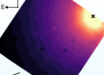
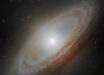
Celebrating four years of science, the NASA/ESA/CSA James Webb Space Telescope has pierced the thick dust of the giant galaxy Centaurus A to reveal its active core, intricate dust lanes and millions of stars that illuminate the aftermath of an ancient galactic collision.
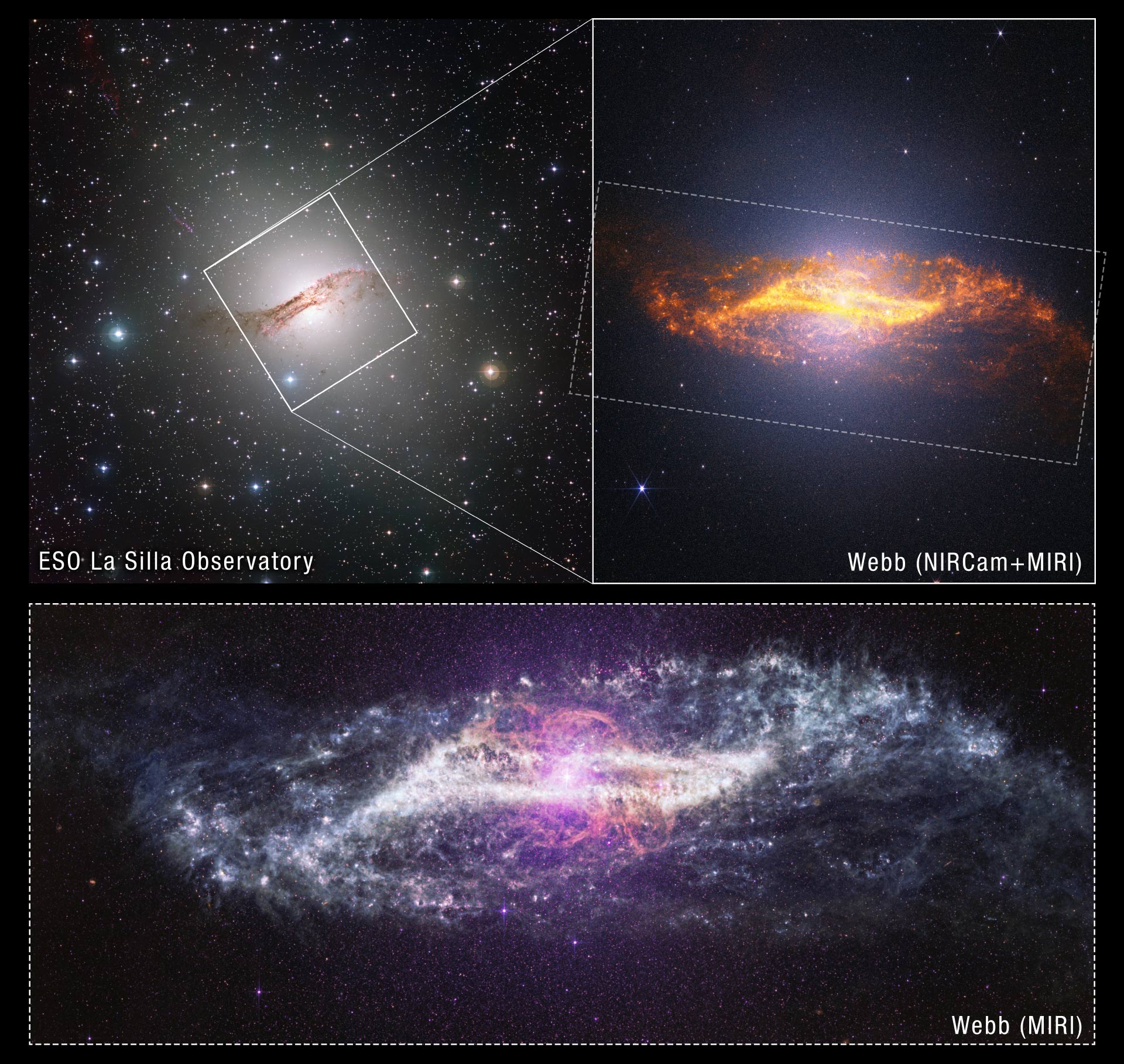
The ground-based image of Centaurus A from ESO (top left) puts the near-infrared and mid-infrared views from Webb into context. Image credit: ESO / NASA / ESA / CSA / STScI / A. Pagan, STScI.
Centaurus A is a giant galaxy located in the southern constellation of Centaurus.
Also known as NGC 5128, LEDA 46957, ESO 270-9, and Caldwell 7, the galaxy is one of the brightest objects in the southern hemisphere night sky.
Centaurus A was discovered on April 29, 1826 by the Scottish astronomer James Dunlop.
At a distance of 13 million light-years, it is the closest active galactic nucleus to us.
Astronomers theorize that what was originally an elliptical galaxy collided with a relatively smaller spiral galaxy, giving it the peculiar shape we see now.
“At Centaurus A’s core sits a supermassive black hole actively feeding on surrounding material,” the Webb astronomers said in a statement.
“As it does, the black hole launches powerful jets and releases enormous amounts of energy, shaping the galaxy around it.”
“At the same time, Centaurus A bears the scars of a dramatic past: a major collision with another galaxy roughly two billion years ago.”
“The aftermath of that merger is still visible today in its unusual structure and ongoing star formation.”
Visible light observations from the NASA/ESA Hubble Space Telescope could not reveal the central region of Centaurus A where dust blocked the view, while NASA’s retired Spitzer Space Telescope revealed large scale structures in the infrared without resolving individual stars.
Now, Webb brings both clarity and depth, exposing the galaxy’s inner workings star by star.
“Webb’s mid-infrared vision highlights the galaxy’s rich dust structures, which glow in intricate shapes that surprise and even perplex astronomers,” the researchers said.
“A warped, parallelogram-like band cuts across the galaxy’s center, while wisps of material stretch outward like cosmic clouds.”
“An ‘S’ shaped feature, most notable in the image from Webb’s MIRI (Mid-Infrared Instrument), is also unusual and invites questions that need further study to answer. What created this shape? How does the black hole influence it? Is it influenced by merger-induced star formation?”
“Many of the glowing red points in the MIRI image are dust-rich stars or stellar nurseries, where aging stars are shedding material back into space or new stars are forming.”
“This dust is the raw ingredient for future generations of stars and planets, making it central to the ongoing life cycle of the galaxy.”
With Webb’s high resolution, the scientists can now study Centaurus A star by star, even in its long-obscured central region.
“What looks ‘grainy’ in the image from Webb, most obvious in the combined MIRI and NIRCam (Near-Infrared Camera) view, is actually a densely packed field of individual stars, together carrying information about the galaxy’s past,” they said.
“With Webb’s view of Centaurus A, it becomes a case of galactic archaeology.”
“Each star revealed helps to reconstruct when different events happened: when older stars first formed, when activity slowed down, a burst of star formation during the collision, and stars born from gas stirred in its aftermath.”
“Together, they form a timeline of the galaxy’s evolution.”