Some of the planet’s earliest complex animals may owe their remarkable preservation to sea levels that fell and then rose by a lot, according to an Adelaide University-led study of rocks in Australia.
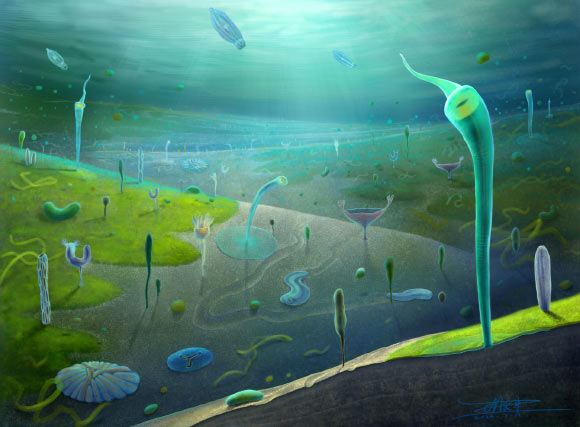
Reconstruction of the Ediacaran Jiangchuan Biota. Image credit: Xiaodong Wang.
“Our findings provide a clearer picture of how the landscape changed before and during the formation of one of the world’s most significant fossil deposits,” said lead author Dr. Karol Faehnrich, a researcher at Adelaide University.
“More than half a billion years ago, the landscape of what is now South Australia looked very different.”
“We found evidence that huge underwater canyons cut across the continental shelf before being rapidly flooded as sea levels rose again.”
“This flooding created the conditions that allowed one of the world’s richest Ediacaran fossils to be preserved.”
In the study, the researchers examined the base of the Ediacara Member, a rock layer in the Flinders Ranges that holds one of the most diverse collections of Ediacaran fossils in the world.
The fossils are the soft-bodied imprints of some of the first animals, which lived more than 540 million years ago.

Close up of Quaestio simpsonorum footprint. Image credit: Evans et al., doi: 10.1111/ede.12491.
For decades, paleontologists have debated what carved the surface of erosion beneath the layer, and whether it formed above or below the water.
After logging more than 3,000 m of rock sections and mapping the terrain with satellite-derived elevation models, Dr. Faehnrich and colleagues found that the surface cuts deep valleys oriented to the southeast. Some are up to 280 m deep and nearly 6 km wide.
Their bases are strewn with broken rock fragments, overlain by sediment deposited by underwater landslides and sediment-laden currents.
The authors argue the valleys are too deep to have been carved by rivers alone.
They propose that the valleys began as underwater canyons that cut into the ancient shelf, possibly when global sea level was low, and that rivers on the briefly exposed shelf helped shape them.
A rapid rise in sea level then flooded the area and filled the canyons with sediment, burying the seafloor below the reach of storm waves.
Those conditions created a rare window in which soft-bodied organisms could be preserved.
The same pattern of falling and then rising seas appears in rocks of similar age in Eastern Europe and elsewhere, hinting that the sea-level swings could have been global.
“The evidence points to a combination of changing sea levels and local geological processes shaping the ancient basin,” said co-author Dr. Diego Garcia-Bellido, also from Adelaide University.
“This extraordinary evolution paved the way for the preservation of fossil-rich horizons.”
“Many Ediacaran fossils are preserved as delicate impressions of soft-bodied organisms.”
“Those kinds of fossils only survive when environmental conditions are just right.”
“Our work shows that the rise in sea levels played an important role in creating a window of exceptional preservation.”
The study was published in the journal Earth and Planetary Science Letters.
_____
Karol Faehnrich et al. 2027. Submarine canyons and sea-level fluctuations in the Late Ediacaran: evidence from the Ediacara Member, South Australia. Earth and Planetary Science Letters 697: 120285; doi: 10.1016/j.epsl.2026.120285