For the first time, astronomers have directly detected radio emission from a planet beyond our Solar System.
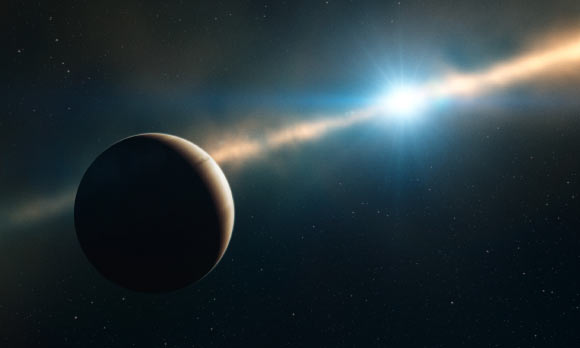
This artist’s impression shows how the gas giant exoplanet inside the disc of Beta Pictoris may look. Image credit: L. Calçada / ESO.
First discovered in 2008 by astronomers using ESO’s Very Large Telescope, Beta Pictoris b is a gas giant 9 to 13 times the mass of Jupiter.
The planet orbits its host star, Beta Pictoris, at a distance of 8 times the Earth-Sun distance.
The star also hosts at least two more planets and a circumstellar disk of gas and dust that could, in time, evolve into a torus of icy bodies much like Solar System’s Kuiper Belt.
The system is located around 63 light-years away in the constellation of Pictor, and is estimated to be only 23 million years old.
“The most massive planet in the system, Beta Pictoris b, reaches an angular separation of up to 0.55’’ across its 24-year orbit, and the host star is magnetically quiet, making the system an ideal target for radio observations,” said Kevin Ortiz Ceballos from the Harvard & Smithsonian’s Center for Astrophysics and his colleagues.
Using South Africa’s MeerKAT radio telescope array, the astronomers identified auroral radio bursts coming from beta Pictoris b.
The discovery marks the first time radio emission has been unambiguously traced to an exoplanet itself rather than its host star.
The researchers attribute the signal to a mechanism called the electron cyclotron maser instability, the same process responsible for auroral radio emission from Jupiter, Earth, Saturn, Uranus and Neptune, as well as some cold, planet-like brown dwarfs.
“We attribute the radio emission to magnetosphere-ionosphere coupling at Beta Pictoris b,” they said.
Because the highest frequency of this type of emission depends directly on the strength of the magnetic field at its source, the detection allowed the scientists to calculate a minimum magnetic field strength for beta Pictoris b of about 1.25 kilogauss — several thousand times stronger than Earth’s own magnetic field.
“This constitutes the first direct measurement of magnetic field strength for an exoplanet, and is consistent with dynamo-scaling predictions for a young, massive giant planet,” they said.
The team’s paper was posted this month on the arXiv.org preprint server.
_____
Kevin N. Ortiz Ceballos et al. 2026. Discovery of radio emission from the exoplanet β Pictoris b. arXiv: 2609.16720