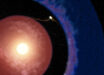
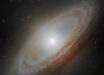
PicII-503, a primordial star located in the >10-billion-year-old ultrafaint dwarf galaxy Pictor II, appears to preserve the chemical imprint of the Universe’s first stars.
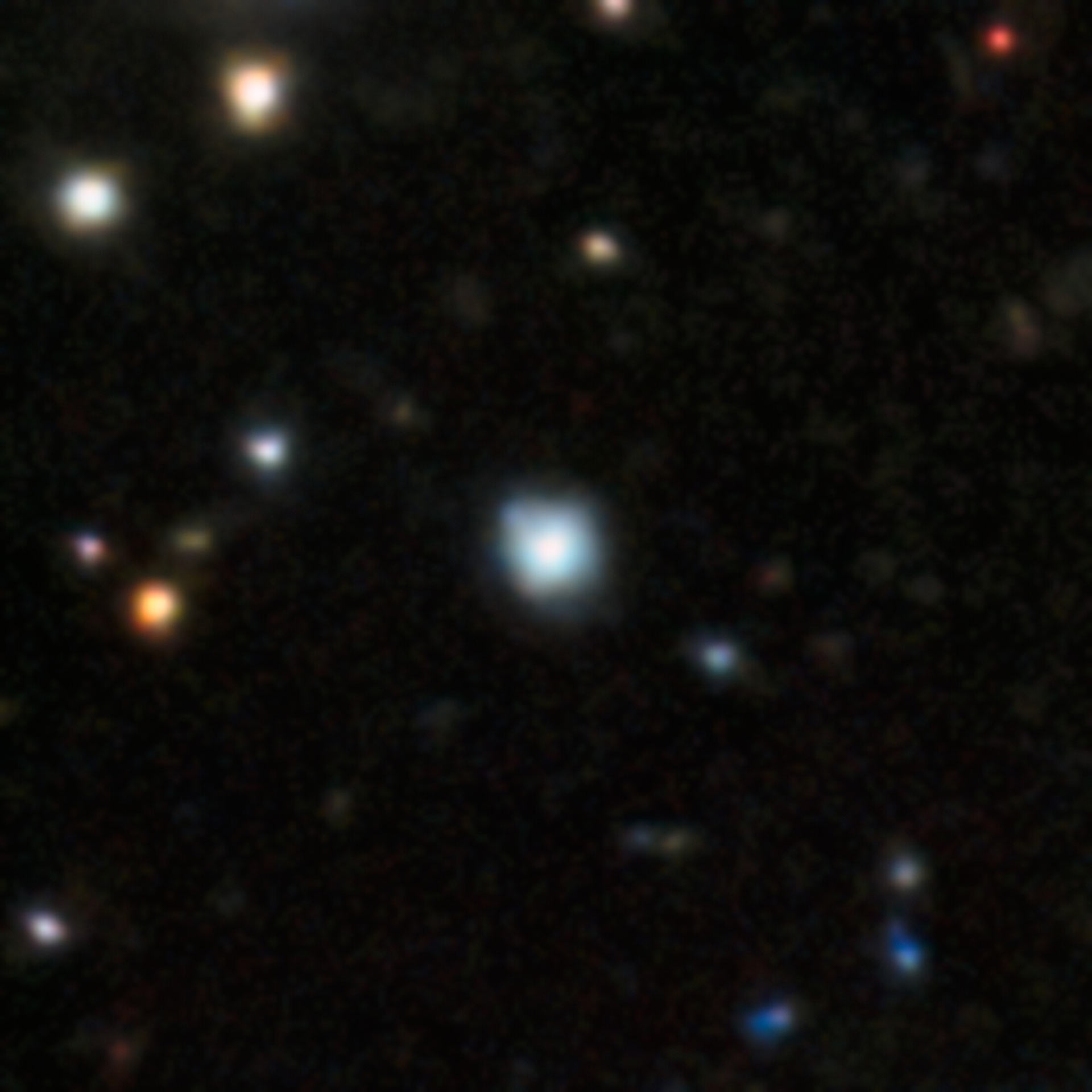
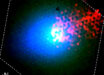
This image shows the second-generation star PicII-503, with the lowest iron content ever measured outside of the Milky Way. Image credit: CTIO / NOIRLab / DOE / NSF / AURA / T.A. Rector, University of Alaska Anchorage & NSF’s NOIRLab / M. Zamani & D. de Martin, NSF’s NOIRLab / Anirudh Chiti / Alex Drlica-Wagner.
“This is the first really clear detection of which elements are initially produced in primordial galaxies,” said Dr. Anirudh Chiti, a postdoctoral researcher at the University of Chicago at the time of the study and now at Stanford University.
“It’s a nice missing piece of the puzzle about how elements were formed back in those early days.”
In those early days after the Big Bang, the Universe was a lot less interesting than it is now.
There were stars, but they were all the same kind of massive star made of three elements — hydrogen, helium and lithium — because those were the only elements that existed.
You wouldn’t be able to find any of the calcium, gold or other elements that make up our world today, because those elements first had to be forged inside the stars themselves.
In the hearts of these massive stars, atoms were fusing to become increasingly heavy elements.
When those stars exploded at the end of their lives, new stars formed from the debris, and the process happened over and over until we got the full range of elements that we know and love today.
“To find them, what you want to do is look for the stars with the lowest amount of heavy elements, because the heavier elements only built up with time,” said University of Chicago astronomer Alexander Ji.
Using the Magellan Telescopes at Las Campanas Observatory and ESO’s Very Large Telescope, they detected a promising candidate star in the ultrafaint dwarf galaxy Pictor II.
Called PicIII-503, this star has a very distinct makeup compared to modern stars; for example, it contains about 100,000 times less iron than our Sun does.
This rare finding is exciting, but also sheds light on a long-standing stellar mystery about how these early stars formed.
Because PicIII-503 is still in its original tiny, primordial galaxy, astronomers could see that its composition gave weight to one particular formation theory — which has to do with how the parent star explodes.
“At the end of a really massive star’s life, it has this onion-skin structure, with the lighter elements like carbon in the outer layers, and the heavier ones inside,” Dr. Ji said.
“Then when the star dies, it might be a very weak explosion where only the lightest outer layers get ejected.”
“A highly powerful explosion would have flung the star’s guts far away, out of the bounds of the small galaxies that populated the Universe back then.”
“But a weaker explosion could mean the debris stuck around to become part of the next generation of stars.”
“It’s a really nice finding because we have seen a lot of these carbon-rich stars in our own Milky Way Galaxy, and now we can see how these stars likely originated,” Dr. Chiti said.
The discovery of PicIII-503 is described in a paper in the journal Nature Astronomy.
_____
A. Chiti et al. Enrichment by the first stars in a relic dwarf galaxy. Nat Astron, published online March 16, 2026; doi: 10.1038/s41550-026-02802-z