The newly-identified gas cloud, dubbed G2t, follows nearly the same orbit as two known clouds, suggesting they were all expelled by a pair of massive stars near the core of our Milky Way Galaxy.
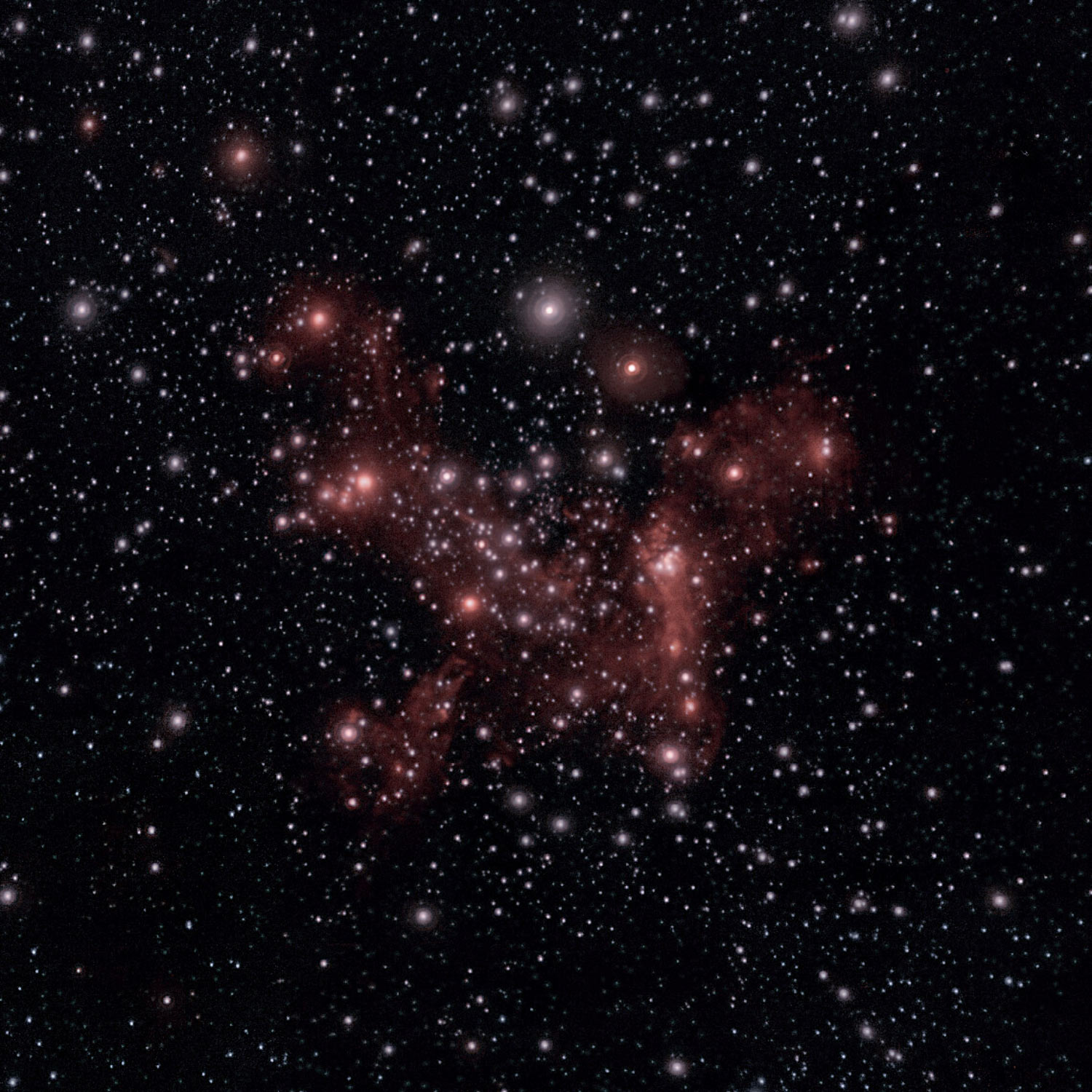
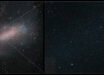
This VLT image shows the stars and gas surrounding Sagittarius A*, a supermassive black hole in the center of the Milky Way Galaxy. Image credit: ESO / D. Ribeiro, MPE GC Team.
“This is a hugely dynamic environment, with stars and gas clouds hurtling by the black hole at dramatic speeds,” said Dr. Stefan Gillessen from the Max Planck Institute for Extraterrestrial Physics and his colleagues.
“Two gas clouds, G1 and G2, were already known, but their nature and origin were still being debated.”
“In particular, it was unclear whether these clouds were hiding a star inside or consisted purely of gas.”
“However, the discovery of a third gas cloud, named G2t, now helps answer these questions.”
G2t was discovered with the Enhanced Resolution Imager and Spectrograph (ERIS) instrument on ESO’s Very Large Telescope (VLT).
“Thanks to VLT, we were able to measure the 3D orbits of the clouds around the black hole,” the astronomers said.
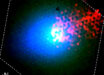
“The clouds move within a very small region at the center of this wide-field image.”
“It was revealed that G1, G2 and G2t are actually on almost identical orbits, only rotated a bit with respect to each other.”
“This rules out the possibility that each cloud hides a star in their core, as the odds of different stars having almost identical orbits are slim.”
“The similarity of the orbits suggests that the three clouds probably share the same origin, most likely IRS16SW, a pair of massive stars expelling an enormous amount of gas.”
“As IRS16SW moves around the black hole, each cloud of gas is ejected in a slightly different orbit, explaining the small differences in the trajectories of the ‘G-triplet’.”
“This discovery shows that, despite decades of monitoring our Milky Way center, new unanswered curiosities still arise,” they said.
“But what could be more exciting than mysteries waiting to be solved?”
The discovery is described in a paper in the journal Astronomy & Astrophysics.
_____
S. Gillessen et al. 2026. The gas streamer G1-2-3 in the Galactic center. A&A 707, A79; doi: 10.1051/0004-6361/202555808