The giant planet’s bow shock isn’t just deflecting the solar wind, it’s acting as a powerful particle accelerator, firing electrons to relativistic energies of at least 1 MeV, according to a new analysis of data from NASA’s Juno spacecraft.
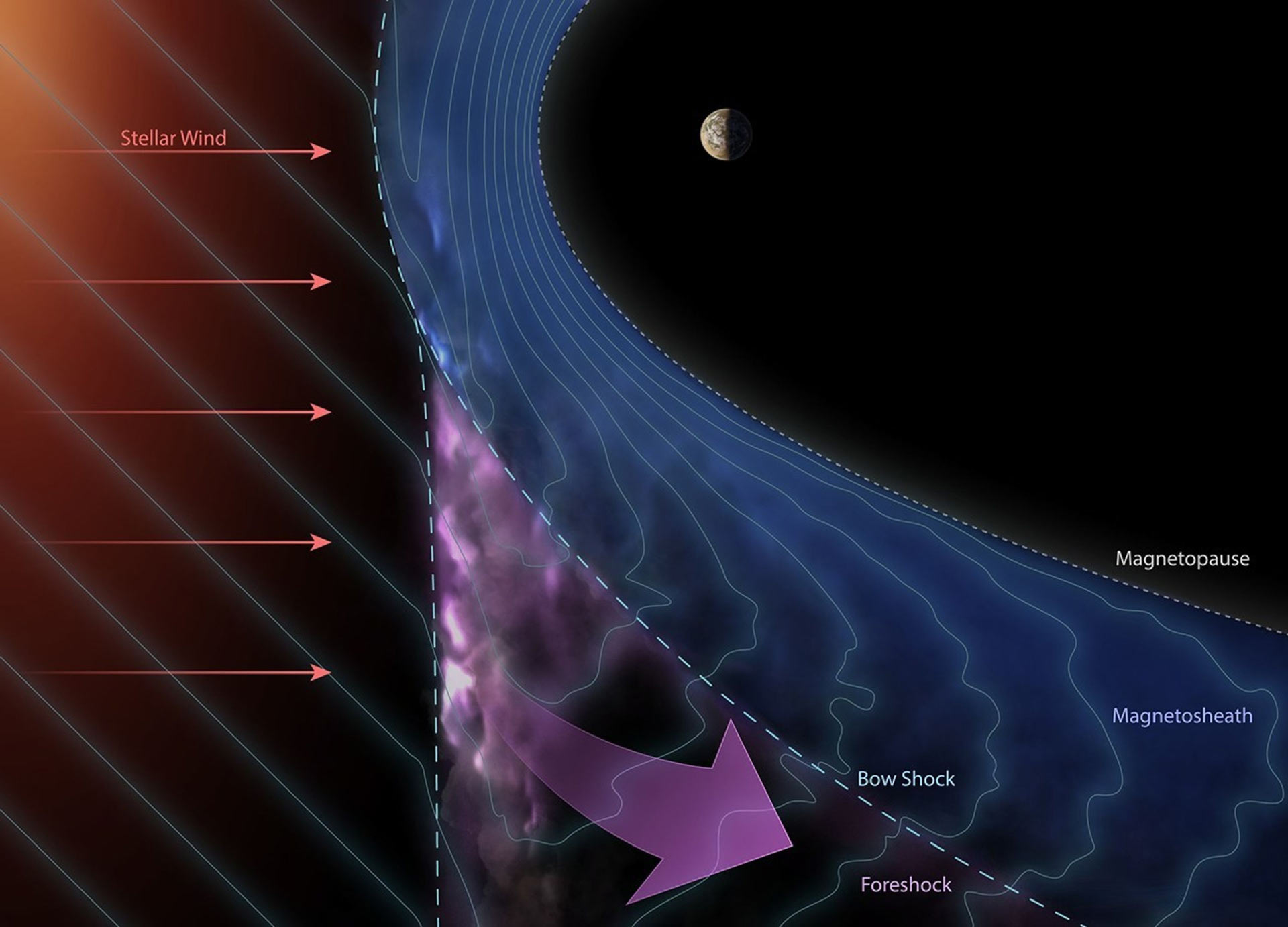
As planets and stars travel through the streams of charged particles flowing across space, their magnetic fields act like obstacles; incoming particles are slowed and deflected, forming a boundary called the bow shock; just ahead of this boundary lies the foreshock, a variable region where magnetic conditions can accelerate some particles to nearly the speed of light. Image credit: Ben C. Smith, Johns Hopkins Applied Physics Laboratory.
Shocks are disturbances created by a perturber/object/fluid moving through a fluid faster than the local speed of sound, causing an abrupt change in pressure at the boundary between the two.
Typical examples are bow shocks where planetary atmospheres and solar winds meet, named after the analogous shocks produced on water by the bow of a ship.
Most shocks in space plasma are collisionless, because particle densities are too low for direct collisions between particles to convert the shock’s energy into heat. Instead, this is done by electromagnetic forces.
Collisionless shocks are thought to be a site in which cosmic rays can accelerate to relativistic speeds (near the speed of light), a process known as relativistic electron acceleration.
However, a lack of direct observational evidence has limited scientists’ understanding of how these structures work.
“Astronomers have sought the origins of cosmic rays since their discovery more than 100 years ago,” Dr. Savvas Raptis from the Johns Hopkins University Applied Physics Laboratory and colleagues said in a statement.
“These energetic particles can come from many sources, including supernovas and eruptions from the Sun.”
“When solar cosmic rays reach Earth, they can trigger space weather effects that disrupt satellites, communications, and power systems.”
“NASA missions showed how some electrons become highly energized in a region near Earth called the foreshock, where solar particles first encounter Earth’s magnetic field.”
“Scientists suspected the same process was responsible for accelerating high-energy particles in foreshocks at other planets and astrophysical systems, but they could not confirm it until now.”
The researchers analyzed data collected by Juno on October 1, 2023, as the spacecraft approached Jupiter.
Before crossing the bow shock itself, the probe flew through the foreshock, a turbulent region that forms upstream where the solar wind first ‘feels’ the planet’s magnetic influence.
During a roughly 20-min window, Juno spotted a large, bubble-like disturbance called foreshock transient.
Using three onboard instruments, the spacecraft measured electrons being accelerated to energies up to 1 MeV right inside this structure.
“Leveraging these and complementary Solar System observations, we propose a universal scaling law for the Hillas limit that empirically connects the observable size of a transient to maximum particle energy,” the authors concluded.
“Applying this scaling to various environments, from planetary bow shocks to protostellar jets and supernova remnants, yields a simple model of maximum obtainable particle energies ranging from MeV scales up to about tens of GeV, and about tens of TeV, respectively, providing an observationally grounded method for constraining maximum cosmic ray energies at astrophysical shocks.”
The team’s paper was published June 3, 2026 in the journal Nature.
_____
S. Raptis et al. 2026. Relativistic electron acceleration at the bow shock of Jupiter and beyond. Nature 654, 47-51; doi: 10.1038/s41586-026-10473-z