Genetic and acoustic evidence show that the rare Ijima’s leaf warbler (Phylloscopus ijimae) is actually two distinct bird species, including the newly-identified Tokara leaf warbler — both with small, vulnerable populations.
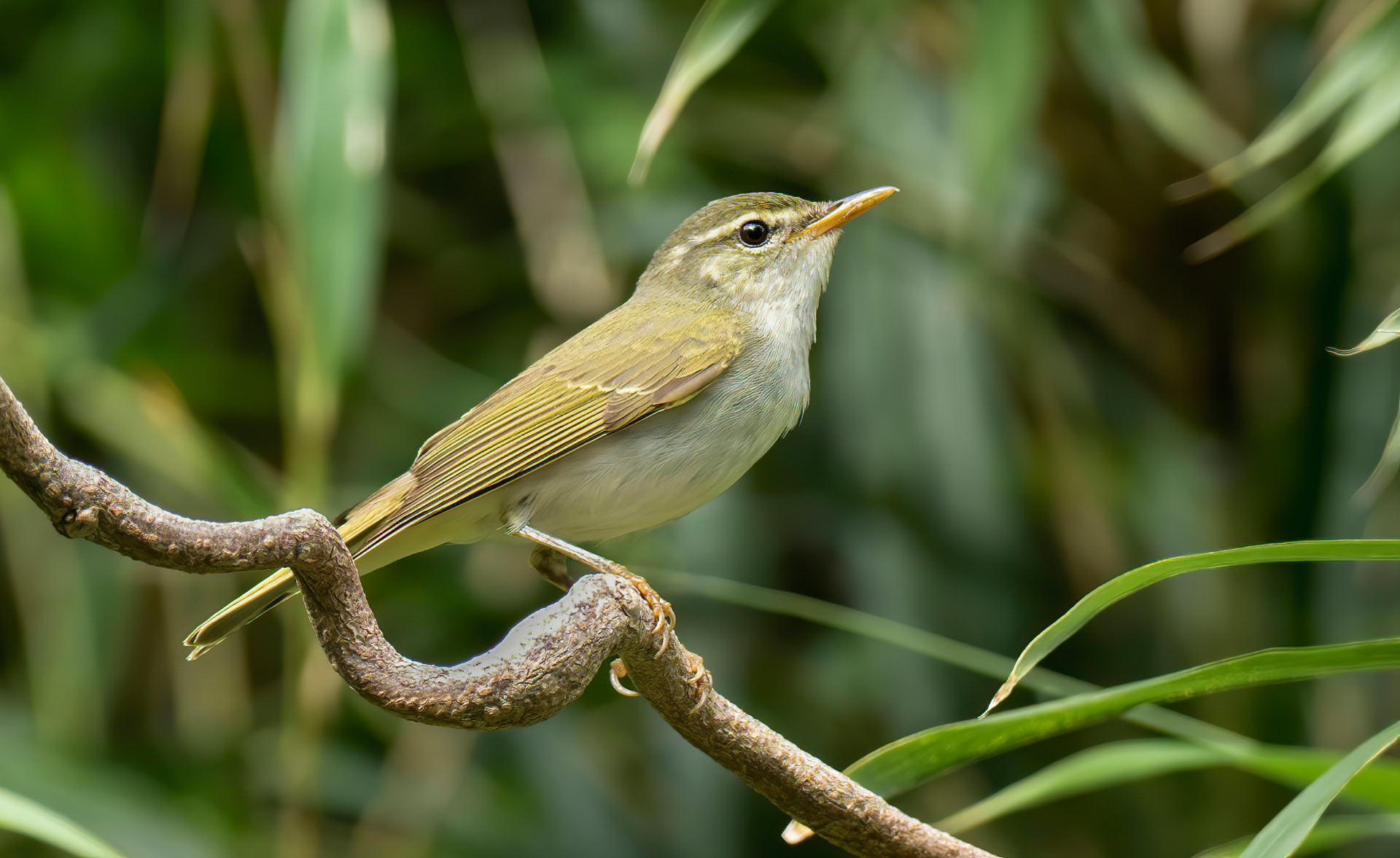
The Tokara leaf warbler (Phylloscopus tokaraensis) on Nakanoshima, the Tokara Islands, in June 2017. Image credit: Per Alström / Uppsala University.
The Ijima’s leaf warbler is a rare migratory bird species found in Japan.
It breeds in two Japanese archipelagos, separated by a distribution gap of around 1,000 km: the Izu Islands, southeast of Honshu, and the Tokara Islands.
The latter population was only discovered in 1988 on the island of Nakanoshima, and the species has been observed in the breeding season on four other small nearby islands.
Birds from these two populations look so similar that comparisons of museum specimens found no clear plumage differences, and only slight variations in measurements such as head and leg length.
Their songs, however, tell a different story, according to a new study led by Uppsala University researcher Per Alström.
Recordings show consistent and measurable differences between the island populations, allowing the authors to distinguish them with high accuracy.
Genetically, the divide is even starker: analyses of thousands of genome-wide markers and mitochondrial sequences indicate a deep split comparable to, or greater than, that separating many recognized bird species.
“This shows how important it is to use genetic methods to reveal hidden biodiversity at a time of global biodiversity crisis,” Dr. Alström said.
“These methods can help provide more complete knowledge on which to base future nature conservation efforts.”
The researchers estimate that the two lineages diverged roughly 2.8 to 3.2 million years ago.
Despite seasonal migration routes that could bring the birds into proximity, they found no sign of gene flow between the populations, suggesting long-standing reproductive isolation.
“The new species is a little cryptic and tricky to define,” Dr. Alström said.
“In terms of appearance, it doesn’t differ from the Ijima’s leaf warbler.”
“It is DNA analyses and differences in song that show that this is a separate species.”
The Izu population is already classified as vulnerable, and the newly-described Tokara species, named the Tokara leaf warbler (Phylloscopus tokaraensis), may be even more precarious.
It has been confirmed breeding on only one island, Nakanoshima, with limited sightings elsewhere in the archipelago.
The genomic data also show that both species have low genetic diversity and evidence of past population declines, consistent with small, isolated populations.
At the same time, the genomes bear signs of limited recent inbreeding and possible recovery from earlier bottlenecks.
The birds face a range of threats typical of island species, including habitat disturbance and invasive predators such as weasels, as well as environmental pressures that could quickly affect such a restricted population.
The study highlights a broader problem in conservation biology: species that have not yet been formally recognized may receive no protection at all.
By combining genomics with traditional taxonomy, scientists can uncover these hidden lineages before they vanish.
“Island species are particularly vulnerable to extinction, yet many remain undiscovered,” the authors concluded.
“Our study demonstrates how genomics can uncover hidden biodiversity and provide critical metrics of population health.”
“Our findings highlight the urgent global need to formally recognize and evaluate the conservation status of cryptic species, ensuring that overlooked lineages receive protection in a rapidly changing world.”
“This study adds a whole-genome conservation assessment in passerine birds to the growing body of work applying genomics to conservation.”
The team’s paper was published today in the journal PNAS Nexus.
_____
Takema Saitoh et al. 2026. Discovering and protecting cryptic biodiversity: A case study of a previously undescribed, vulnerable bird species in Japan. PNAS Nexus 5 (3): pgag037; doi: 10.1093/pnasnexus/pgag037