Deep in the rugged Mekongga Mountains of Sulawesi, scientists have found a cryptic new species of flying frog small enough to perch on a person’s cheek. Named Rhacophorus kurniatiae, it looks a lot like its relatives, but it does something none of them are known to do: it lays its eggs in gel.
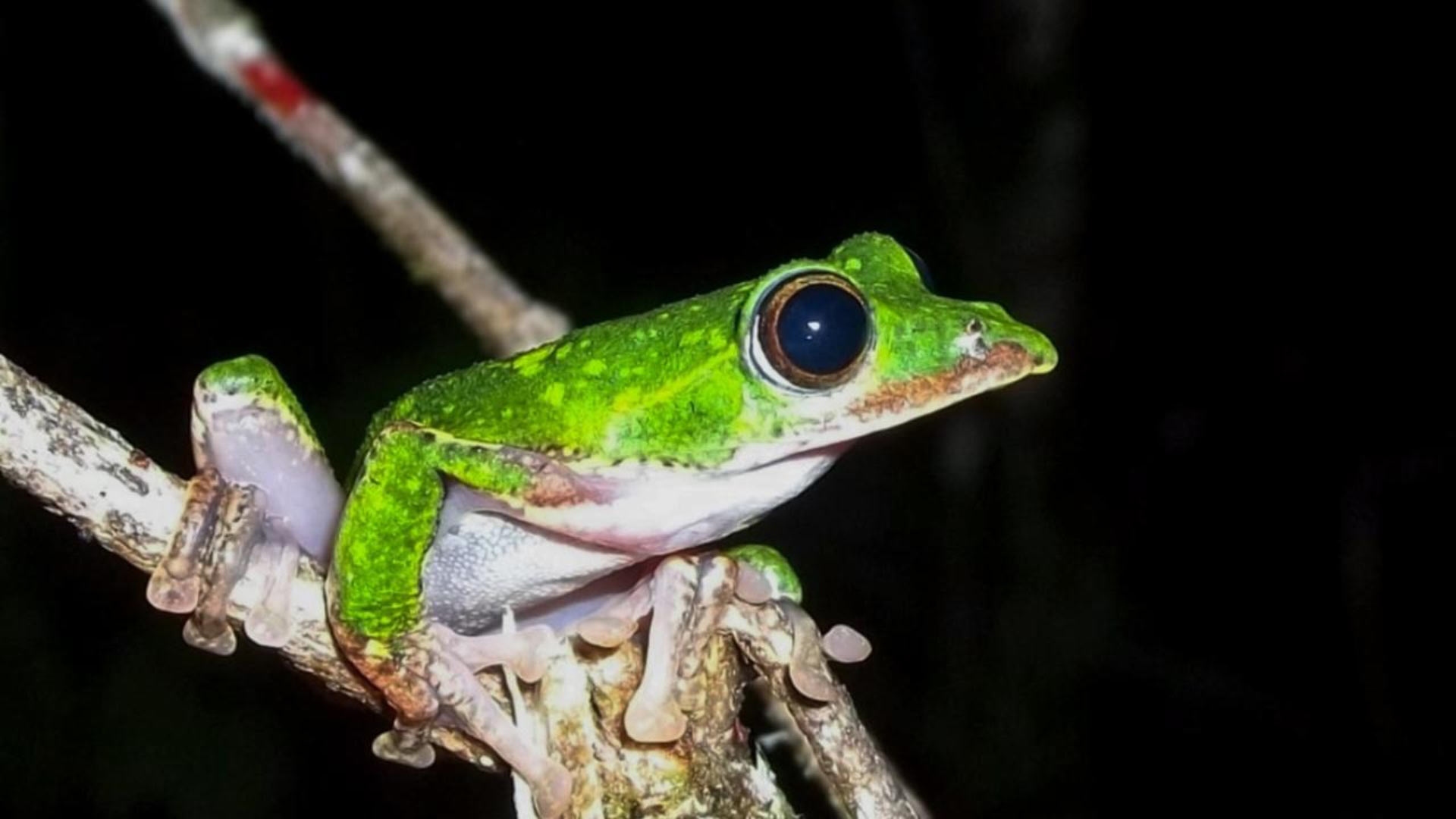
Rachophorus kurniatiae. Image credit: Wahyu Trilaksono, Museum Zoologicum Bogoriense.
The genus Rhacophorus, commonly known as the flying frogs or Asian flying frogs, is a group of tree-dwelling amphibians in the family Rhacophoridae.
Found across South and East Asia, from India and southern China to Japan, the Philippines and the Greater Sunda Islands, these frogs inhabit tropical and subtropical forests, where they spend much of their lives among branches and foliage.
Many species are recognizable by their predominantly green or brown coloration, large eyes, slender bodies and exceptionally long toes connected by extensive webs of skin. Some also have prominent skin flaps along their limbs and bodies.
Despite their name, these amphibians do not truly fly: several species can glide between trees, using their webbed hands and feet as parachutes to slow their descent and control their movements through the air.
“Rhacophorus kurniatiae has a different reproductive strategy from all other Asian flying frogs,” said Dr. Alamsyah Elang Nusa Herlambang, a researcher at the Museum Zoologicum Bogoriense.
To establish that Rhacophorus kurniatiae was a separate species, the researchers measured 28 physical traits and analyzed the frogs’ DNA and recorded calls.
They found differences including pointed snouts and distinctive calls; most striking was the egg-laying.
Related frogs build foam nests, frothy coverings that keep eggs moist as larvae develop.
The new species instead deposits its eggs in an irregular, jelly-like mass on vegetation hanging over or near water, and the eggs and tadpoles develop inside the gel.
“This distinct reproductive mode may reflect ecological adaptation to ephemeral aquatic habitats and suggests a transitional or derived state within the genus,” the scientists said.
“It’s the first time we have seen Rhacophorus with gelatinous matrix for its reproduction strategy. It’s unique,” Dr. Herlambang added.
Rhacophorus kurniatiae is endemic to a high-elevation lake known as Danau Coca-Cola in the Mekongga Mountains, Southeast Sulawesi.
Genetically, the species is closest to Rhacophorus boeadii, though the divergence between them is minimal.
“The discovery of the new species reveals further unstudied lineage diversification within Sulawesi’s montane amphibian fauna, and underscores the urgency of targeted surveys in montane regions increasingly threatened by anthropogenic pressures,” the authors concluded.
“Our findings highlight the importance of integrative approaches in uncovering cryptic diversity and refining our understanding of reproductive evolution within Rhacophoridae.”
The discovery is reported in a paper in the journal Zootaxa.
_____
Wahyu Trilaksono et al. 2026. Montane endemism and cryptic diversity in Sulawesi: A new species of flying frog with derived breeding traits. Zootaxa 5900 (4): 349-370; doi: 10.11646/zootaxa.5900.4.3