Astronomy News

Mar 22, 2021 by Enrico de Lazaro

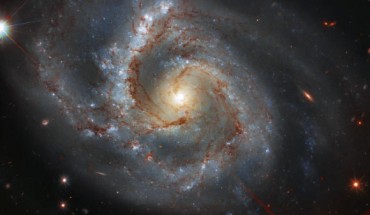
The NASA/ESA Hubble Space Telescope shot this image of the face-on barred spiral galaxy Arp 28. This Hubble image shows Arp 28, a bright barred spiral galaxy some 145 million light-years away in the constellation Pegasus. Image credit: NASA / ESA / Hubble / A. Riess et al. Arp 28 is located approximately 145 million light-years away in the constellation of Pegasus. Also known as NGC 7678, LEDA 71534 and UGC 12614, the galaxy is classified as a barred...
Mar 19, 2021 by News Staff

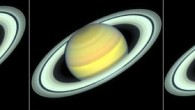
Astronomers using the NASA/ESA Hubble Space Telescope observed Saturn, the second largest planet in our Solar System, in 2018, 2019, and 2020, just after...

Mar 18, 2021 by News Staff

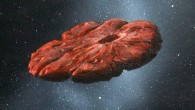
1I/‘Oumuamua, a strange object of extrasolar origin discovered on October 19, 2017 by the Pan-STARRS 1 telescope, was small, about half as long as a...

Mar 17, 2021 by Enrico de Lazaro

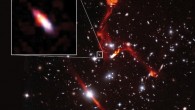
The newly-discovered galaxy, named VLAHFF-J071736+374506 (J0717+3745 for short), is likely the faintest radio-emitting object yet found, according to astronomers...

Mar 16, 2021 by News Staff

Data suggest that 80% of ‘hot’ rocky exoplanets — rocky planets with orbital period less than 100 days — formed as gas-rich sub-Neptunes...

Mar 16, 2021 by News Staff

The wormholes are theoretical portals through space-time that could create shortcuts for long journeys across our Universe. They have entered modern physics...

Mar 15, 2021 by News Staff

A team of researchers from University College London and the Cyprus Institute’s Science and Technology in Archaeology and Culture Research Center has...

Mar 15, 2021 by Enrico de Lazaro

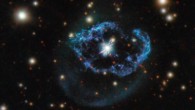
Astronomers using the NASA/ESA Hubble Space Telescope and the 1.8-m Pan-STARRS1 telescope have captured a detailed image of the unusual planetary nebula...

Mar 12, 2021 by News Staff

Using the Arecibo and Gemini observatories, astronomers have detected a mobile supermassive black hole in a galaxy called SDSS J043703.67+245606.8 (hereafter...

Mar 12, 2021 by News Staff

2001 FO32, a near-Earth asteroid discovered two decades ago, will fly safely past Earth on March 21, 2021, at a distance of about 2 million (1.25 million...

Mar 11, 2021 by News Staff

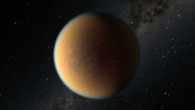
Using the NASA/ESA Hubble Space Telescope, astronomers have found evidence of volcanic activity reforming the atmosphere of Gliese 1132b, a rocky exoplanet...

Mar 11, 2021 by News Staff

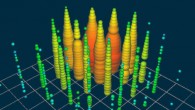
On December 6, 2016, a high-energy particle called an electron antineutrino hurtled to Earth from outer space at close to the speed of light carrying 6.3...

Mar 10, 2021 by News Staff

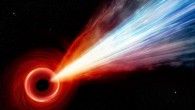
The source of the 160,000-light-year-long jet of particles is PSO J352.4034-15.3373 (PJ352-15 for short), a rapidly growing supermassive black hole, or...

Mar 10, 2021 by News Staff

The zodiacal light is sunlight reflected by interplanetary dust in the inner Solar System. Variations in the zodiacal light with ecliptic latitude reveal...

Mar 9, 2021 by Natali Anderson

Five sub-Neptunes and one super-Earth exoplanet orbit a moderately bright K-type star called K2-138. An artist’s impression of the six-planet system...

Mar 9, 2021 by News Staff

Astronomers have discovered evidence for a giant planet orbiting Vega, a young star located 25 light-years away in the constellation of Lyra. An artist’s...

Mar 8, 2021 by News Staff

Astronomers using several ground-based telescopes have spotted the most distant cosmic jet discovered so far. Its source is PSO J172.3556+18.7734, a radio-loud...

Mar 8, 2021 by Enrico de Lazaro

The NASA/ESA Hubble Space Telescope has captured a striking new photo of the star-forming region AFGL 5180. This Hubble image shows AFGL 5180, a stellar...

Mar 5, 2021 by News Staff

Astronomers using data from the eROSITA X-ray telescope aboard the Spektrum-Roentgen-Gamma (SRG) observatory have detected the largest supernova remnant...

Mar 5, 2021 by News Staff

Astronomers using the NASA/ESA Hubble Space Telescope have discovered the reason for the dimming of a red hypergiant star called VY Canis Majoris. This...