Paleontology News

Jan 23, 2026 by News Staff

New research by paleontologists from the University of Bristol, the University of Manchester and the University of Melbourne finds that giant ancestors of modern-day kangaroos had robust hindlimb bones and tendon support capable of withstanding hopping stresses, indicating that size didn’t strictly limit this iconic gait as once believed. Simosthenurus occidentalis. Image credit: Nellie Pease / ARC CoE CABAH / CC BY-SA 4.0 Deed. Today, the red kangaroo...

Jan 22, 2026 by Enrico de Lazaro

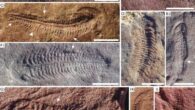
For more than 165 years, one of the earliest giants to rise above Earth’s barren land has defied classification. Known as Prototaxites, the towering,...

Jan 21, 2026 by News Staff

Shorebirds are widespread birds whose dependence on coastal and wetland environments makes them effective paleoenvironmental indicators. Wading shorebirds...

Jan 15, 2026 by News Staff

A comprehensive analysis of 17 fossil specimens reveals that Tyrannosaurus rex grew far more slowly than previously thought — reaching its full-grown...

Jan 14, 2026 by Enrico de Lazaro

The woolly rhinoceros (Coelodonta antiquitatis) is a cold-adapted herbivore that went extinct around 14,000 years ago, but little is known about their...

Jan 12, 2026 by Enrico de Lazaro

A team of paleontologists from Mexico and the United States has identified a new species of bird-like dinosaur with an unusually thick and domed skull,...

Jan 12, 2026 by News Staff

A long-standing mystery in vertebrate evolution — why most major fish lineages appear suddenly in the fossil record tens of millions of years after...

Dec 29, 2025 by News Staff

Frogs have conserved their ecology in the last 45 million years, according to new research led by University College Cork. Falk et al. show that the geometry...

Dec 26, 2025 by Enrico de Lazaro

The newly-discovered theropod and sauropod footprints are part of the Late Jurassic Majala Formation, and represent the oldest dinosaur footprints reported...

Dec 23, 2025 by News Staff

University of Maryland paleontologist Thomas R. Holtz Jr. has spent decades puzzling over how dinosaurs fit into their ancient worlds — and how those...

Dec 18, 2025 by News Staff

Paleontologists have examined the 160-million-year-old fossils of Anchiornis huxleyi, a species of non-avian theropod dinosaur from the Late Jurassic Tiaojishan...

Dec 17, 2025 by News Staff

Bees are well known for their species and remarkable behavioral diversity, ranging from solitary species that nest in burrows to social species that construct...

Dec 16, 2025 by News Staff

Paleontologists have unearthed a dense assemblage of dugong remains at the site of Al Maszhabiya in the Early Miocene Dam Formation of Qatar. This fossil...

Dec 15, 2025 by Enrico de Lazaro

A new genus and species of nimravid from the middle Oligocene epoch has been identified from the fossilized remains found in northern China. The discovery...

Dec 15, 2025 by News Staff

Paleontologists have unearthed a 66-million-year-old mosasaurine tooth in the Hell Creek Formation in North Dakota, the United States. This discovery adds...

Dec 8, 2025 by Enrico de Lazaro

Paleontologists have performed a comprehensive anatomical reassessment of the fossilized remains of two coelurosaurian theropod dinosaurs from the Early...

Dec 8, 2025 by News Staff

Nanotyrannus lancensis — long thought by many to be a teenage Tyrannosaurus rex — was in fact a fully mature, distinct species of smaller tyrannosaurid,...

Dec 4, 2025 by Natali Anderson

The Carreras Pampa site in the Torotoro National Park, Bolivia, records 1,321 trackways and 289 solitary tracks, totaling 16,600 theropod dinosaur tracks;...

Dec 3, 2025 by News Staff

Scientists have successfully extracted and sequenced ancient RNA from permafrost-preserved tissues of 10 woolly mammoths. One of these, dated to be 39,000...

Dec 2, 2025 by News Staff

Anacondas are among the largest living snakes in the world. They are usually 4 to 5 m long and in rare cases can reach 7 m. In new research, paleontologists...