A new analysis of archival data from the Near Infrared Mapping Spectrometer (NIMS) on board NASA’s Galileo spacecraft has revealed the first evidence of ammonia-bearing compounds on Jupiter’s icy moon Europa, offering new clues about its subsurface ocean and recent geological activity.
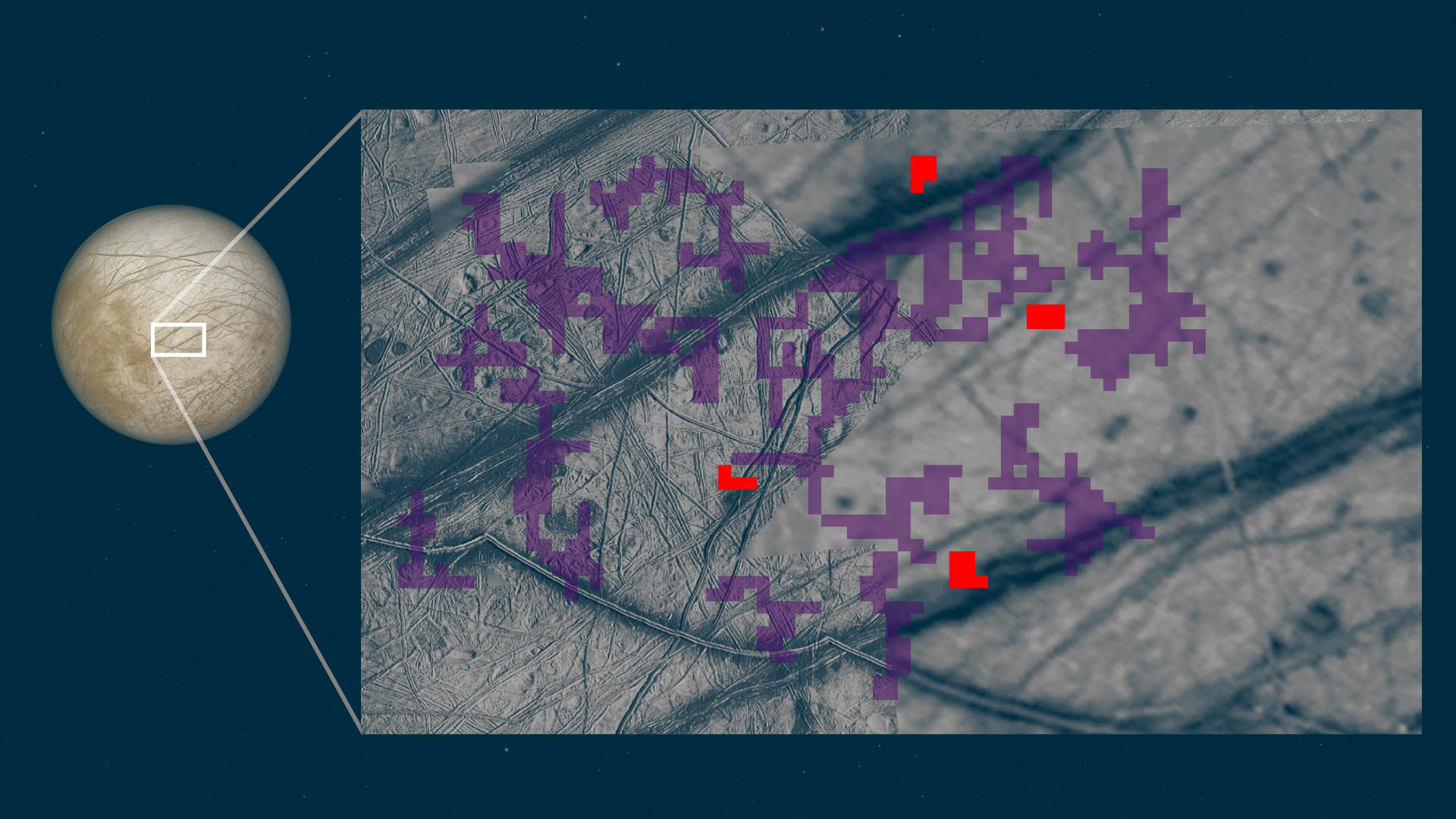
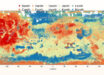
In this composite image, red pixels mark locations on Europa’s surface where ammonia-bearing compounds were detected; purple indicates no such detection. Image credit: NASA / JPL-Caltech.
“The detection of ammonia (NH3) or ammonia-bearing components (ammonia hydrate, salts, or minerals) on icy planetary bodies in the Solar System is of significant interest for understanding their geology, potential habitability, and astrobiological relevance,” said study author Dr. Al Emran, a researcher at NASA’s Jet Propulsion Laboratory.
“On Jupiter’s moon Europa, the presence of ammonia or ammoniated species is particularly important for constraining ocean chemistry, assessing habitability, and reconstructing the moon’s early atmosphere.”
“Ammonia acts as an antifreezer; an abundant presence of this can lower the freezing point of liquid water by up to 100 K and may enable retention of subsurface oceans for icy bodies.”
“Although it remains unclear whether Europa’s subsurface ocean is directly connected to its surface, the detection of ammonia compounds may suggest such a connection, as these materials are unstable in space radiation.”
In his new paper published in the Planetary Science Journal, Dr. Emran reports the detection of a characteristic ammonia absorption feature at 2.20 microns in near-infrared spectra of Europa’s surface.
The signal was identified in observations from Galileo’s NIMS instrument, which surveyed Europa during flybys in the 1990s.
Ammonia hydrate and ammonium chloride are the most plausible materials responsible for the detected feature.
Ammonia is unstable under intense space radiation, a property that makes its presence on Europa’s surface significant.
According to the paper, the survival of ammonia-bearing materials suggests they were transported from Europa’s underground ocean or shallow subsurface to the surface in the moon’s recent geological past, possibly through effusive cryovolcanism or a similar mechanism.
The analysis also points to broader implications for Europa’s internal structure.
The presence of ammoniated compounds is consistent with a thinner ice shell and a chemically reduced, high-pH subsurface ocean.
Ammonia acts as an antifreezing agent, capable of lowering the freezing point of water ice and helping sustain liquid oceans beneath icy crusts.
“Hidden in the data were faint signals of ammonia near fractures on the moon’s frozen surface, through which liquid water containing dissolved ammonia compounds would be expected to rise,” Dr. Emran said.
“The compounds may have reached the surface through geologically recent cryovolcanism.”
“That’s because ammonia significantly lowers the freezing point of water, acting as a sort of antifreeze.”
While ammonia-bearing species have been identified on other icy bodies in the outer Solar System — including Pluto, Charon, several Uranian moons, and Saturn’s moon Enceladus — previous attempts to confirm their presence on Europa had produced inconclusive or conflicting results.
“The detection of ammonia-bearing components in this study provides the first evidence of nitrogen-bearing species on Europa, an observation of considerable astrobiological significance due to nitrogen’s foundational role in the molecular basis of life,” Dr. Emran said.
_____
A. Emran. 2026. Detection of an NH3 Absorption Band at 2.2 μm on Europa. Planet. Sci. J 6, 255; doi: 10.3847/PSJ/ae1291