Tyrannoroter heberti, a new species of pantylid ‘microsaur’ from the Carboniferous period, shows that some of Earth’s earliest land vertebrates had already evolved complex teeth for grinding plants, suggesting terrestrial herbivory emerged rapidly after animals moved onto land.
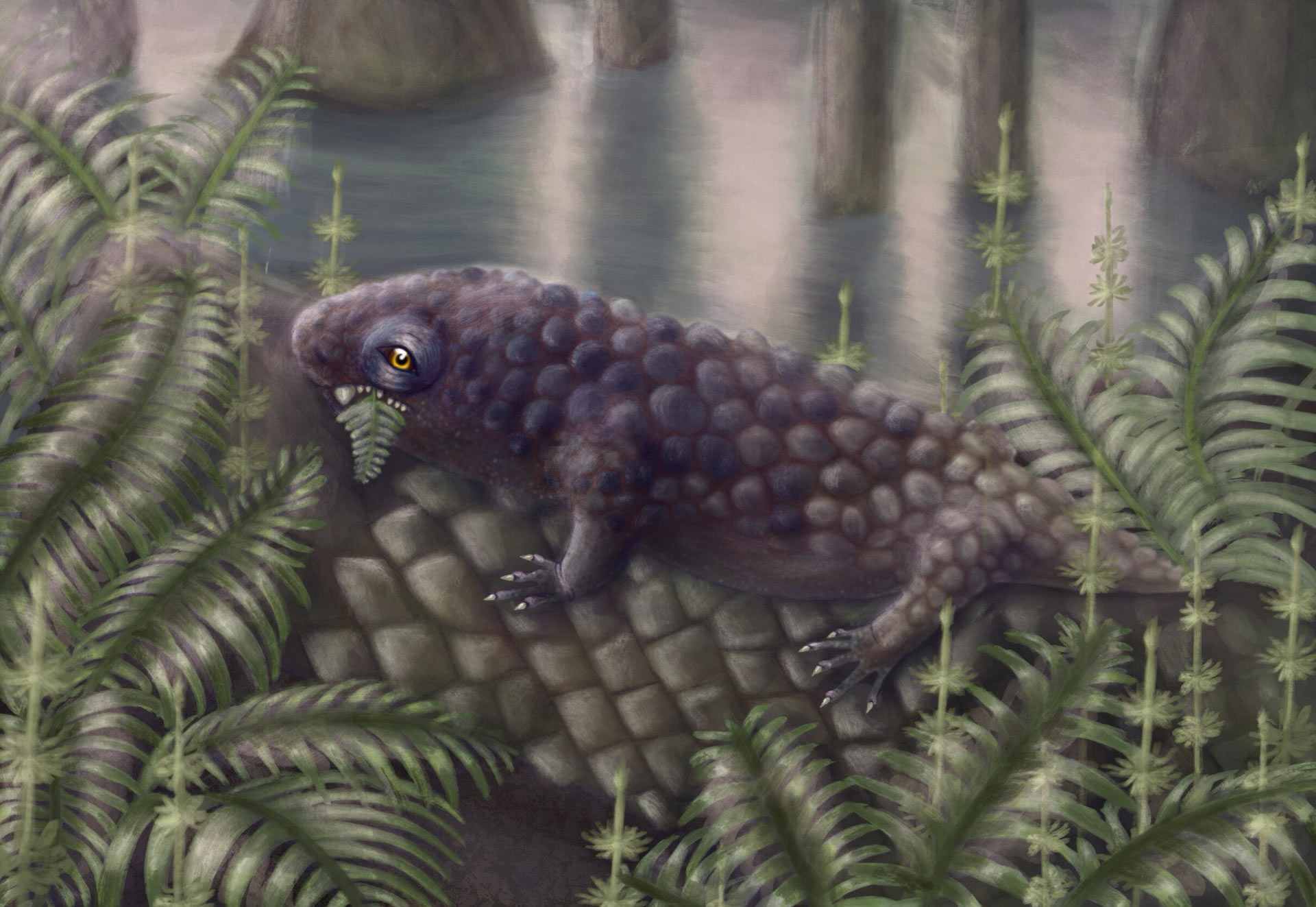
Life reconstruction of Tyrannoroter heberti. Image credit: Hannah Fredd.
Tyrannoroter heberti lived in what is now Canada during the Carboniferous period, some 307 million years ago.
“This is one of the oldest known four-legged animals to eat its veggies,” said Dr. Arjan Mann, assistant curator of fossil fishes and early tetrapods at the Field Museum.
“It shows that experimentation with herbivory goes all the way back to the earliest terrestrial tetrapods — the ancient relatives of all land vertebrates, including us.”
“The specimen is the first of its group to receive a detailed 3D reconstruction, which allowed us to look inside its skull and reveal its specialized teeth, helping us to trace the origin of terrestrial herbivory,” added Zifang Xiong, a Ph.D. student at the University of Toronto.
The fossilized skull of Tyrannoroter heberti was discovered on Cape Breton Island, Nova Scotia.
Based on the size of its head and the more complete skeletons of its relatives, the animal measured about 30 cm (one foot) in length.
“It was roughly the size and shape of an American football,” Dr. Mann said.
“By modern standards, that’s not terribly large, but it was one of the largest land-dwelling animals of its time.”
“Tyrannoroter heberti probably looked a little like a lizard, but it lived before the ancestors of reptiles and mammals split off from each other, so it technically wasn’t a reptile.”
Tyrannoroter heberti belongs to an extinct family of small amphibian-like tetrapods called Pantylidae.
“The pantylids are a fairly early chapter in the story of vertebrate animals living on land,” Dr. Mann said.
“When lobe-finned fish first evolved limbs that let them scoot onto the land, they still depended largely on their watery homes. “
“The pantylids are from the second phase of terrestriality, when animals became permanently adapted to life on dry land.”
“They’re what scientists call stem amniotes — animals closely related to the group of tetrapods that evolved eggs that could stay dry outside of water.”
“In later years, these stem amniotes would split into reptiles and the early ancestors of mammals.”
“Tyrannoroter heberti is of great interest because it was long thought that herbivory was restricted to amniotes,” said Dr. Hans Sues, curator of vertebrate paleontology at the Smithsonian National Museum of Natural History.
“It is a stem amniote but has a specialized dentition that could be used for processing plant fodder.”
Tyrannoroter heberti probably also ate smaller animals, including insects, in addition to vegetation, and the insect exoskeletons in early tetrapods’ diets may have paved the way for stem amniotes like Tyrannoroter heberti to be able to crush and process tough plant materials.
What’s more, digesting the bodies of plant-eating insects may have given early tetrapods the gut flora and microbes they would need to process plants.
“At the end of the Carboniferous, the rainforest ecosystems collapsed, and we had a period of global warming,” Dr. Mann said.
“The lineage of animals that Tyrannoroter heberti belongs to didn’t do very well.”
“This could be a data point in the bigger picture of what happens to plant-eating animals when climate change rapidly alters their ecosystems and the plants that can grow there.”
A paper describing the discovery of Tyrannoroter heberti was published in the journal Nature Ecology and Evolution.
_____
A. Mann et al. Carboniferous recumbirostran elucidates the origins of terrestrial herbivory. Nat Ecol Evol, published online February 10, 2026; doi: 10.1038/s41559-025-02929-8