Paleontology News

Mar 9, 2026 by Enrico de Lazaro

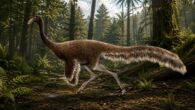
Fossils from the Chinle Formation of Petrified Forest National Park in Arizona, the United States, reveal that Sonselasuchus cedrus, a species of shuvosaurid that lived about 215 million years ago (Triassic period), likely began life walking on four legs before shifting to a bipedal stance as it matured. An artist’s reconstruction of Sonselasuchus cedrus in its environment in what is now Petrified Forest National Park, 215 million years ago. Image...

Mar 6, 2026 by Enrico de Lazaro

Paleontologists have identified a new, giant species of the mosasaur genus Pluridens from the Late Cretaceous phosphate deposits of Morocco. Named Pluridens...

Mar 3, 2026 by News Staff

The newly-discovered minuscule fossils of Purgatorius — a shrew-sized mammal considered the earliest known relative of all primates, including humans,...

Mar 3, 2026 by Enrico de Lazaro

Paleontologists at the University of Toronto Mississauga have found dozens of tooth marks on the fossilized bones of three juveniles of Diadectes, one...

Mar 2, 2026 by Enrico de Lazaro

For many years, the fossil record of pachycephalosaurs (dome-headed dinosaurs) has been dominated by fossilized skulls. The postcranial material of young...

Feb 27, 2026 by News Staff

Fossils trapped in amber aren’t just beautiful, they may preserve real ecological interactions, including possible parasitism or commensal relationships...

Feb 25, 2026 by Enrico de Lazaro

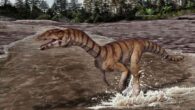
A remarkably complete skeleton of the alvarezsauroid dinosaur species Alnashetri cerropoliciensis from Patagonia, Argentina, as well as two alvarezsauroid...

Feb 24, 2026 by News Staff

Several 250-million-year-old specimens from museum collections in Australia and the United States have revealed a surprising diversity of trematosaurid...

Feb 23, 2026 by Enrico de Lazaro

Paleontologists in Brazil have identified a previously unknown species of somphospondylan sauropod dinosaur with European affinities, hinting at ancient...

Feb 23, 2026 by News Staff

Two species of myllokunmingiid fishes that lived in what is now China around 518 million years ago (Cambrian period) possessed two large lateral eyes...

Feb 19, 2026 by Enrico de Lazaro

Paleontologists have identified the first unequivocal new species of the fish-eating dinosaur Spinosaurus in more than a century. Spinosaurus mirabilis...

Feb 17, 2026 by Enrico de Lazaro

For decades, depictions of Triceratops and its kin have been driven by bone alone. Now, paleontologists in Japan have mapped the soft-tissue anatomy of...

Feb 16, 2026 by Sergio Prostak

Paleontologists have unearthed fossilized bones of one of the smallest sauropodomorph dinosaurs from the Late Triassic of southern Brazil, offering fresh...

Feb 13, 2026 by Sergio Prostak

Between 73,000 and 20,000 years ago (Late Pleistocene), the Japanese Archipelago was inhabited by cave lions (Panthera spelaea), according to a new genetic...

Feb 11, 2026 by News Staff

Apteribis, an extinct species of ibis that once inhabited the Hawaiian Islands, occupied a niche similar to that of the New Zealand kiwi: a nocturnal,...

Feb 10, 2026 by News Staff

Tyrannoroter heberti, a new species of pantylid ‘microsaur’ from the Carboniferous period, shows that some of Earth’s earliest land vertebrates had...

Feb 9, 2026 by Enrico de Lazaro

Paleontologists in China have discovered a nearly complete skeleton of a previously unknown species of iguanodontian dinosaur that preserves exceptionally...

Feb 9, 2026 by Enrico de Lazaro

The detection of chitin in an Olenellus trilobite from the Carrara Formation (514.5 to 506.5 million years ago) of California, the United States, not only...

Feb 5, 2026 by News Staff

New research led by Field Museum of Natural History paleontologists suggests that Archaeopteryx, the oldest known bird, had a feeding apparatus shaped...

Feb 3, 2026 by Sergio Prostak

A fossil trunk vertebra from the Chiting Formation of Taiwan reveals that nearly 4-m-long pythons roamed the island during the Middle Pleistocene. An artistic...