For decades, the motions of stars near the center of our Milky Way Galaxy have been treated as some of the clearest evidence for a supermassive black hole. But Dr. Valentina Crespi from the Institute of Astrophysics La Plata and colleagues suggest that a radically different kind of compact object — one made of self-gravitating fermionic dark matter — could reproduce the same stellar motions.
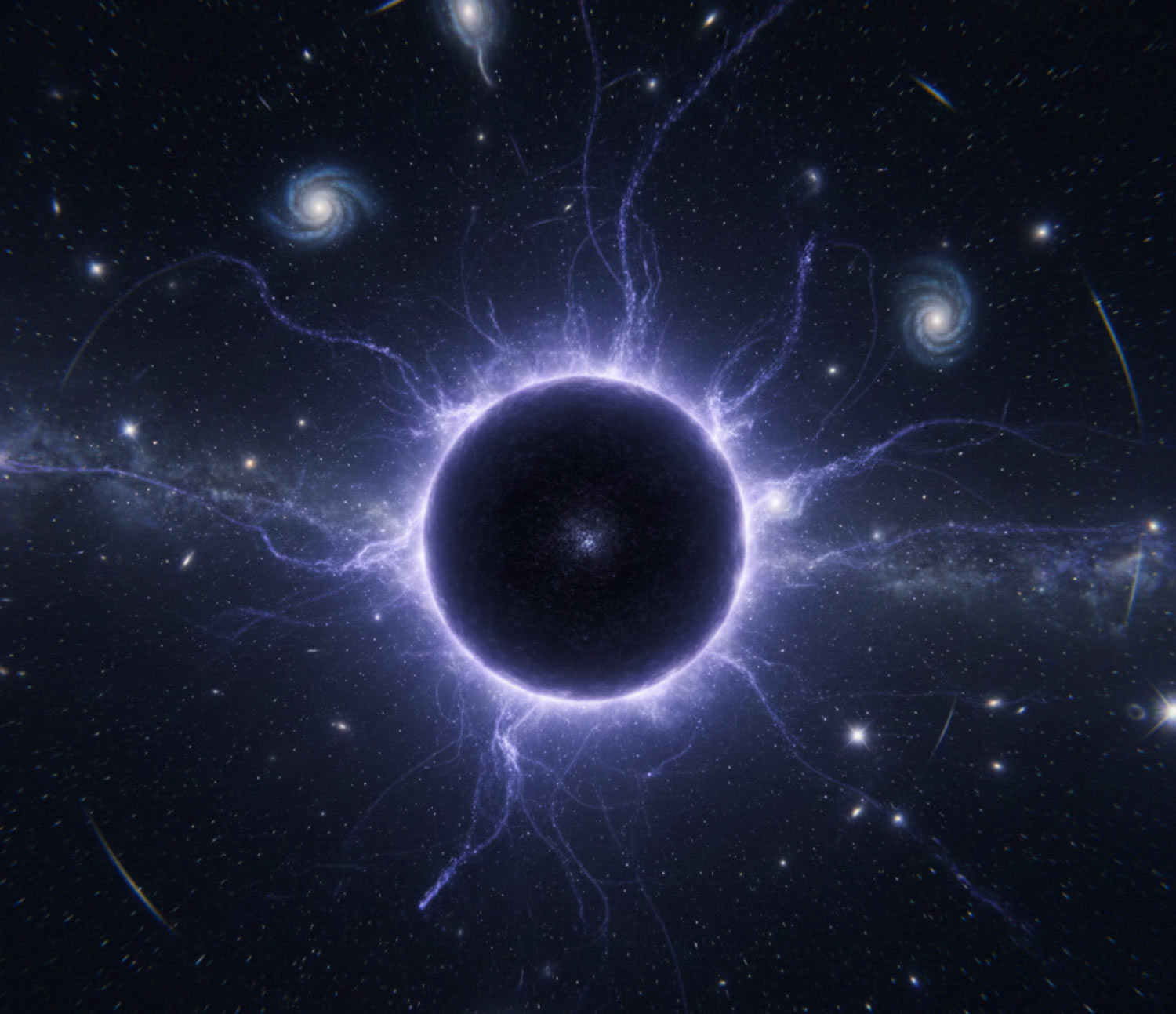
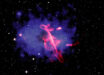
A compact object made of self-gravitating fermionic dark matter. Image credit: Gemini AI.
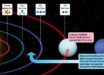
According to the leading theory, Sagittarius A* — a proposed supermassive black hole at the heart of our Galaxy — is responsible for the observed orbits of a group of stars, known as the S-stars, which whip around at tremendous speeds of up to a few thousand kilometers per second.
Dr. Crespi and co-authors have instead put forward an alternative idea — that a specific type of dark matter made up of fermions, or light subatomic particles, can create a unique cosmic structure that also fits with what we know about the Milky Way’s core.
It would in theory produce a super-dense, compact core surrounded by a vast, diffuse halo, which together would act as a single, unified entity.
The Milky Way’s inner core would be so compact and massive that it could mimic the gravitational pull of a black hole and explain the orbits of S-stars that have been observed in previous studies, as well as the orbits of the dust-shrouded objects known as G-sources which also exist nearby.
Of particular importance to the new research is the latest data from ESA’s Gaia DR3 mission, which has meticulously mapped the rotation curve of the Milky Way’s outer halo, showing how stars and gas orbit far from the center.
It observed a slowdown of our Galaxy’s rotation curve, known as the Keplerian decline, which can be explained by their dark matter model’s outer halo when combined with the traditional disk and bulge mass components of ordinary matter.
This strengthens the fermionic model by highlighting a key structural difference.
While traditional Cold Dark Matter halos spread out following an extended ‘power law’ tail, the fermionic model predicts a tighter structure, leading to more compact halo tails.
“This is the first time a dark matter model has successfully bridged these vastly different scales and various object orbits, including modern rotation curve and central stars data,” said Dr. Carlos Argüelles, also from the Institute of Astrophysics La Plata.
“We are not just replacing the black hole with a dark object; we are proposing that the supermassive central object and the Galaxy’s dark matter halo are two manifestations of the same, continuous substance.”
Crucially, the team’s fermionic dark matter model had already passed a significant test.
A 2024 study showed that when an accretion disk illuminates these dense dark matter cores, they cast a shadow-like feature strikingly similar to the one imaged by the Event Horizon Telescope (EHT) collaboration for Sagittarius A*.
“This is a pivotal point. Our model not only explains the orbits of stars and the Galaxy’s rotation but is also consistent with the famous ‘black hole shadow’ image,” Dr. Crespi said.
“The dense dark matter core can mimic the shadow because it bends light so strongly, creating a central darkness surrounded by a bright ring.”
The astronomers statistically compared their fermionic dark matter model to the traditional black hole model.
They found that while current data for the inner stars cannot yet decisively distinguish between the two scenarios, the dark matter model provides a unified framework that explains the Galactic center (central stars and shadow), and the Galaxy at large.
“More precise data from instruments such as the GRAVITY interferometer on ESO’s Very Large Telescope in Chile, and the search for the unique signature of photon rings — a key feature of black holes and absent in the dark matter core scenario — will be crucial to test the predictions of this new model,” the authors said.
“The outcome of these findings could potentially reshape our understanding of the fundamental nature of the cosmic behemoth at the heart of the Milky Way.”
The team’s work was published today in the Monthly Notices of the Royal Astronomical Society.
_____
V. Crespi et al. 2026. The dynamics of S-stars and G-sources orbiting a supermassive compact object made of fermionic dark matter. MNRAS 546 (1): staf1854; doi: 10.1093/mnras/staf1854