Using high-precision radio-occultation measurements from NASA’s Juno mission and incorporating the effects of zonal winds, planetary scientists derived Jupiter’s shape with an order-of-magnitude reduction in uncertainty, finding polar, equatorial and mean radii smaller than previous estimates made with NASA’s Pioneer and Voyager missions.

This visible-light image of Jupiter was created from data captured on January 11, 2017 using Hubble’s Wide Field Camera 3. Near the top, a long brown feature called a ‘brown barge’ extends 72,000 km (nearly 45,000 miles) in the east-west direction. The Great Red Spot stands out prominently in the lower left, while the smaller feature nicknamed Red Spot Jr. (known to Jovian scientists as Oval BA) appears to its lower right. Image credit: NASA / ESA / NOIRLab / NSF / AURA / Wong et al. / de Pater et al. / M. Zamani.
“Jupiter, the largest planet in the Solar System, is approximately an oblate spheroid (ellipsoid of revolution), meaning it is slightly flattened at the poles and bulging at the equator owing to its rapid 9 h 55 min 29 s rotation period,” said Dr. Eli Galanti from the Weizmann Institute of Science and colleagues.
“This shape results from the balance between gravitational forces pulling inwards in the radial direction and centrifugal forces pushing outwards from the rotation axis, resulting, in the case of Jupiter, in the equatorial radius being about 7% larger than its polar radius.”
“For a body with constant density, the shape is an exact ellipsoid. However, Jupiter’s interior density profile varies dramatically from the cloud level at around 1 bar, where the density is less than 1 kg/m3, to the deep levels, where density reaches thousands of kg/m3. “
“This leads to variations in the shape of the planet from an ellipsoid on the order of tens of kilometers, which are expressed as latitudinal variations in the gravity field.”
“Additional variations in Jupiter’s shape come from the strong zonal winds observed at the cloud level.”
“These modify the centrifugal forces to create variations on the order of 10 km, mostly at low latitudes.”
Previously, Jupiter’s physical dimensions were based on data from six radio occultation experiments performed by NASA’s Pioneer and Voyager missions in the 1970s.
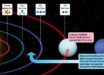
In a new study, the authors analyzed the radio occultation data obtained by Juno during 13 flybys of Jupiter, and incorporated the effects of zonal winds.
“Radio occultation is used to ‘see’ through the dense, opaque clouds of Jupiter’s atmosphere to understand its internal structure,” they explained.
“During an occultation experiment, Juno beams radio signals back to NASA’s Deep Space Network on Earth.”
“As these signals pass through the charged upper layer of Jupiter’s atmosphere, called the ionosphere, gases bend and delay the signals.”
“By measuring the change in frequency caused by this bending, we can calculate the temperature, pressure, and electron density of Jupiter’s atmosphere at different depths. “
The team’s results show that Jupiter is about 8 km narrower at the equator and 24 km flatter at the poles.
“Incorporating the effects of zonal winds, we derive Jupiter’s shape with an order-of-magnitude reduction in uncertainty,” the researchers said.
“At the 1-bar pressure level, we find a polar radius of 66,842 km, an equatorial radius of 71,488 km and a mean radius of 69,886 km, which are 12 km, 4 km and 8 km smaller than previous estimates, respectively.”
The findings were published this week in the journal Nature Astronomy.
_____
E. Galanti et al. The size and shape of Jupiter. Nat Astron, published online February 2, 2026; doi: 10.1038/s41550-026-02777-x