A fossil trunk vertebra from the Chiting Formation of Taiwan reveals that nearly 4-m-long pythons roamed the island during the Middle Pleistocene.
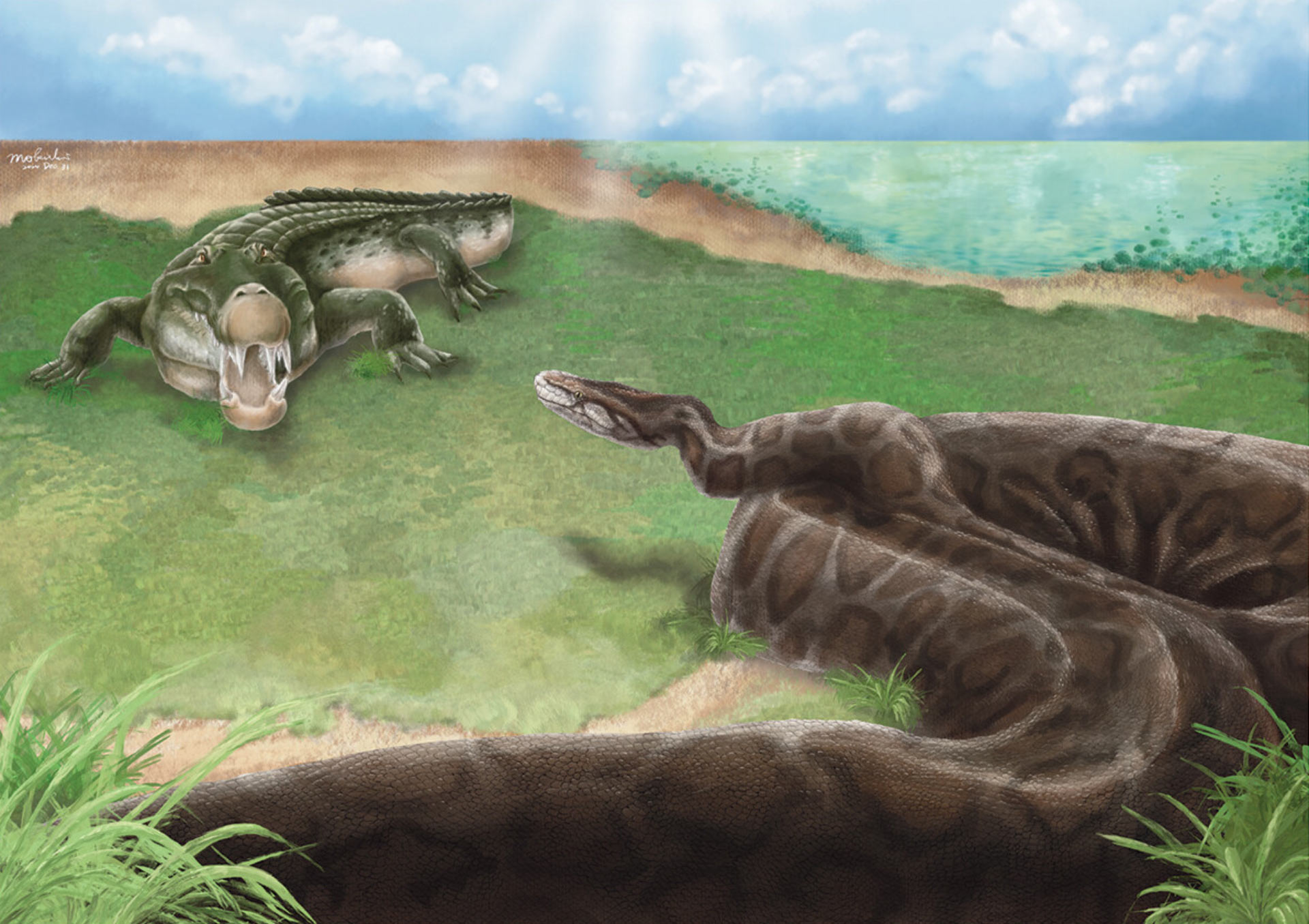
An artistic reconstruction of the possible ecological interaction between Python and Toyotamaphimeia in the Middle Pleistocene of Taiwan. Image credit: Lab of Evolution and Diversity of Fossil Vertebrates, National Taiwan University / Cheng-Han Sun.
Python is a genus comprising nearly ten species of snakes in the family Pythonidae, distributed throughout the tropical and subtropical regions of the eastern hemisphere.
In Africa, pythons are native to tropical regions south of the Sahara but are absent from the extreme southwestern tip of southern Africa and from Madagascar.
In Asia, they occur from Bangladesh, Nepal, India, Pakistan, and Sri Lanka through Myanmar and eastward to Indochina, southern China, Hong Kong, and Hainan, as well as across the Malayan region of Indonesia and the Philippines.
“No living members of the genus Python inhabit the main island of Taiwan,” said Yi-Lu Liaw and colleagues from the National Taiwan University.
In their new study, the paleontologists examined a large single trunk vertebra recovered near Tainan City, Taiwan.
The specimen dates to the Middle Pleistocene, between about 800,000 and 400,000 years ago.
The researchers identified the specimen as belonging to the genus Python, making it the first confirmed fossil evidence of a python on Taiwan’s main island.
Using measurements from a reconstructed 3D model of the specimen, they estimated that the ancient snake reached a total length of about 4 m — exceeding the size of any modern Taiwanese snake species.
More than 50 snake species live on the island, but none approach the size suggested by the fossil.
“This fossil represents the largest and most unexpected fossil snake from Taiwan,” they said.
The vertebra was recovered from the Chiting Formation, a fossil-rich geological unit in southern Taiwan that has also yielded remains of saber-toothed cats, large crocodilians and megaherbivores such as mammoths and extinct rhinoceroses.
Together, these finds point to a complex and predator-rich ecosystem during the Middle Pleistocene, sharply contrasting with Taiwan’s modern fauna.
“The vanished top predator, as shown by this large Python or previously published sabre-toothed cat and large crocodile, in the modern biodiversity of Taiwan, indicates a drastic faunal turnover,” the scientists concluded.
“We propose that the niche of top predators in the modern ecosystem may have been vacant since the Pleistocene extinction.”
“Future discovery and in-depth analysis should test the hypotheses and illuminate the origin of modern biodiversity in the Far East.”
The discovery is described in a paper in the journal Historical Biology.
_____
Yi-Lu Liaw et al. An unexpected snake fossil (Pythonidae, Python) from Taiwan. Historical Biology, published online January 16, 2026; doi: 10.1080/08912963.2025.2610741