ESA’s CHaracterising ExOPlanet Satellite (CHEOPS) has revealed a four-planet system whose outermost world is a small and rocky planet — not a gas giant. The unexpected arrangement around the nearby red dwarf star LHS 1903 suggests that the outermost member of the system formed long after the others, providing the strongest observational hint yet that planets can emerge in gas-poor conditions once thought impossible.
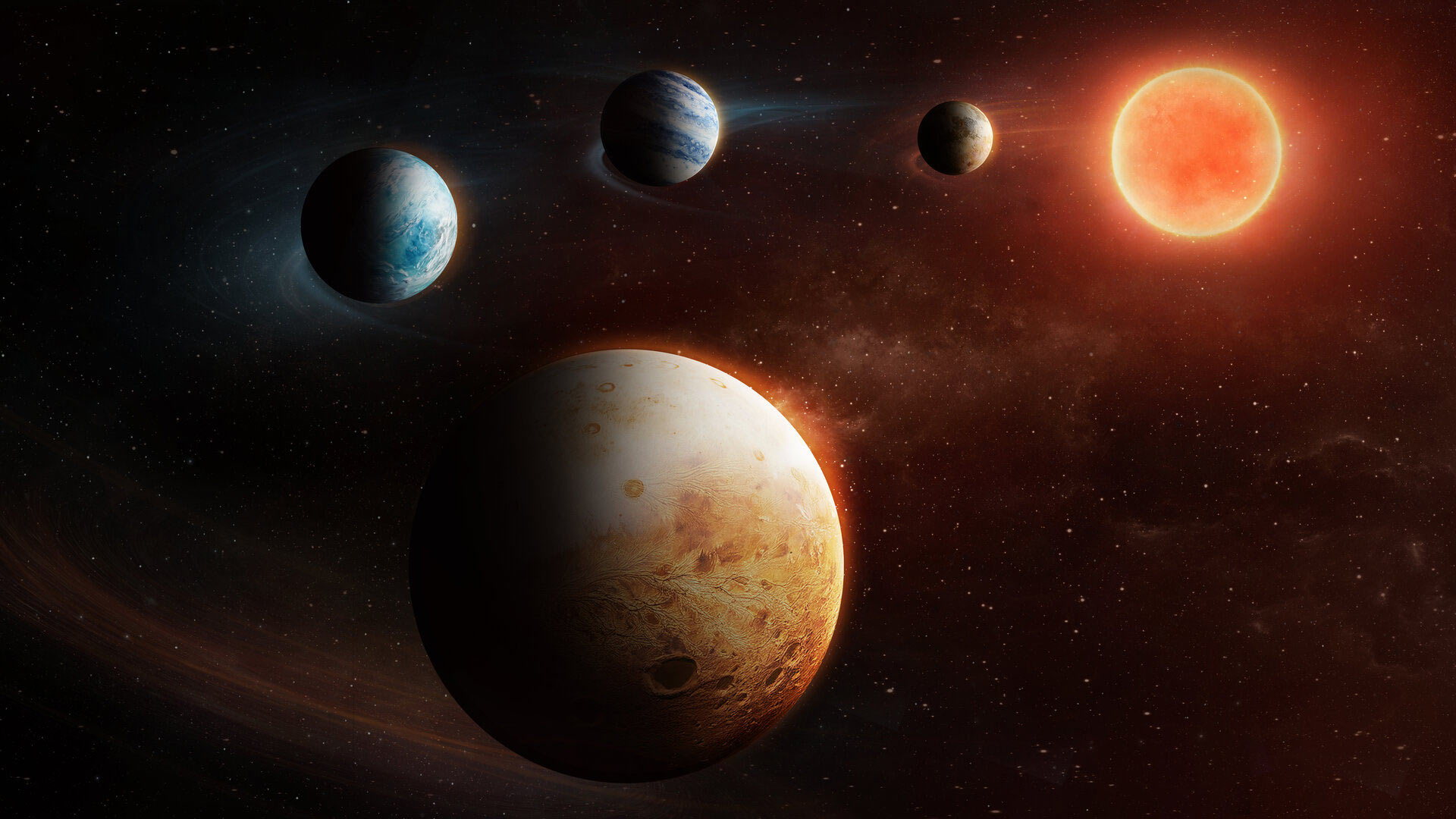
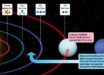
An artist’s impression of the four-planet system around LHS 1903. Image credit: ESA / ATG Europe.
LHS 1903 is a small M-dwarf located 116.3 light-years away in the constellation of Lynx.
Also known as TOI-1730 or G 107-55, the star is cooler and shines less brightly than our Sun.
The planets around LHS 1903 begin with the rocky planet LHS 1903b orbiting close by and then two gas worlds, LHS 1903c and LHS 1903d, the expected planetary pattern.
However, using the CHEOPS spacecraft, University of Warwick astronomers Thomas Wilson and his colleagues saw a surprising fourth planet at the system’s outer edge was rocky, not gaseous.
“That makes this an inside-out system, with a planet order of rocky-gaseous-gaseous-and then rocky again,” Dr. Thomas said.
“Rocky planets don’t usually form so far away from their home star.”
Current models suggest that the closest planets to stars are rocky because stellar radiation sweeps away their gaseous atmospheres, leaving dense, solid cores behind.
Gas giants form farther out in cooler regions where gas can accumulate, and planets can hold onto it.
Yet LHS 1903e appeared to have either lost its gaseous atmosphere or never formed one.
“Much about how planets form and evolve is still a mystery,” said CHEOPS project scientist Dr. Maximilian Günther, an astronomer at ESA.
“Finding clues like this one for solving this puzzle is precisely what CHEOPS set out to do.”
The astronomers then explored various explanations for why this strange rocky planet breaks the familiar pattern.
Was the planet, for example, at some point in its past hit by a giant asteroid, comet, or another big object, that blew away its atmosphere?
Or had the planets around LHS 1903 swapped places at some point during their evolution?
After testing these scenarios through simulations and calculations of the planets’ orbital times, the researchers ruled them out.
Instead, their investigation led them to a more intriguing explanation: the planets may have formed one after the other, instead of at the same time.
“By the time this outer planet formed, the system may have already run out of gas, which is considered vital for planet formation. Yet here is a small, rocky world, defying expectations,” Dr. Wilson said.
“It seems that we have found first evidence for a planet which formed in what we call a gas-depleted environment.”
A paper describing the discovery was published today in the journal Science.
_____
Thomas G. Wilson et al. Gas-depleted planet formation occurred in the four-planet system around the red dwarf LHS 1903. Science, published online February 12, 2026; doi: 10.1126/science.adl2348