New research led by Field Museum of Natural History paleontologists suggests that Archaeopteryx, the oldest known bird, had a feeding apparatus shaped by early flight pressures, hinting that its diet and aerodynamics evolved together in the dawn of avian history. The results appear this week in The Innovation.
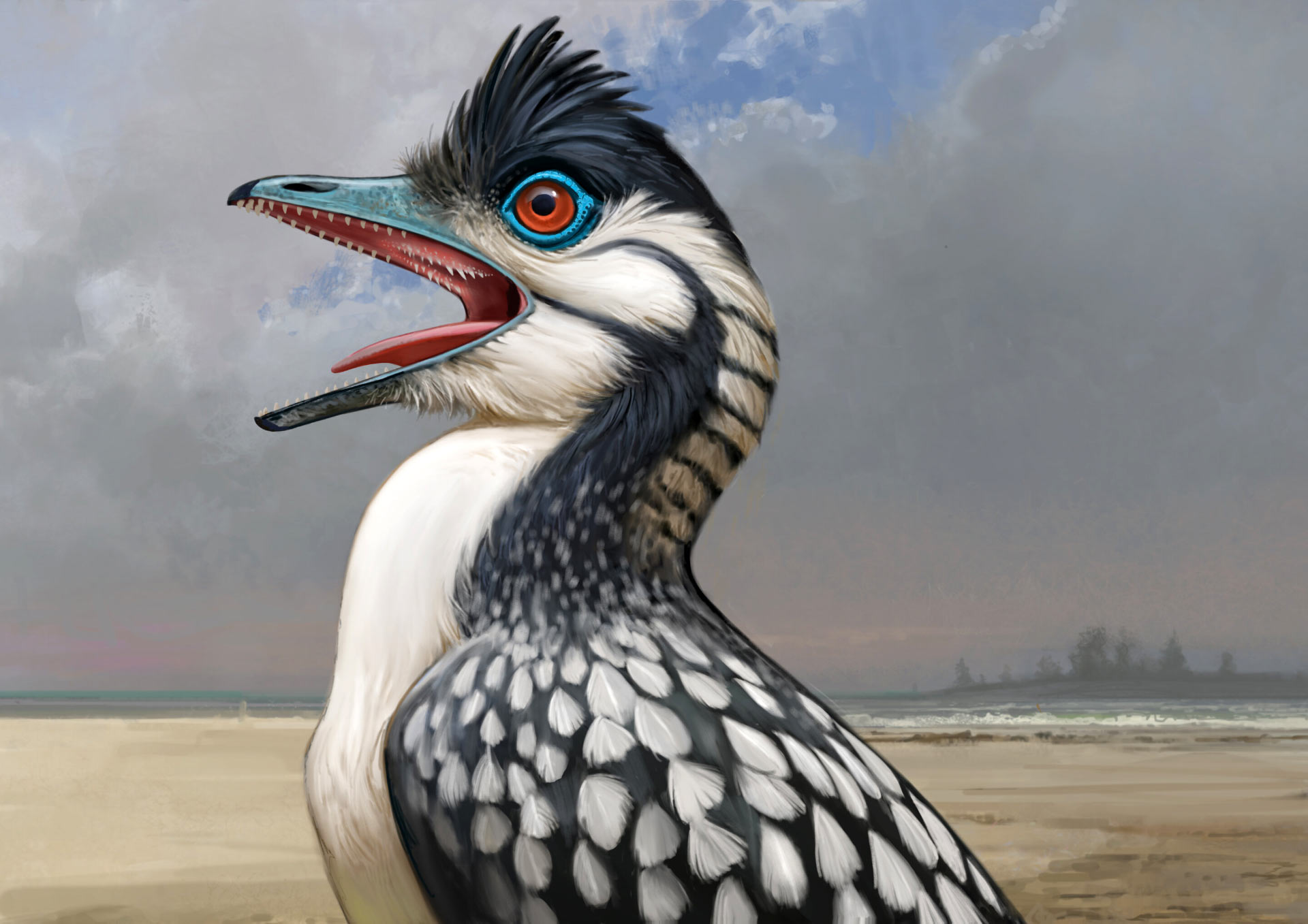
A life reconstruction of Archaeopteryx, including the oral papillae on the roof of its mouth, a bill-tip organ at the end of its beak, and a flexible-yet-sturdy tongue made possible by an extra tongue bone. Image credit: Ville Sinkkonen.
Flying is really hard work. Compared to walking, swimming, or running, flying is the form of movement that takes the most energy and requires the most calories.
That means that birds have had to evolve specialized ways to be really efficient at finding and digesting their food.
Archaeopteryx, which lived in what’s now Germany about 150 million years ago (Jurassic period), is the earliest known dinosaur that also qualifies as a bird.
“For a long time, there have been very few things that we could say really characterize the transition from terrestrial dinosaurs to flying bird dinosaurs,” said Dr. Jingmai O’Connor, an associate curator of fossil reptiles at the Field Museum.
“These weird little features in the mouth of Archaeopteryx, that are also found in living birds, are giving us new criteria that we can use to tell whether a dinosaur fossil is a bird or not.”
In the study, Dr. O’Connor and colleagues focused on the Chicago Archaeopteryx, the latest Archaeopteryx specimen to join the scientific record.
They compared the position and appearance of the tissues preserved in Archaeopteryx’s mouth to the oral papillae in modern birds.
They determined that the best explanation was that they’d found the first examples of an Archaeopteryx’s oral papillae (and first oral papillae in the fossil record).
They also found several other features within Archaeopteryx’s skull that had never been seen in this species.
They spotted a tiny splinter of bone that turned out to be a tongue bone.
Human tongues do not contain bones, but most birds have a set of bones that form the central structure of their tongues.
These bones provide additional muscle attachment points, resulting in flexible tongues that help birds use their tongues to reach and manipulate food.
“This teeny-tiny bone is one of the smallest bones in the body, and it indicates that Archaeopteryx had a highly mobile tongue, like many birds today,” Dr. O’Connor said.
Through CT scanning, the researchers also observed that the tip of the Archaeopteryx’s beak contained tiny tunnels: traces of nerves.
Many modern birds have what’s called a bill-tip organ, a sensitive part at the end of their beaks that can help them root around for food.
Taken together, the evidence of oral papillae, tongue bones, and bill-tip organs in Archaeopteryx suggest that the first birds evolved multiple strategies to help them find and swallow food more efficiently, and that these features go hand-in-hand with their newfound ability to fly.
“These discoveries show this really clear shift in how dinosaurs were feeding when they started flying and had to meet the enormous energetic demands of flight,” Dr. O’Connor said.
“Birds have a super-efficient digestive system — everything is modified to maximize the efficiency of eating and the calories that they can extract from food. And the digestive system starts with the mouth.”
_____
Jingmai K. O’Connor et al. 2026. Avian features of Archaeopteryx feeding apparatus reflect elevated demands of flight. The Innovation 7 (2): 101086; doi: 10.1016/j.xinn.2025.101086