New orbital data reveal that the most recently active volcanic systems on Mars weren’t simple one-off blasts into space; instead, long-lived magmatic plumbing beneath Pavonis Mons, one of the Red Planet’s largest volcanoes, reshaped lava flows over time, with distinct eruptive phases and evolving chemical signatures, offering fresh insights into the planet’s inner dynamics and how rocky planets build and transform their surfaces.
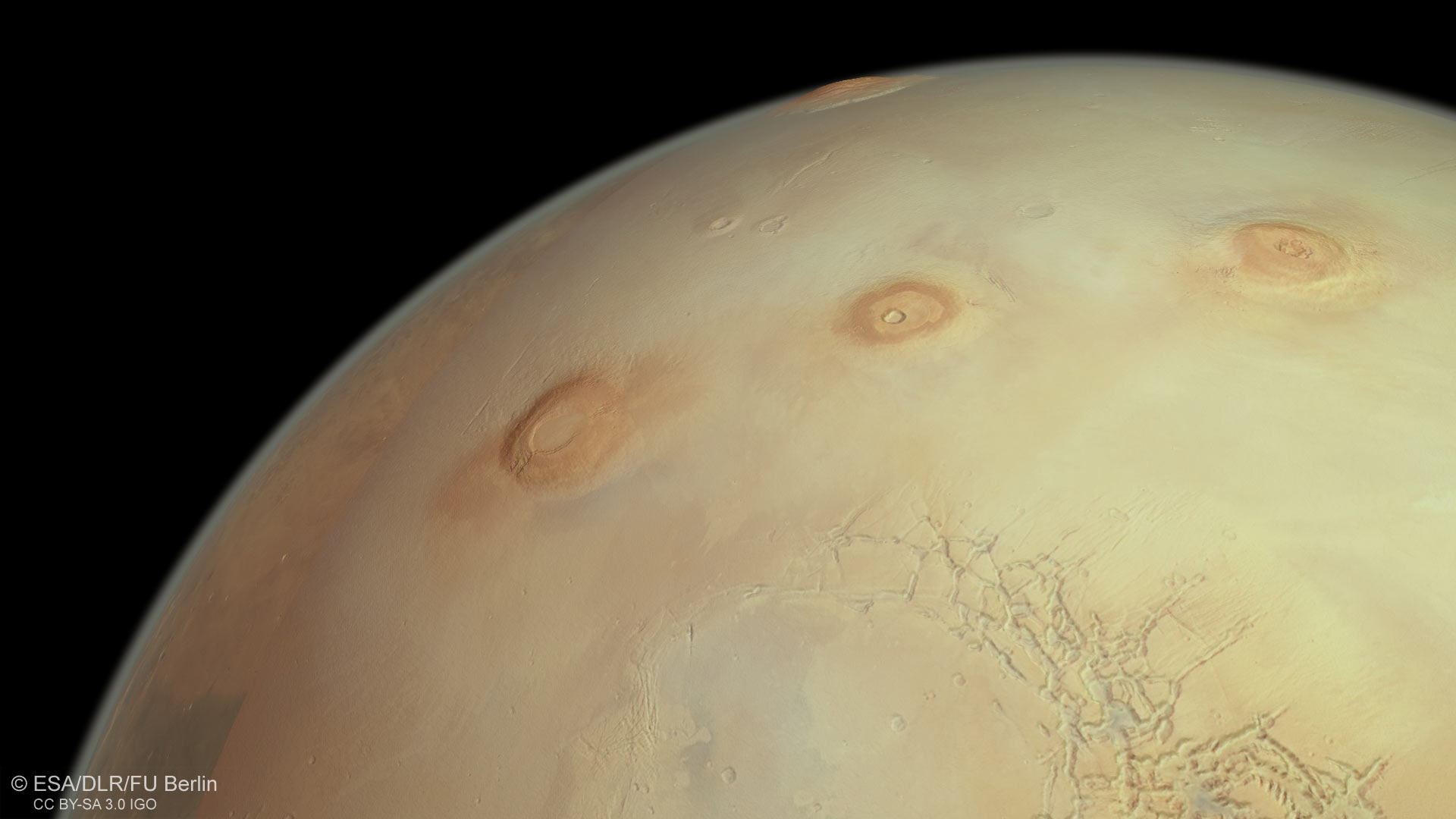
This perspective view from ESA’s Mars Express shows three of Mars’ famously colossal volcanoes (from left to right): Arsia, Pavonis and Ascraeus Mons. Image credit: ESA / DLR / FU Berlin.
What appears to be a single volcanic eruption is often the result of complex processes operating deep beneath the surface, where magma moves, evolves, and changes over long periods of time.
To fully understand how volcanoes work, geoscientists study the volcanic products that erupt at the surface, which can reveal the hidden magmatic systems feeding volcanic activity.
Led by Adam Mickiewicz University researcher Bartosz Pieterek, the new research shows that this complexity also applies to Mars.
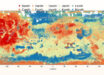
By combining detailed surface mapping with orbital mineral data, the authors reconstructed the volcanic and magmatic evolution of the volcanic system south of Pavonis Mons in unprecedented detail.
“Our results show that even during Mars’ most recent volcanic period, magma systems beneath the surface remained active and complex,” Dr. Pieterek said.
“The volcano did not erupt just once — it evolved over time as conditions in the subsurface changed.”
The study shows that this volcanic system developed through multiple eruptive phases, transitioning from early fissure-fed lava emplacement to later point-source activity that produced cone-forming vent.
Although these lava flows appear different on the surface, they were supplied by the same underlying magma system.
Each eruptive phase preserved a distinct mineral signature, allowing the scientists to trace how the magma changed through time.
“These mineral differences tell us that the magma itself was evolving,” Dr. Pieterek said.
“This likely reflects changes in how deep the magma originated and how long it was stored beneath the surface before erupting.”
“Because direct sampling of Martian volcanoes is currently not possible, studies like this provide rare insight into the structure and evolution of the planet’s interior.”
“The findings highlight how powerful orbital observations can be in revealing the hidden complexity of volcanic systems — on Mars and on other rocky planets.”
The results were published on January 29, 2026 in the journal Geology.
_____
Bartosz Pieterek et al. Spectral evidence for magmatic differentiation within a Martian plumbing system. Geology, published online January 29, 2026; doi: 10.1130/G53969.1