A team of scientists at New York University has created a version of the exotic phase of matter in which particles levitate acoustically and interact by exchanging sound waves.
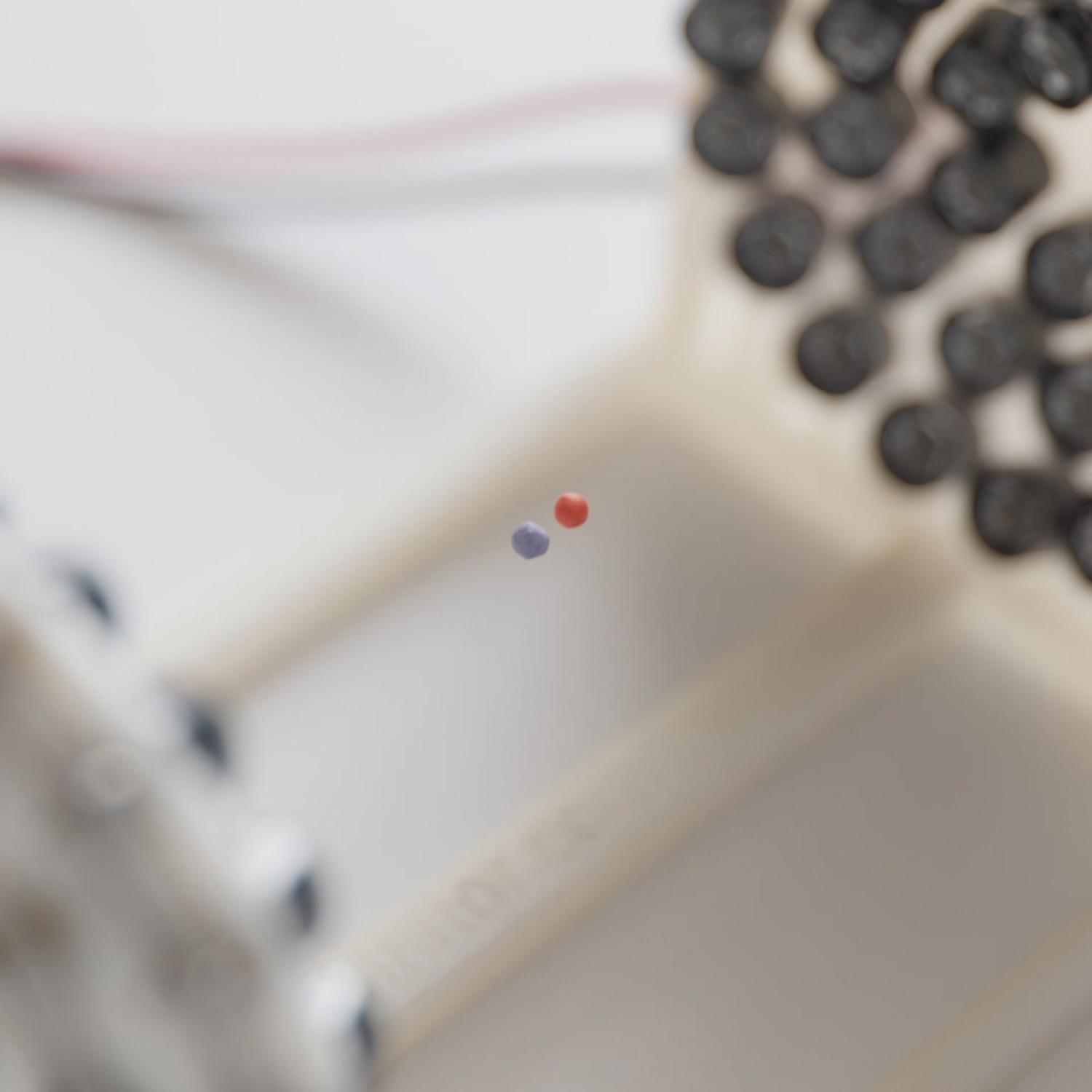
Morrell et al. observed a new type of time crystal — one whose particles levitate on a cushion of sound while interacting with each other by exchanging sound waves. Image credit: David Song / NYU.
Time crystals — a collection of particles that ‘tick’ — hold great promise for advancing quantum computing and data storage, among other uses.
Particles in the new type of time crystal defy Newton’s third law of motion, which states that for every action of an object, there is an equal and opposite reaction — meaning forces always occur in balanced pairs (i.e., equal in magnitude and opposite in direction).
By contrast, these particles interact more independently and are not necessarily tied to balanced forces — they move nonreciprocally.
Notably, these time crystals, which can be seen with an unaided eye, are suspended on a one-foot-high device that you can hold in your hand.
“The speakers emit sound waves and that allows us to place small particles in the pressure nodes of the wave, where they are levitated against gravity,” said New York University undergraduate Leela Elliott.
The team’s time crystal consists of styrofoam beads suspended in by sound waves, which served as an ‘acoustic levitator’ to initially hold the beads motionlessly in mid-air.
“We’ve discovered that a really simple system of two particles levitated in an acoustic standing wave can achieve spontaneous oscillations and a time crystal effect through their unbalanced interactions,” said New York University graduate student Mia Morrell.
“Crucially, when these levitated particles interacted with each other, they did so by exchanging scattered sound waves.”
“More specifically, larger particles scatter more sound than smaller particles.”
“Therefore a large particle will influence a small particle more than the small particle influences the large particle.”
“As a result, the interaction between a small and large particle is unbalanced.”
“Think of two ferries of different sizes approaching a dock.”
“Each one makes water waves that pushes the other one around — but to different degrees, depending on their size.”
The findings expand the prospects that these crystals hold for technology and industry.
“Time crystals are a lot more autonomous in that they choose everything for themselves, and they keep themselves going,” said New York University’s Professor David Grier.
“They are fascinating not only because of the possibilities, but also because they seem so exotic and complicated.”
“Our system, by contrast, is remarkable because it’s incredibly simple.”
The findings were published in the journal Physical Review Letters.
_____
Mia C. Morrell et al. 2026. Nonreciprocal Wave-Mediated Interactions Power a Classical Time Crystal. Phys. Rev. Lett 136, 057201; doi: 10.1103/zjzk-t81n