An experiment in Germany offers the first evidence of a long-predicted pairing between a nucleus of carbon-11 and η’ meson (eta prime meson), shedding light on how the strongest force in nature helps generate mass.
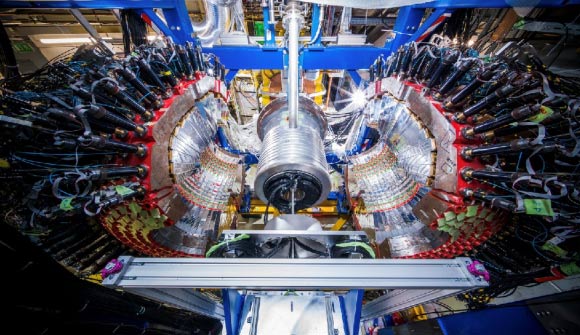
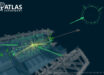
Sekiya et al. found evidence for an exotic atomic nucleus state in an experiment at the GSI/FAIR research center in Germany. Image credit: J. Hosan, GSI/FAIR.
“In physics, a distinction is made between four fundamental forces: gravity, electromagnetism, strong interaction, and weak interaction,” said Professor Kenta Itahashi from RIKEN and the University of Osaka and colleagues.
“Many bound systems are held together by these forces. For example, the Earth and Moon are bound by gravity, and in atoms, the electromagnetic interaction holds the positively charged atomic nucleus and the negatively charged electrons together.”
“Atomic nuclei consist of protons and neutrons and are bound together by the strong interaction.”
“In addition to protons and neutrons, each of which consists of three quarks, there are other particles that are subject to the strong interaction, including mesons.”
“Some mesons are electrically negative,” the physicists added.
“In rare cases, they can therefore replace an electron in atoms and are then bound to the atomic nucleus by the electromagnetic interaction, similar to electrons.”
“However, there are also electrically neutral mesons such as the η’ meson.”
“Because it carries no electric charge, it cannot be bound to the nucleus electromagnetically, but only via the strong interaction.”
“Such a state, in which only the strong interaction binds, is particularly interesting because it allows conclusions to be drawn about the properties of this force.”
In 2005, scientists predicted the existence of a meson-nucleus system bound solely by the strong interaction.
However, experiments searching for this exotic state remained unsuccessful until recently.
Professor Itahashi and co-authors carried out their new experiment at the GSI fragment separator in Germany.
“A proton beam strikes a nucleus of carbon-12 at around 96% of the speed of light and snatches a neutron from it, which forms a deuteron together with the proton and moves away in forward direction,” they explained.
“The remaining carbon-11 nucleus is placed in a highly energetic state. This excitation energy can give rise to an η’ meson, which in rare cases binds to the carbon-11 nucleus — a short-lived bound quantum state.”
The significance of this experimental result goes far beyond the first detection of an exotic nuclear state.
At the same time, it was shown that the mass of the η’ meson decreases in the matter of an atomic nucleus.
The result helps to understand how the mass of mesons arises: if you add up the masses of the quarks in the η’ meson, you only get about one percent of the mass that a free η’ meson has.
“Our collaboration plans to conduct an improved follow-up experiment with significantly more measurement data in order to determine the spectroscopic properties of the bound η’-meson-nucleus system more precisely, in particular energy levels, binding energy, and decay width,” the researchers said.
Their paper appears in the journal Physical Review Letters.
_____
R. Sekiya et al. 2026. Excitation Spectra of the 12C(𝑝,𝑑) Reaction near the 𝜂’-Meson Emission Threshold Measured in Coincidence with High-Momentum Protons. Phys. Rev. Lett 136, 142501; doi: 10.1103/6vsl-ng7x