A new statistical analysis of archival sky surveys from the early Cold War has found that mysterious, short-lived bursts of light in the night sky were more likely to appear around the time of above-ground nuclear weapons tests and to increase alongside reports of unexplained aerial phenomena (UAPs).
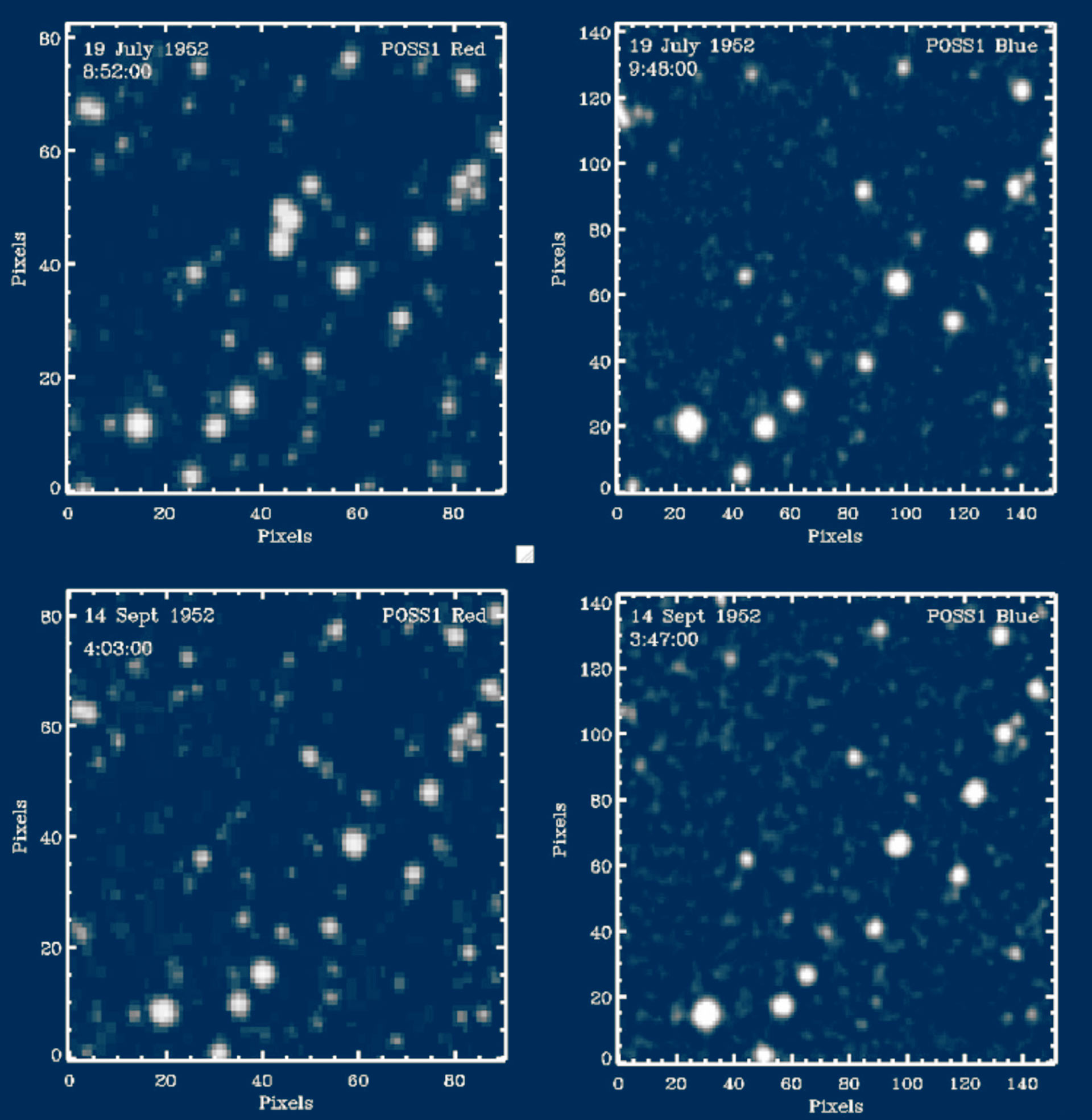
Four exposures of the 3 x 3 arcmin region of sky centered on the triple transient identified in July 1952. Upper left: the POSS I red image on July 19, 1952 at 8:52 (UT) containing the triple transient just above center. Upper right: a 10 m exposure POSS I blue image of the same region taken immediately afterward with no evidence of the triple transient. Lower left and right: POSS I red (left) and blue (right) images taken two months later (September 14, 1952) showing the transient still gone. Image credit: Solano et al., doi: 10.1093/mnras/stad3422.
“Transient star-like objects have been identified in sky surveys conducted prior to the launch of the first artificial satellite on October 4, 1957,” said Dr. Beatriz Villarroel of the Nordic Institute for Theoretical Physics (Nordita) and Dr. Stephen Bruehl from the Vanderbilt University Medical Center.
“These short-lived transients — lasting less than one exposure time of 50 min — have point spread functions and are absent in images taken shortly before the transients appear and in all images from subsequent surveys.”
“In some cases multiple transients appear in a single image, exhibiting characteristics not easily accounted for by prosaic explanations (e.g., gravitational lensing, gamma ray bursts, fragmenting asteroids, plate defects).”
As part of their VASCO (Vanishing and Appearing Sources during a Century of Observations) project, Dr. Villarroel and Dr. Bruehl identified more than 100,000 short-lived, star-like ‘transients’ on photographic plates from the first Palomar Observatory Sky Survey, conducted between 1949 and 1957.
They then compared the timing of these flashes with records of 124 above-ground nuclear tests and thousands of reported UAP sightings.
“Of the 2,718 days in this period, transients were observed on 310 days (11.4%),” they said.
“In the overall sample, the number of transients per date ranged from 0 to 4,528, across multiple locations on multiple plates.”
“Above-ground nuclear weapons tests (US, Soviet, and British) were conducted on 124 days (4.6%) during the study period.”
“UAP reports were recorded in the UFOCAT database on 2,428 days during the study period (89.3%).”
The researchers found that the transients were about 45% more likely to occur on days within a one-day window of a nuclear test than on other days.
The effect was strongest the day after a test, when the likelihood of observing a transient rose by roughly 68%.
The study also reported a modest correlation between the number of transients and the number of UAP sightings recorded on the same date.
For each additional sighting report, the number of transients increased by about 8.5%, on average.
The team’s findings do not establish what the transients are, nor do they demonstrate a causal connection, but they challenge some conventional explanations.
The transients do not resemble defects caused by dust or radioactive contamination on photographic plates, the scientists note, and their timing — particularly the peak one day after nuclear tests — does not fit simple scenarios like debris from explosions.
Instead, the authors outline two broad possibilities.
One is that nuclear detonations may have triggered previously unrecognized atmospheric phenomena capable of producing brief, point-like flashes.
The other, more speculative, is that some transients could reflect objects at high altitude or in orbit — potentially related to the same events that generated UAP sightings.
The researchers emphasize that both ideas remain unproven.
“Our findings provide additional empirical support for the validity of the UAP phenomenon and its potential connection to nuclear weapons activity, contributing data beyond eyewitness reports,” they said.
“The possibility that some transients may represent UAP events in orbit captured on photographic plates prior to the launch of the first artificial satellite cannot be ruled out.”
“This study adds to the small peer-reviewed literature seeking to apply systematic scientific methods to the study of UAP-related data.”
“The ultimate importance of the associations reported in the current work for enhancing understanding of transients and UAP remains to be determined.”
A paper on the findings was published on October 20, 2025 in the journal Scientific Reports.
_____
S. Bruehl & B. Villarroel. 2025. Transients in the Palomar Observatory Sky Survey (POSS-I) may be associated with nuclear testing and reports of unidentified anomalous phenomena. Sci Rep 15, 34125; doi: 10.1038/s41598-025-21620-3