New pictures from NASA’s Dawn spacecraft show a cluster of mysterious bright spots and a pyramid-shaped peak on the surface of the dwarf planet Ceres.

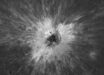
A cluster of bright spots can be seen in this image. The image was captured on June 9, 2015, when Dawn was nearly 2,700 miles (4,400 km) from the dwarf planet. Image credit: NASA / JPL-Caltech / UCLA / MPS / DLR / IDA.
Ceres’ intriguing bright spots are located in a crater about 55 miles (90 km) across.
At least eight spots can be seen next to the largest bright area, which planetary researchers think is around 6 miles (9 km) wide.
Reflection from ice is the leading candidate for these spots, but the scientists continue to consider alternate possibilities, such as salt.
The Visible-IR Mapping Spectrometer (VIR) on Dawn allows the researchers to identify specific minerals present on the dwarf planet’s surface by looking at how light is reflected.

This image, taken by Dawn on June 14, 2015, shows a pyramid-shaped peak on Ceres protruding from a relatively smooth area. Image credit: NASA / JPL-Caltech / UCLA / MPS / DLR / IDA.
So, as the space probe continues to send back more images and data, they will learn more about these bright spots.
In addition to the bright spots, the latest images also show a mountain with steep slopes protruding from a relatively smooth area of the dwarf planet’s surface. The structure rises about 3 miles (5 kilometers) above the surface.
“The surface of Ceres has revealed many interesting and unique features. For example, icy moons in the outer Solar System have craters with central pits, but on Ceres central pits in large craters are much more common,” said Dr Carol Raymond of NASA’s Jet Propulsion Laboratory in Pasadena.
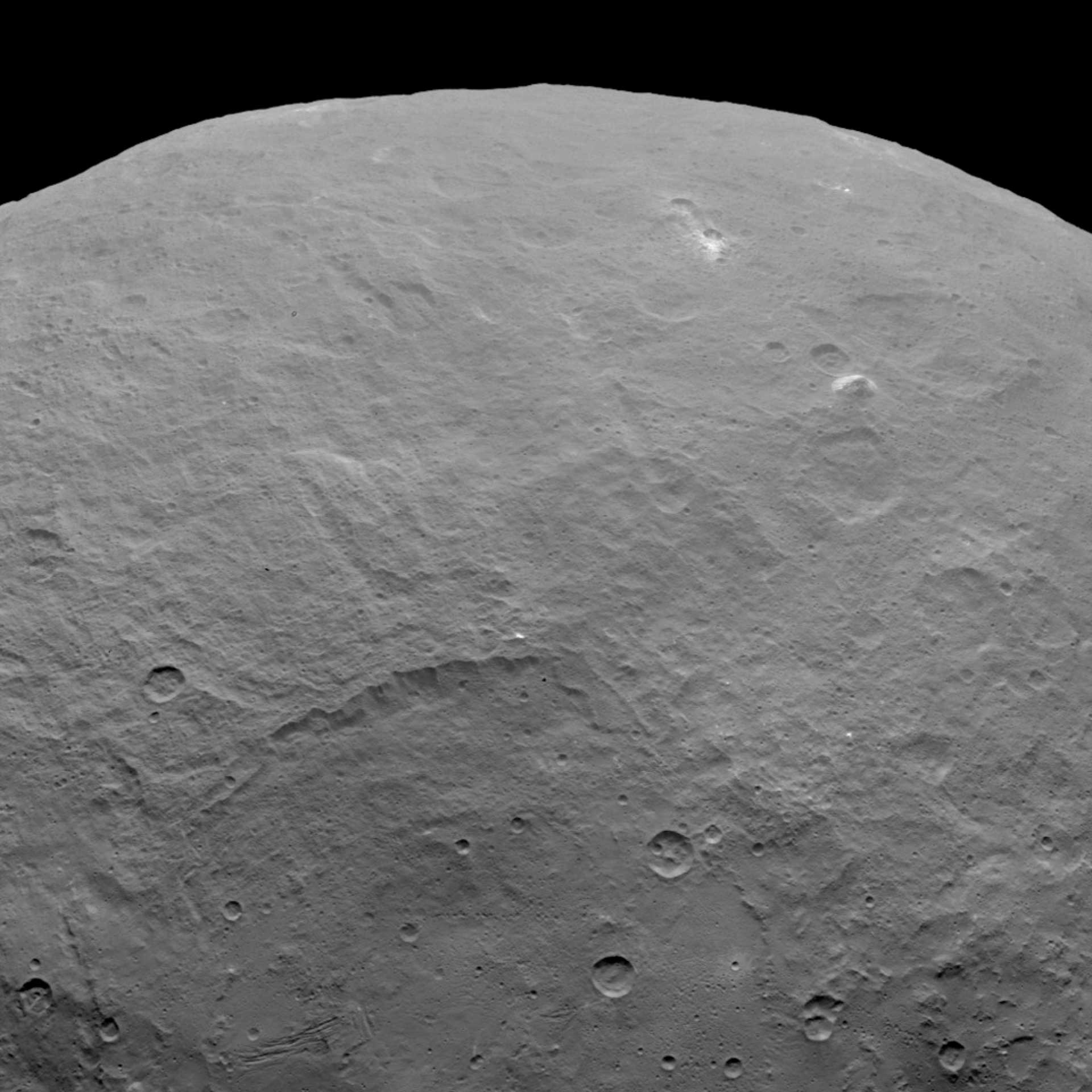
Among the fascinating features on Ceres is an intriguing mountain (upper right) protruding from a relatively smooth area. This image was taken on June 6, 2015. Image credit: NASA / JPL-Caltech / UCLA / MPS / DLR / IDA.
“These and other features will allow us to understand the inner structure of Ceres that we cannot sense directly.”
Dawn will remain in its current altitude until June 30, 2015, continuing to take images and spectra of the dwarf planet in orbits of about 3 days each.
The probe then will move into its next orbit at an altitude of 900 miles (1,450 km), arriving in early August.