As human space exploration pushes farther from Earth, the need for sustainable ways to obtain local resources is becoming increasingly urgent, as routine resupply missions grow impractical. Asteroids — some of them rich in valuable metals such as platinum-group elements — have emerged as especially promising targets. In a new experiment aboard the International Space Station (ISS), scientists tested the use of bacteria and fungi to extract 44 elements from asteroidal material under microgravity.
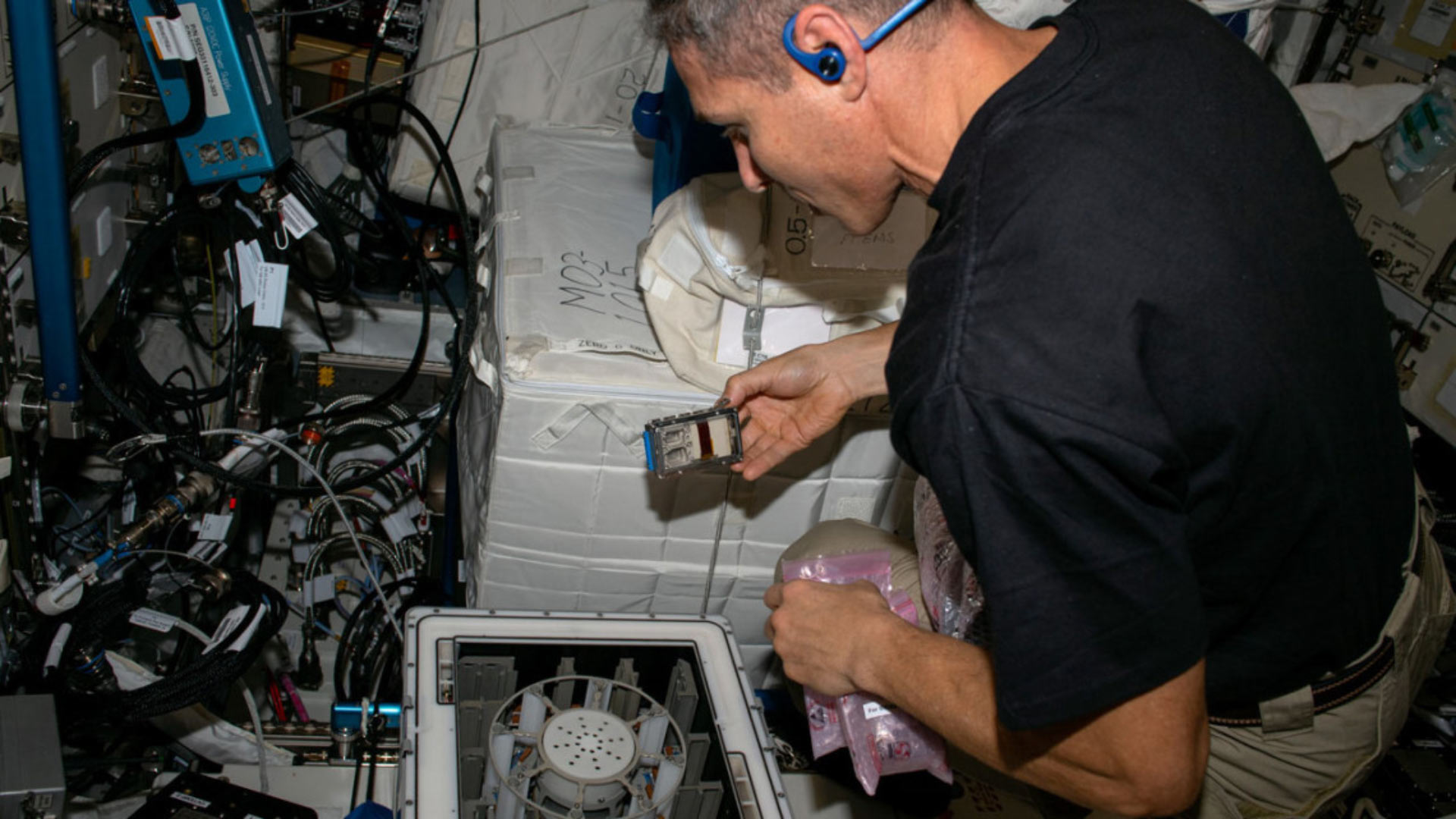
NASA astronaut Michael Scott Hopkins performs a microgravity experiment on the International Space Station. Image credit: NASA.
In the BioAsteroid project, University of Edinburgh’s Professor Charles Cockell and his colleagues used the bacterial species Sphingomonas desiccabilis and the fungus species Penicillium simplicissimum to see which elements could potentially be extracted from L-chondrite asteroidal material.
But understanding how the microbes interact with rocks in microgravity was equally important.
“This is probably the first experiment of its kind on the International Space Station on meteorite,” said Dr. Rosa Santomartino, a researcher at Cornell University and the University of Edinburgh.
“We wanted to keep the approach tailored in a way, but also general to increase its impact.”
“These are two completely different species, and they will extract different things.”
“So, we wanted to understand how and what, but keep the results relevant for a broader perspective, because not much is known about the mechanisms that influence microbial behavior in space.”
These microbes are promising tools for resource extraction because they produce carboxylic acids, the carbon molecules which can attach to minerals via complexation and spur their release.
But many questions remain about how this mechanism works, so the authors also conducted a metabolomic analysis, whereby a portion of the liquid culture is collected from the completed experiment samples, and the researchers examine the biomolecules contained, specifically the secondary metabolites.
NASA astronaut Michael Scott Hopkins performed the ISS experiment, to test microgravity, while the researchers conducted their own control version in the lab, to test terrestrial gravity and compare these with the space results.
The scientists then analyzed the voluminous amount of data that was collected, which comprised 44 different elements, of which 18 were biologically extracted.
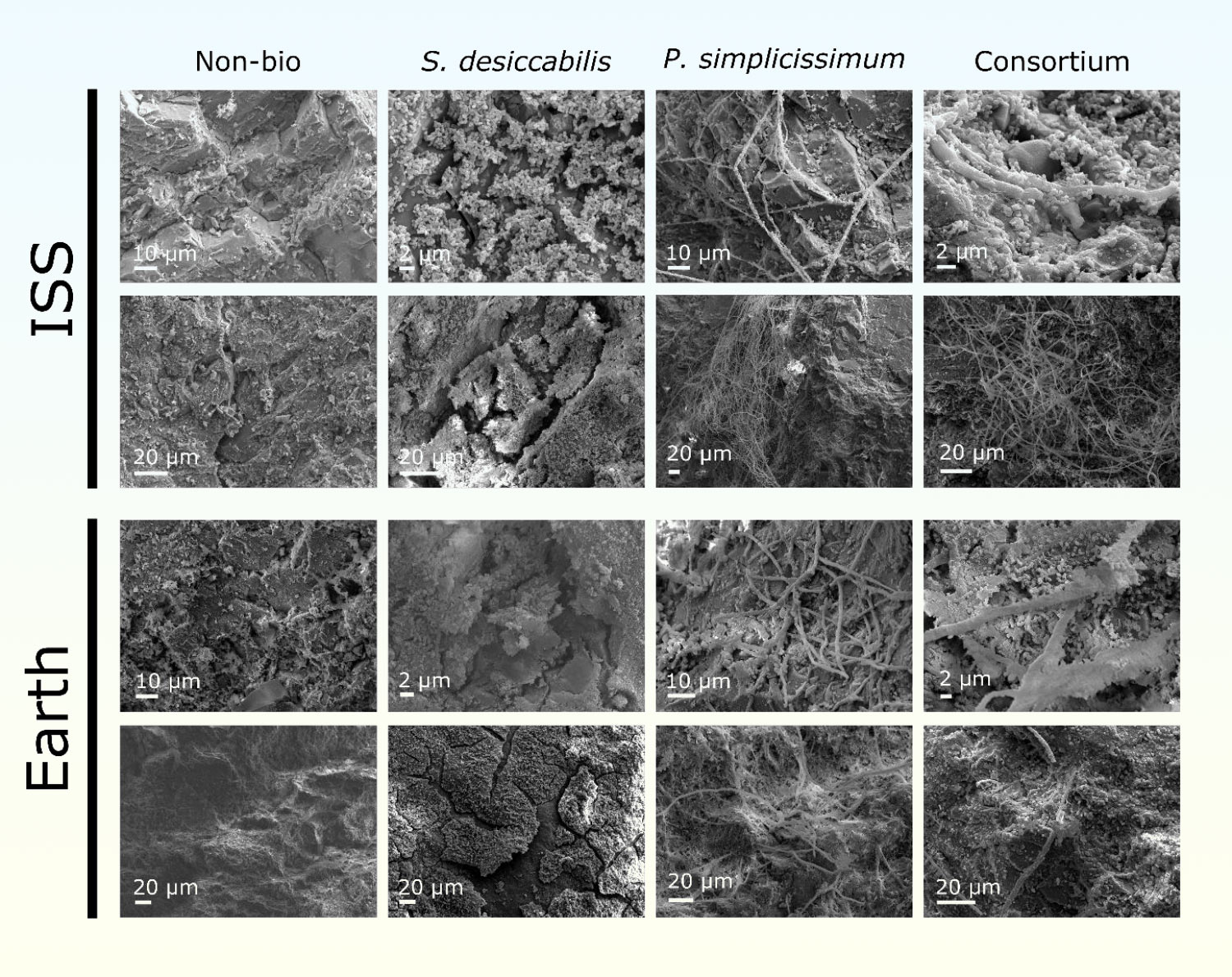
Scanning electron microscopy (SEM) images of the L-chondrite fragments in the two gravity conditions. Image credit: Santomartino et al., doi: 10.1038/s41526-026-00567-3.
“We split the analysis to the single element, and we started to ask, OK, does the extraction behave differently in space compared to Earth?” said Dr. Alessandro Stirpe, also of Cornell University and the University of Edinburgh.
“Are these elements more extracted when we have a bacterium or a fungus, or when we have both of them?”
“Is this just noise, or can we see something that maybe makes a bit of sense? We don’t see massive differences, but there are some very interesting ones.”
The analysis revealed distinct changes in microbial metabolism in space, particularly for the fungus, which increased its production of many molecules, including carboxylic acids, and enhanced the release of palladium, as well as platinum and other elements.
For many elements, non-biological leaching was less effective in microgravity than on Earth. Meanwhile, the microbes had consistent results in both settings.
“In these cases, the microbe doesn’t improve the extraction itself, but it’s kind of keeping the extraction at a steady level, regardless of the gravity condition,” Dr. Santomartino said.
“And this is not just true for the palladium, but for different types of metals, although not all of them.”
“Indeed, another complex but very interesting result, I think, is the fact that the extraction rate changes a lot depending on the metal that you are considering, and also depending on the microbe and the gravity condition.”
The results were published in the journal npj Microgravity.
_____
R. Santomartino et al. Microbial biomining from asteroidal material onboard the international space station. npj Microgravity, published online January 30, 2026; doi: 10.1038/s41526-026-00567-3