Excavations at the archaeological site of Didé West 1 in eastern Senegal have uncovered an exceptionally well-preserved iron-smelting workshop dated between the 4th century BCE and the 4th century CE, representing nearly eight centuries of activity.
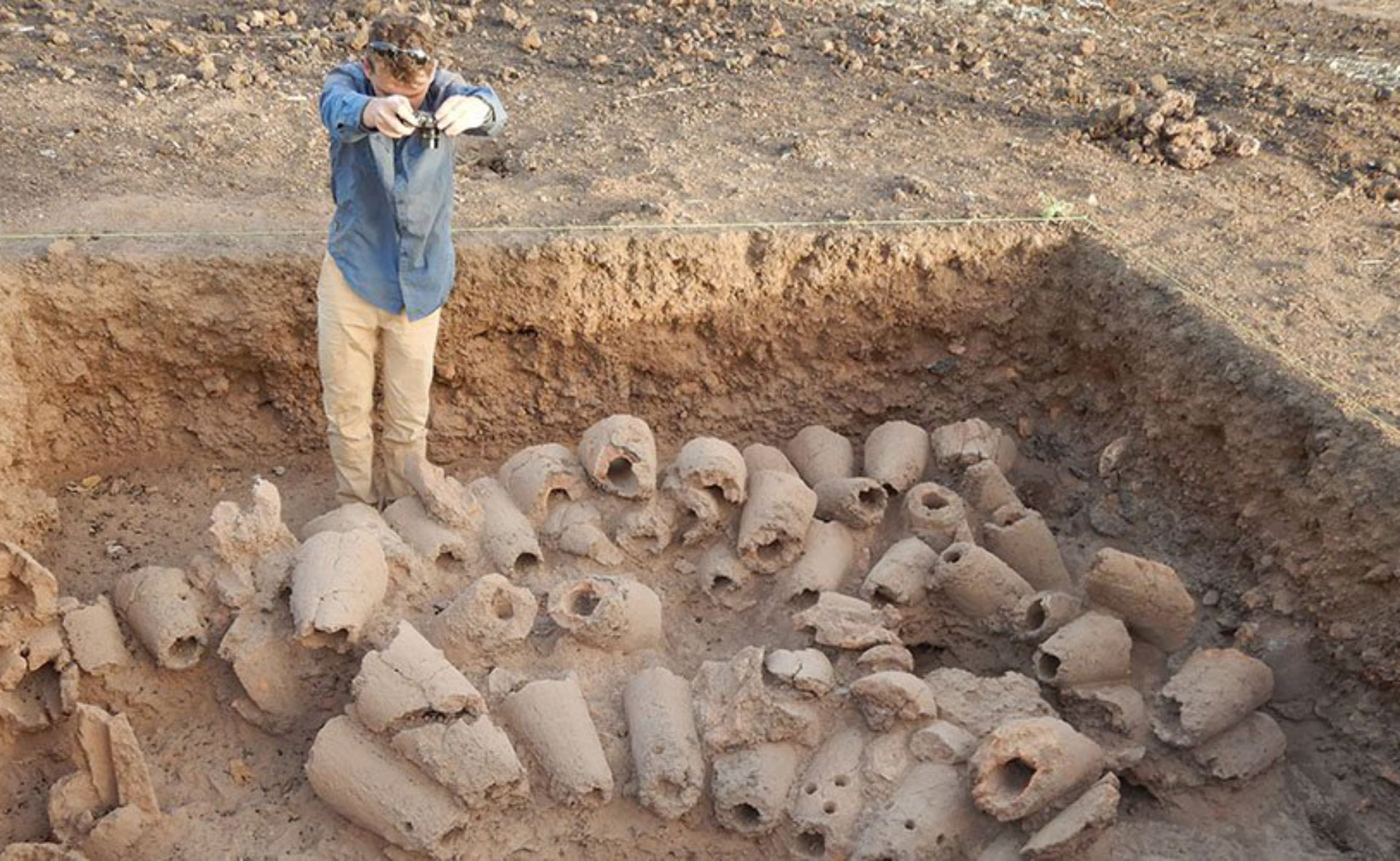
A pile of tuyères at the site of Didé West 1 in Senegal. Image credit: Anne Mayor.
In Europe, the Iron Age is generally dated from around 800 BCE to the end of the first century CE.
However, these chronological frameworks vary widely across different regions of the world.
The earliest evidence of iron production is thought to date to the second millennium BCE in Anatolia (modern-day Turkey) and the Caucasus.
“The iron-smelting workshop at the Didé West 1 site in Senegal sheds new light on the emergence of iron metallurgy in West Africa,” said UNIGE archaeologist Mélissa Morel and her colleagues.
The workshop consists of a large heap containing around 100 tons of slag, a semicircular arrangement of about 30 used tuyères — clay pipes that channel air into the furnace — and 35 circular furnace bases, each approximately 30 cm deep.
This iron and steel production was likely carried out on a small scale to meet local needs, particularly for the manufacture of agricultural tools.
“Thanks to its exceptional state of preservation, its age, the length of time it remained in use, and its distinctive technical features, this site is truly unique,” Dr. Morel said.
“It offers a rare opportunity to study the continuity and adaptation of an iron smelting technique over the long term.”
“At the Didé West 1 site, the spatial organization, furnace morphology and associated waste products point to the tradition known as FAL02.”
“It is characterized by small circular furnaces topped with a removable chimney, as well as large clay tuyères.”
“A key feature is that these tuyères do not have a single air outlet but multiple small openings connected to the main channel by perpendicular side ducts. This design allows air to be distributed to the bottom of the furnace.”
“Another distinctive characteristic is the use of palm nut seeds as packing material at the base of the furnace — a practice not previously documented.”
“Despite the very long period during which this workshop operated, this tradition remained remarkably stable, undergoing only minor technical adjustments,” said Dr. Anne Mayor, an archaeologist at UNIGE and the Global Studies Institute.
“This continuity contrasts with other African metallurgical contexts and highlights the importance of understanding the technical and cultural choices made by early metallurgists in iron production.”
The team’s paper was published in the journal African Archaeological Review.
_____
M. Morel et al. Evolution of an Early and Long-Lasting Iron Smelting Technique at Didé West 1, Falémé Valley, Eastern Senegal. Afr Archaeol Rev, published online March 25, 2026; doi: 10.1007/s10437-026-09653-z