A cache of 142 beads and pendants from five Natufian (15,000 to 11,650 years before the present) sites in Israel reveals that clay was first used not for tools or cooking, but for symbolism and identity, often crafted by children whose fingerprints still mark the objects. The findings suggest that the roots of art, learning and social expression emerged long before agriculture.
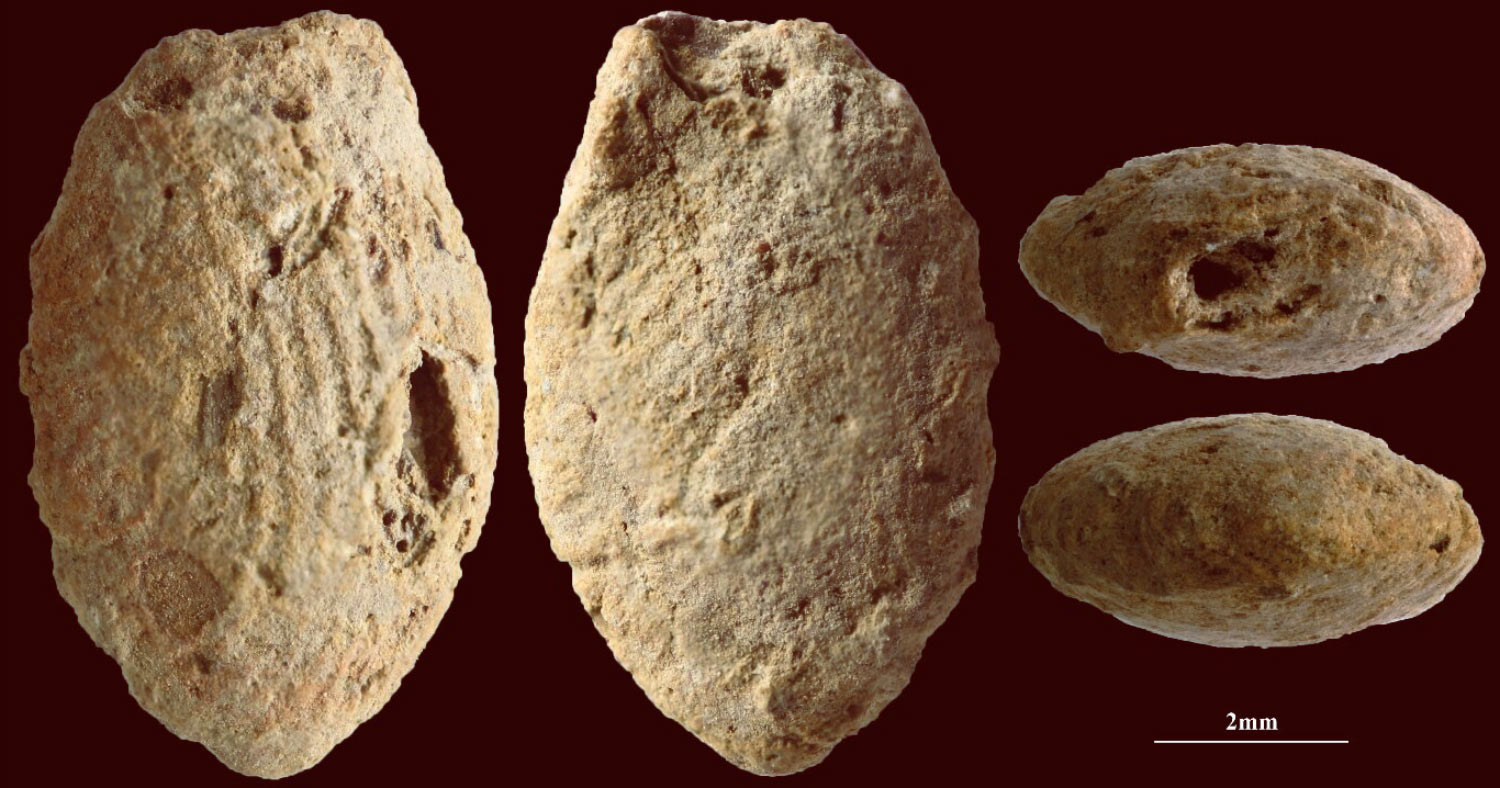
A butterfly clay bead from the Final Natufian period in Eynan-Mallaha, the Upper Jordan Valley, colored red with ochre and marked with the fingerprints of the child (around 10 years old) who modeled it 12,000 years ago. Image credit: Laurent Davin.
“This discovery completely changes how we understand the relationship between clay, symbolism, and the emergence of settled life,” said Hebrew University of Jerusalem archaeologist Laurent Davin.
The authors examined an assemblage of 142 beads and pendants from five Natufian sites spanning more than three millennia of occupation.
Small enough to fit in the palm of a hand, the artifact were carefully shaped from unbaked clay into cylinders, discs, and ellipses.
Many were coated in red ochre, using a technique known as engobe, a thin layer of liquid clay smoothed onto the surface.
This is the earliest known use of this coloring technique anywhere in the world.
The sheer number and diversity of the beads reveal something unexpected: this was not an isolated experiment, but a sustained tradition.
Clay, it turns out, had already become a medium for visual communication, long before it was used for bowls or jars.
The researchers identified 19 distinct bead types, many echoing the shapes of plants that were central to Natufian life: wild barley, einkorn wheat, lentils, and peas.
These were the same plants the Natufians harvested, processed, and consumed intensively, plants that would later form the backbone of agriculture.
Traces of plant fibers preserved on some beads show how they were strung and worn, offering rare insight into organic materials that usually disappear from the archaeological record.
Together, the ornaments suggest that nature, especially the plant world, was not just a source of food, but a source of meaning.
Perhaps the most striking discovery lies not in the shapes of the beads, but in their surfaces.
Preserved fingerprints, 50 in total, allowed the scientists to identify who made them.
The prints belong to individuals of different ages: children, adolescents, and adults.
It is the first time archaeologists have been able to directly identify the makers of Paleolithic ornaments, and the largest such fingerprint assemblage ever documented from this period.
Some objects appear to have been designed specifically for children, including a tiny clay ring just 10 mm wide.
The findings suggest that making ornaments was a shared, everyday activity, one that played a role in learning, imitation, and the transmission of social values from one generation to the next.
For decades, archaeologists believed that symbolic uses of clay in Southwest Asia emerged only with farming and the Neolithic way of life.
This study and the recent discovery of a clay figurine at Nahal Ein Gev II overturn that assumption.
Instead, it shows that a symbolic revolution began earlier, during the first stages of sedentarization, when communities were still hunting and gathering but beginning to live in permanent settlements.
Clay ornaments became a way to express identity, affiliation, and social relationships, visually and publicly.
“These objects show that profound social and cognitive changes were already underway,” said Hebrew University of Jerusalem’s Professor Leore Grosman.
“The roots of the Neolithic lie deeper than we once thought.”
“By documenting one of the world’s oldest traditions of clay adornment, our study reframes the Natufians not just as forerunners of agriculture, but as innovators of symbolic culture, people who used clay to say something about who they were, and who they were becoming.”
The results were published in the journal Science Advances.
_____
Laurent Davin et al. 2026. Modeling identities among the first-sedentary communities: Emergence of clay personal ornaments in Epipaleolithic Southwest Asia. Science Advances 12 (12); doi: 10.1126/sciadv.aea2158