According to new observations by NASA’s SPHEREx mission, the interstellar object 3I/ATLAS has dramatically changed its behavior, developing the hallmarks of a fully active comet after a close encounter with the Sun.
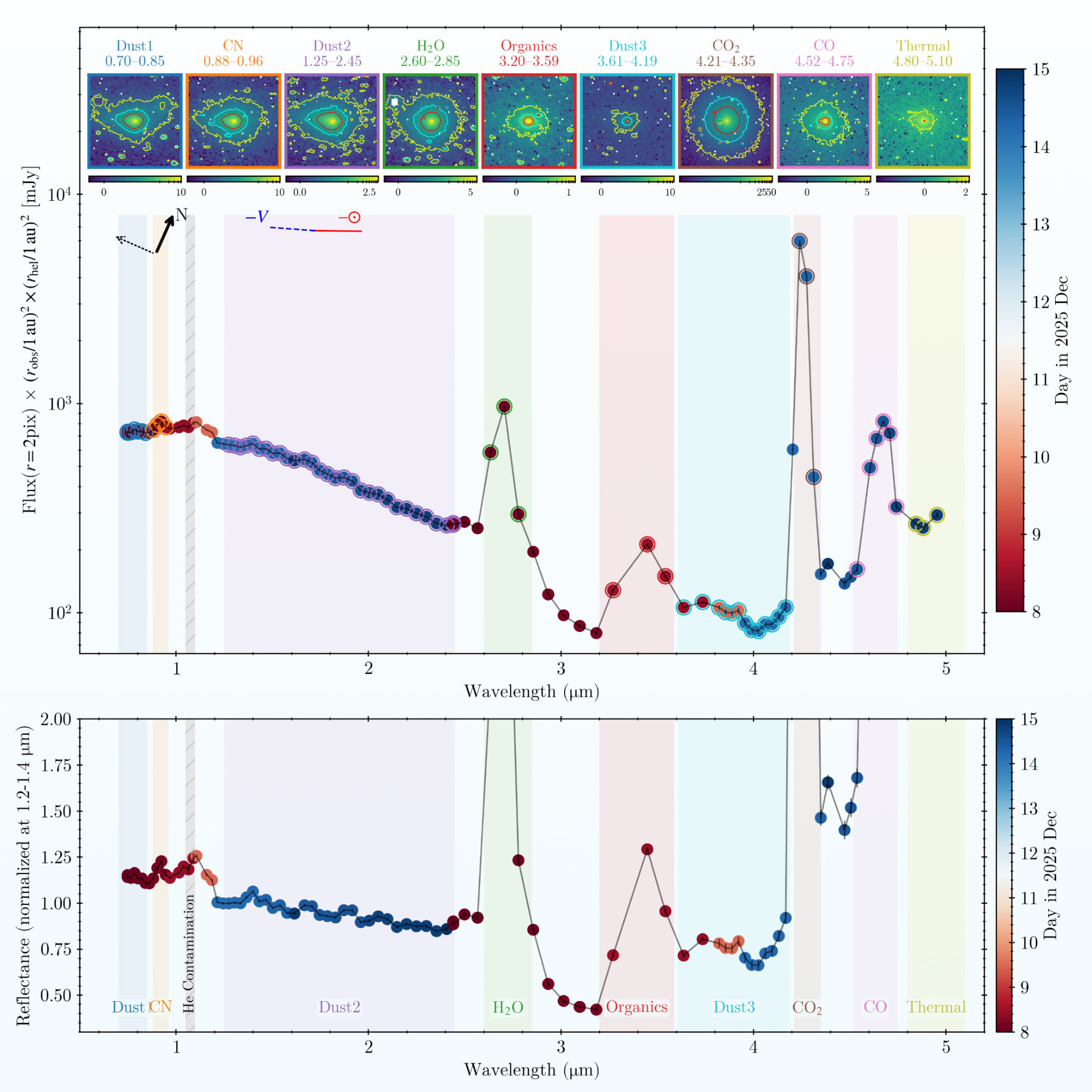
The SPHEREx 0.75-5.0μm imaging of 3I/ATLAS taken on December 8 to 15, 2025. Image credit: NASA / arXiv: 2601.06759 / Lisse et al., arXiv: 2601.06759.
The SPHEREx mission observed 3I/ATLAS between December 8 and 15, 2025, after it reached its closest approach to the Sun — known as perihelion.
“In December 2025, SPHEREx re-observed 3I/ATLAS post-perihelion, finding a much more active object compared to the August 2025 SPHEREx pre-perihelion observations, with marked evidence for development into a cometary body fully sublimating all its ices,” said Dr. Carey Lisse, an astronomer at the Johns Hopkins University Applied Physics Laboratory, and his colleagues.
The new SPHEREx data reveal a coma rich in gas and dust, with emissions from cyanide (CN), water (H2O), organics (C-H), carbon dioxide (CO2), and carbon monoxide (CO).
“The new appearance of cyanide and organic features suggests that these species are contained in the water phases,” said Harvard University’s Professor Avi Loeb, who was not involved in the study.
The researchers found that water activity had surged. At the same time, carbon monoxide emissions also rose sharply.
“The H2O-gas feature, barely detected in August, is now 20x stronger, suggesting water is now fully sublimating,” they said.
“The CO emitted flux has increased 20x, meaning that the CO/CO2 abundance ratio has also increased 15-fold.”
The new images from SPHEREx also show that the object’s gaseous envelope expanded significantly.
“The gas-comae detected by SPHEREx were all resolved, extending from 1’-to-3’ in radius, and all except the CN and C-H organics comae are markedly round with respect to the Sun and orbital velocity directions,” the scientists said.
“By contrast, the SPHEREx continuum dust and organics images are markedly pear-shaped, with the ‘pearstem’ pointing sunward.”
“The very different morphologies suggest that CN and C-H are sourced from the dust, while the H2O, CO2, and CO-gas is from a symmetric region centered on the nucleus.”
“No obvious jet or anti-solar tail structures were found.”
The changes detected by SPHEREx suggest a fundamental shift in the physical state of 3I/ATLAS.
“The December 2025 observations are consistent with a comet that is now fully active, sublimating even water ice,” the authors said.
“The composition now resembles that of typical solar system comets, with ice abundance ratios that are typical numbers found for the majority of most comets.”
They link the transformation to the object’s journey through the inner Solar System.
“By December, 3I/ATLAS had spent 3.5 months inside the Solar System’s ice line, and all of the cometary constituents, not just the highly volatile CO2 and CO ice portions, was active,” they said.
“As a result, bulk matrix comet material was evaporating, releasing everything the comet contains.”
“A more full-up treatment will be produced before 3I/ATLAS passes through SPHEREx’s planned survey pattern again in April 2026,” they concluded.
Their paper has been submitted for publication in the Research Notes of the AAS.
_____
C.M. Lisse et al. 2026. SPHEREx Re-Observation of Interstellar Object 3I/ATLAS in December 2025: Detection of Increased Post-Perihelion Activity, Refractory Coma Dust, and New Coma Gas Species. RNAAS, submitted for publication; arXiv: 2601.06759