A team of astronomers using NASA’s Chandra X-ray Observatory has discovered a new ultraluminous X-ray source (ULX) produced by a black hole in a nearby galaxy.

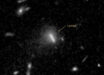
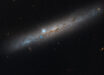
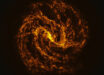
An optical image of M83 from the Very Large Telescope in Chile, left, and a composite image showing X-ray data from Chandra in pink and optical data from the Hubble in blue and yellow (ESO / VLT / NASA / CXC / Curtin University / R.Soria et al. / STScI / Middlebury College / F.Winkler et al.)
The discovery, which will be published in the May 10th issue of the Astrophysical Journal, provides new insight into the nature of a mysterious class of black holes that can produce as much energy in X-rays as a million suns radiate at all wavelengths.
The astronomers spotted the intriguing new ULX in M83, a spiral galaxy about 15 million light years from Earth, in 2010 using Chandra. They compared the new data with Chandra images from 2000 and 2001 and found that the source had increased in X-ray brightness by at least 3,000 times and has since become the brightest X-ray source in the galaxy.
ULXs give off more X-rays than most binary systems, in which a companion star orbits the remains of a collapsed star. These collapsed stars form either a dense core called a neutron star or a black hole. The extra X-ray emission suggests ULXs contain black holes that might be much more massive than the ones found elsewhere in our galaxy.
The sudden brightening of the M83 ULX is one of the largest changes in X-rays ever seen for this type of object, which do not usually show dormant periods.
“The flaring up of this ULX took us by surprise and was a sure sign we had discovered something new about the way black holes grow,” said Dr. Roberto Soria of Curtin University in Australia, a lead author of the study.
The study suggets the dramatic jump in X-ray brightness likely occurred because of a sudden increase in the amount of material falling into the black hole.
“If the ULX only had been observed during its peak of X-ray emission in 2010, the system easily could have been mistaken for a black hole with a massive, much younger stellar companion, about 10 to 20 million years old,” said Dr. William Blair of Johns Hopkins University in Baltimore, a co-author of the study.
The companion to the black hole in M83 is likely a red giant star at least 500 million years old, with a mass less than four times the Sun’s. Theoretical models for the evolution of stars suggest the black hole should be almost as old as its companion.
Another ULX containing a volatile, old black hole recently was discovered in the Andromeda galaxy and described in the February issue of the journal Astronomy and Astrophysics.
“With these two objects, it’s becoming clear there are two classes of ULX, one containing young, persistently growing black holes and the other containing old black holes that grow erratically,” said Dr. Kip Kuntz of Johns Hopkins University, a co-author of the study. “We were very fortunate to observe the M83 object at just the right time to make the before and after comparison.”
The mass of the black hole producing the M83 ULX is uncertain, the authors estimate a range from 40 to 100 times the mass of the Sun. The black hole is expected to blow strong, fast winds of hot gas. Searching for signatures of those winds is the next, ongoing step of the team’s investigation.