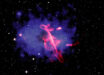
The new dark galaxy candidate is dominated by dark matter and nearly devoid of light. Named Candidate Dark Galaxy-2 (CDG-2), the object consists of four globular clusters and belongs to the Perseus galaxy cluster. The discovery of CDG-2 challenges astronomers’ understanding of how galaxies form and evolve in the cosmic web, offering a new window into the Universe’s most elusive substance, dark matter, which outweighs ordinary matter yet remains unseen.
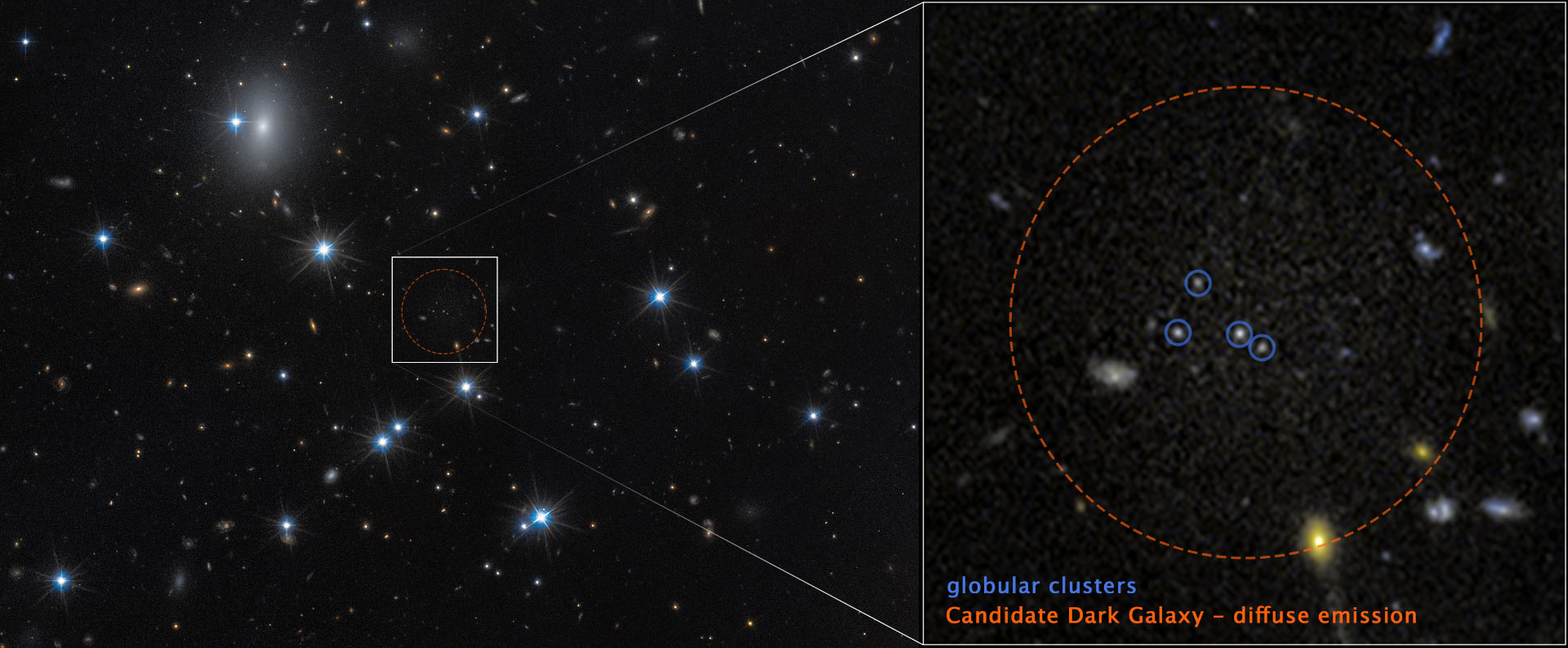
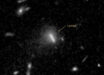
CDG-2 (dashed red circle) is dominated by dark matter and contains only a sparse scattering of stars. Image credit: NASA / ESA / Dayi Li, UToronto / Joseph DePasquale, STScI.
“In the vast tapestry of the Universe, most galaxies shine brightly across cosmic time and space,” said University of Toronto astronomer David Li and his colleagues.
“Yet a rare class of galaxies remains nearly invisible — low-surface-brightness galaxies dominated by dark matter and containing only a sparse scattering of faint stars.”
“Detecting such faint galaxies is extraordinarily difficult.”
Using advanced statistical techniques, Dr. Li and co-authors identified 10 previously confirmed low-surface-brightness galaxies and two additional dark galaxy candidates by searching for tight groupings of globular clusters.
These clusters can signal the presence of a faint, hidden stellar population.
To confirm one of the dark galaxy candidates, they employed the NASA/ESA Hubble Space Telescope, ESA’s Euclid space observatory, and the ground-based Subaru Telescope in Hawaii.
Hubble’s high-resolution imaging revealed a close collection of four globular clusters in the Perseus cluster, a massive cluster of galaxies located around 240 million light-years away in the constellation of Perseus.
Follow-up studies using Hubble, Euclid, and Subaru then revealed a faint, diffuse glow surrounding the star clusters — strong evidence of an underlying galaxy.
“This is the first galaxy detected solely through its globular cluster population,” Dr. Li said.
“Under conservative assumptions, the four clusters represent the entire globular cluster population of CDG-2.”
Preliminary analysis suggests CDG-2 has the luminosity of roughly 6 million Sun-like stars, with the globular clusters accounting for 16% of its visible content.
Remarkably, 99% of its mass, which includes both visible matter and dark matter, appears to be dark matter.
Much of its normal matter to enable star formation was likely stripped away by gravitational interactions with other galaxies inside the Perseus cluster.
“CDG-2 may be the most globular cluster-dominated galaxy and potentially one of the most dark matter-dominated galaxies ever discovered,” the astronomers concluded.
Their paper was published in June 2025 in the Astrophysical Journal Letters.
_____
Dayi (David) Li et al. 2025. Candidate Dark Galaxy-2: Validation and Analysis of an Almost Dark Galaxy in the Perseus Cluster. ApJL 986, L18; doi: 10.3847/2041-8213/adddab