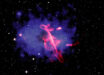
New observations from the NASA/ESA/CSA James Webb Space Telescope reveal a galaxy with sweeping gaseous ‘tentacles’ in a galaxy cluster at redshift of 1.156, meaning we’re seeing it as it was approximately 8.5 billion years ago.
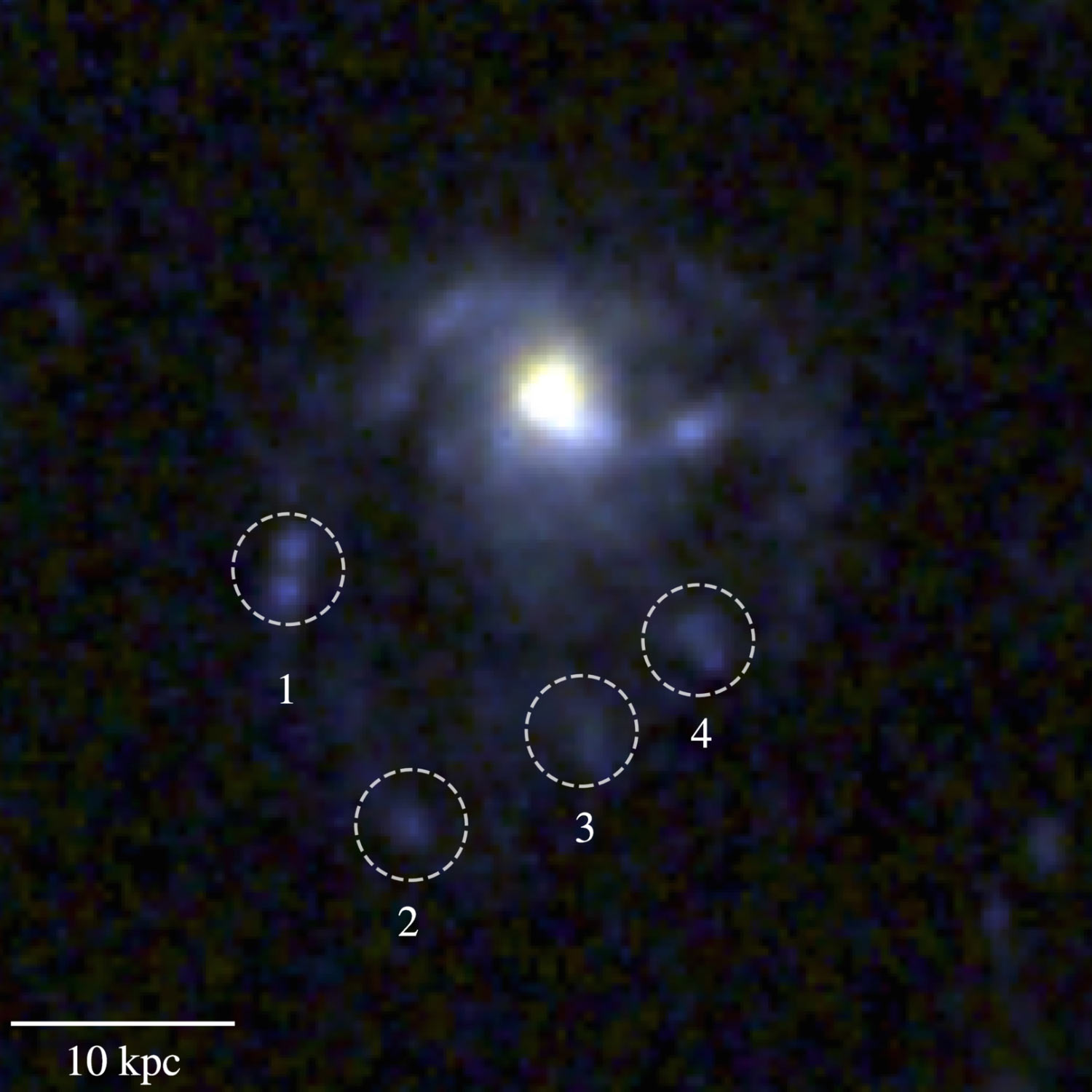
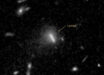
This Webb image shows the jellyfish galaxy COSMOS2020-635829; the dashed circles mark the four extraplanar sources that are identified in the tail of the galaxy. Image credit: Roberts et al., doi: 10.3847/1538-4357/ae3824.
“Jellyfish galaxies are named for the long, tentacle-like streams that trail behind them,” said Dr. Ian Roberts from the University of Waterloo and colleagues.
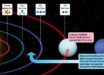
“They move quickly through their hot, dense galaxy cluster, and the gas within the cluster acts like a strong wind pushing the jellyfish galaxy’s own gas out the back, forming trails.”
“The technical term for this process is ram-pressure stripping.”
The authors found the new jellyfish galaxy in deep space data captured by Webb.
Named COSMOS2020-635829, it lies in the COSMOS field, a particular patch of the sky that many telescopes have observed to study distant galaxies.
“We were looking through a large amount of data from this well-studied region in the sky with the hopes of spotting jellyfish galaxies that haven’t been studied before,” Dr. Roberts said.
“Early on in our search of the Webb data, we spotted a distant, undocumented jellyfish galaxy that sparked immediate interest.”
COSMOS2020-635829 had a normal-looking galaxy disk and bright blue knots in its trails, which are very young stars.
The age of the stars suggests that they were formed outside of the main galaxy in the trails of stripped gas, which is expected in a galaxy of this nature.
Information gathered from studying this galaxy has challenged some previously held beliefs about what was happening in deep space at that time.
Scientists believed that galaxy clusters were still forming and that ram-pressure stripping was uncommon.
Dr. Roberts and co-authors made three additional discoveries that could change how we understand the Universe.
“The first is that cluster environments were already harsh enough to strip galaxies, and the second is that galaxy clusters may strongly alter galaxy properties earlier than expected,” Dr. Roberts said.
“Another is that all the challenges listed might have played a part in building the large population of dead galaxies we see in galaxy clusters today.”
“These data provide us with rare insight into how galaxies were transformed in the early Universe.”
The discovery is described in a paper published in the Astrophysical Journal.
_____
Ian D. Roberts et al. 2026. JWST Reveals a Candidate Jellyfish Galaxy at z = 1.156. ApJ 998, 285; doi: 10.3847/1538-4357/ae3824