Using the SETI Institute’s Allen Telescope Array, a 42-element radio interferometer at Hat Creek Radio Observatory in Hat Creek, California, astronomers probed 3I/ATLAS for artificial radio transmissions but found only human-made interference.
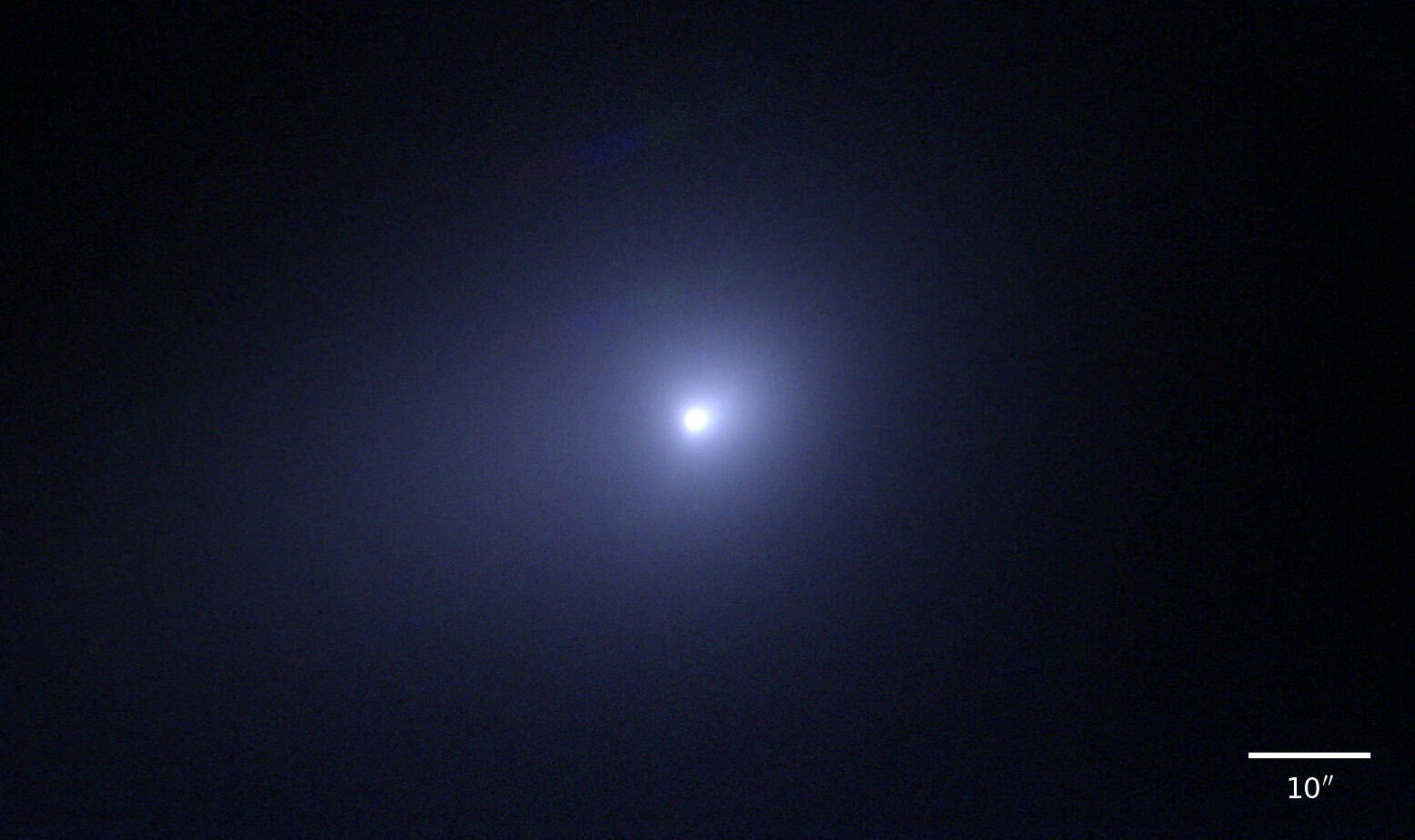
This image from the Subaru Telescope shows the interstellar comet 3I/ATLAS. Image credit: NAOJ.
3I/ATLAS is the third confirmed object from another star system to enter our Solar System, after 1I/‘Oumuamua and 2I/Borisov.
While observations strongly indicate that 3I/ATLAS is a natural object, interstellar visitors are also compelling technosignature targets because an artificial object could represent detectable extraterrestrial technology and potentially provide the first evidence of alien life.
“On July 1, 2025, the third-ever interstellar object — originally reported as C/2025 N1 (ATLAS) and now known more commonly as 3I/ATLAS — was discovered by the Asteroid Terrestrial-impact Last Alert System (ATLAS) facility in Rio Hurtado, Chile,” said SETI Institute astronomer Dr. Sofia Sheikh and her colleagues.
“Many telescopes across the world have tracked the orbit of 3I/ATLAS, and ongoing monitoring has revealed clear cometary activity.”
“If this object is a comet, as expected from the initial characterization, it should be volatile-rich and may produce a dramatic tail now that it has passed perihelion.”
“In early observations, the object appeared red in color, with a coma of cometary emission developing as it approached the Sun.”
“It reached perihelion on October 29, 2025, though observations from Earth were highly impacted by the small angle to the Sun from September until early November.”
“There is still much to learn about this interstellar object, so it is scientifically advantageous that we can observe it throughout its approach.”
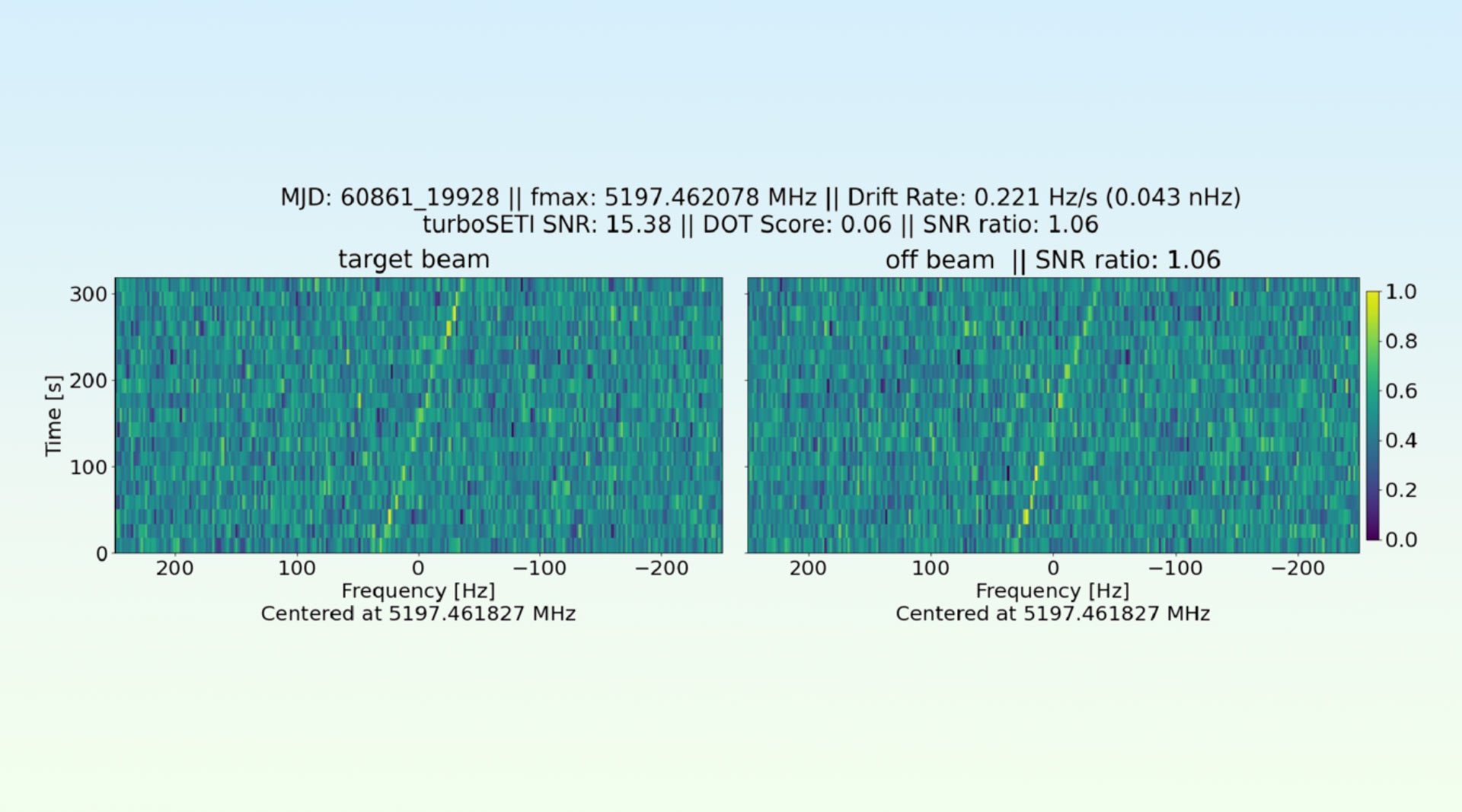
An output waterfall plot from an observation of 3I/ATLAS with 0 signals above the 5.29 SNR ratio threshold. This signal had a nonblanked frequency, a drift rate in the allowable range, and does appear to be truly narrowband (i.e., technological). However, the signal has a similar SNR in both the on-beam and the off-beam, indicating a local interferer in the allocation allotted to fixed-satellite service (Earth-to-space). Image credit: Sheikh et al., doi: 10.3847/1538-3881/ae6651.
In their campaign, the astronomers observed 3I/ATLAS for more than seven hours with the Allen Telescope Array, covering 1 to 9 GHz.
They identified nearly 74 million narrowband signals. After removing human interference and filtering for signals matching the object’s movement, only about 200 remained for review.
All traced back to technology on the surface of the Earth or our own Earth-orbiting satellites.
While no technosignatures were found, the study sets new constraints reinforcing that 3I/ATLAS is a natural object.
The observations place upper limits on the power of any radio transmitter on or near 3I/ATLAS, ruling out signals stronger than about 10-110 W — approximately the power of a household appliance — over the detected frequencies.
“The results from 3I/ATLAS show how realistic it is to detect a signal with the technology we have today,” said Dr. Valeria Garcia Lopez, an astronomer with Furman University and the Breakthrough Listen initiative.
“That is why it is important to keep searching for technosignatures, even from objects we might not expect to have signals.”
The team’s work appears in the Astronomical Journal.
_____
Sofia Z. Sheikh et al. 2026. A Search for Radio Technosignatures from Interstellar Object 3I/ATLAS with the Allen Telescope Array. AJ 172, 1; doi: 10.3847/1538-3881/ae6651