Astronomers have discovered a new black hole in the nearby galaxy Messier 83, also known as M83, the Southern Pinwheel Galaxy or NGC 5236.

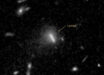
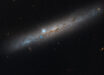
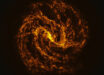
Nearby spiral galaxy M83 and the MQ1 system with jets, as seen by the Hubble Space Telescope. The blue circle marks the position of the MQ1 system in the galaxy, shown inset. Credit: M83 – NASA / ESA / Hubble Heritage Team / WFC3 / UVIS / STScI-PRC14-04a; MQ1 inset – W. P. Blair, Johns Hopkins University / R. Soria, ICRAR-Curtin.
Discovered in 1752, M83 is a barred spiral galaxy located in the constellation Hydra, about 15 million light-years away from Earth.
The astronomers observed the new black hole, dubbed MQ1, with multiple telescopes and discovered that it is a standard-sized small black hole, rather than a slightly bigger version that was theorized to account for all its power.
“It was important to understand how stars were formed, how they evolved and how they died, within a spiral shaped galaxy like M83,” said Dr Roberto Soria from the Curtin University’s International Center for Radio Astronomy Research, who is the lead author of a paper published in the journal Science.
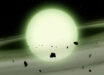
“MQ1 is classed as a microquasar – a black hole surrounded by a bubble of hot gas, which is heated by two jets just outside the black hole, powerfully shooting out energy in opposite directions, acting like cosmic sandblasters pushing out on the surrounding gas.”
MQ1 is only about 100 km wide. Its structure is much bigger than our Solar System, as the jets around it extend about 20 light years from either side of the black hole. It was likely formed when a star died, collapsing to leave behind a compact mass.
“The significance of the huge jet power measured for MQ1 goes beyond this particular galaxy: it helps astronomers understand and quantify the strong effect that black hole jets have on the surrounding gas, which gets heated and swept away.
“This must have been a significant factor in the early stages of galaxy evolution, 12 billion years ago, because we have evidence that powerful black holes like MQ1, which are rare today, were much more common at the time.”
“By studying microquasars such as MQ1, we get a glimpse of how the early universe evolved, how fast quasars grew and how much energy black holes provided to their environment.”
“As a comparison, the most powerful microquasar in our galaxy, known as SS433, is about 10 times less powerful than MQ1,” Dr Soria said.
______
R. Soria et al. Super-Eddington Mechanical Power of an Accreting Black Hole in M83. Science, published online February 27, 2014; doi: 10.1126/science.1248759