On July 2, 2026, the Tianwen-2 probe closed to within 20 km (12.4 miles) of the small near-Earth asteroid 2016 HO3, one of only seven Earth quasi-satellites identified to date, kicking off a science campaign ahead of an eventual sample-return attempt.
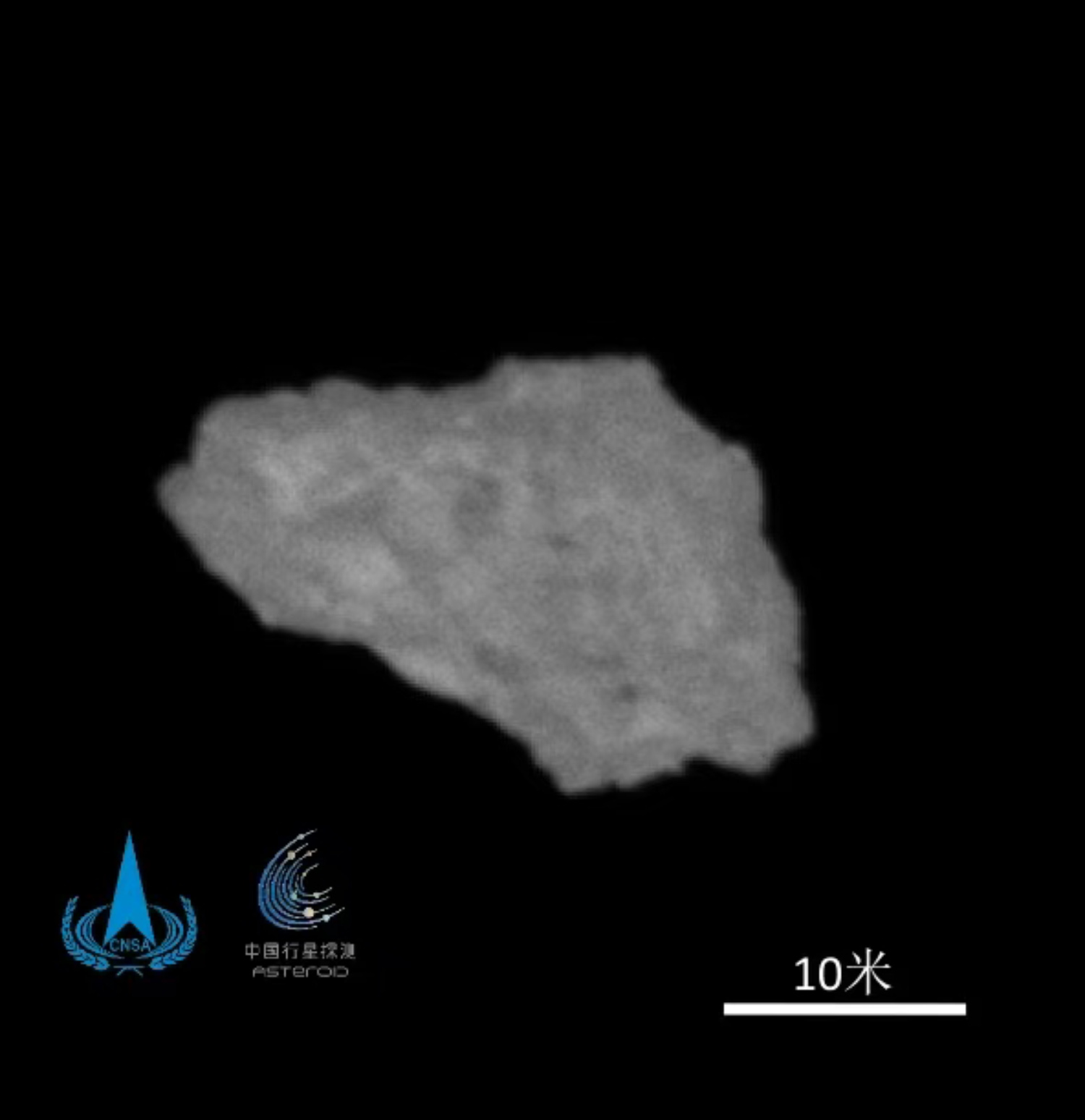
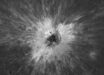
Tianwen-2 captured this image of 2016 HO3 on July 2, 2026 from a distance of about 20 km. Image credit: CNSA.
2016 HO3 was discovered on April 27, 2016 by the Panoramic Survey Telescope and Rapid Response System (Pan-STARRS) at Haleakala Observatory in Hawai’i.
Also known as Kamo’oalewa (meaning ‘oscillating celestial fragment’ in Hawaiian), the asteroid has an orbital period of one year and an estimated diameter of around 30 m (98 feet).
“Among the known near-Earth asteroids, 2016 HO3 is an exceptionally rare Earth co-orbital object,” said Dr. Rongqiao Zhang from the Lunar Exploration and Space Engineering Center and colleagues.
“As an Earth quasi-satellite, its orbital period is close to that of Earth, enabling low energy transfer, and it maintains a stable distance of about 0.1-0.3 astronomical units (AU) from Earth, providing favorable conditions for tracking, control, and communication.”
“Its unusual orbit different, enigmatic origin, and largely uncharacterized physical properties make it a compelling candidate for addressing fundamental questions about the origins of Earth’s quasi-satellites and the dynamical evolution of their orbits.”
“Orbital dynamical models indicate that its current quasi-satellite state began around 100 years ago and is expected to persist for around 300 years,” they added.
“It is currently the closest Earth quasi-satellite (minimum distance 0.2 AU, with no exceedance beyond 0.3 AU throughout its dynamical stability), making it the most stable target of its kind.”
“The plausible origins of this asteroid include local formation, gravitational capture, or ejection from the lunar surface as a result of a collision with another astronomical object.”
2016 HO3 is the primary target of the China National Space Administration (CNSA)’s Tianwen-2 small bodies exploration mission.
“The Tianwen-2 spacecraft of China’s Planetary Exploration Program was launched on May 29, 2025 from the Xichang Satellite Launch Center, utilizing the Long March 3B/G2 rocket,” the researchers said.
“China’s planetary exploration program, known as the Tianwen Project, sets forth an ambitious vision for deep space exploration through a series of four flagship missions.”
“Tianwen-1 marked China’s inaugural journey to Mars, while Tianwen-2 targets small bodies, Tianwen-3 is designed for Mars sample return, and Tianwen-4 aims to investigate the Jupiter system.”
“Among these, Tianwen-2 stands out for its dual objectives: the mission will not only conduct in-orbit observations and collect samples from the near-Earth asteroid 2016 HO3, but will also undertake a subsequent close investigation of the main-belt comet 311P.”
After a 400-day journey covering roughly one billion km (0.6 billion miles), Tianwen-2 arrived within about 20 km of 2016 HO3 on July 2, 2026.
“Along the way, Tianwen-2 carried out a series of deep-space maneuvers and mid-course corrections,” the mission scientists said in a statement.
“The probe spotted the asteroid on June 6, then executed capture control at a distance of 30,000 km on June 7, achieving co-orbital flight with the object. By June 19, it had closed to within 2,000 km.”
“We used the resulting optical navigation data to refine the asteroid’s ephemeris, sharpening its known position from an accuracy of hundreds of km — based solely on ground-based observations — down to just a few km.”
“Tianwen-2 will now begin a more detailed phase of scientific investigation, characterizing the asteroid’s shape, surface composition, and internal structure to lay the groundwork for sample collection.”