Astronomers using the Vera C. Rubin Observatory have discovered over 11,000 new asteroids, including hundreds of trans-Neptunian objects and 33 previously unknown near-Earth asteroids.
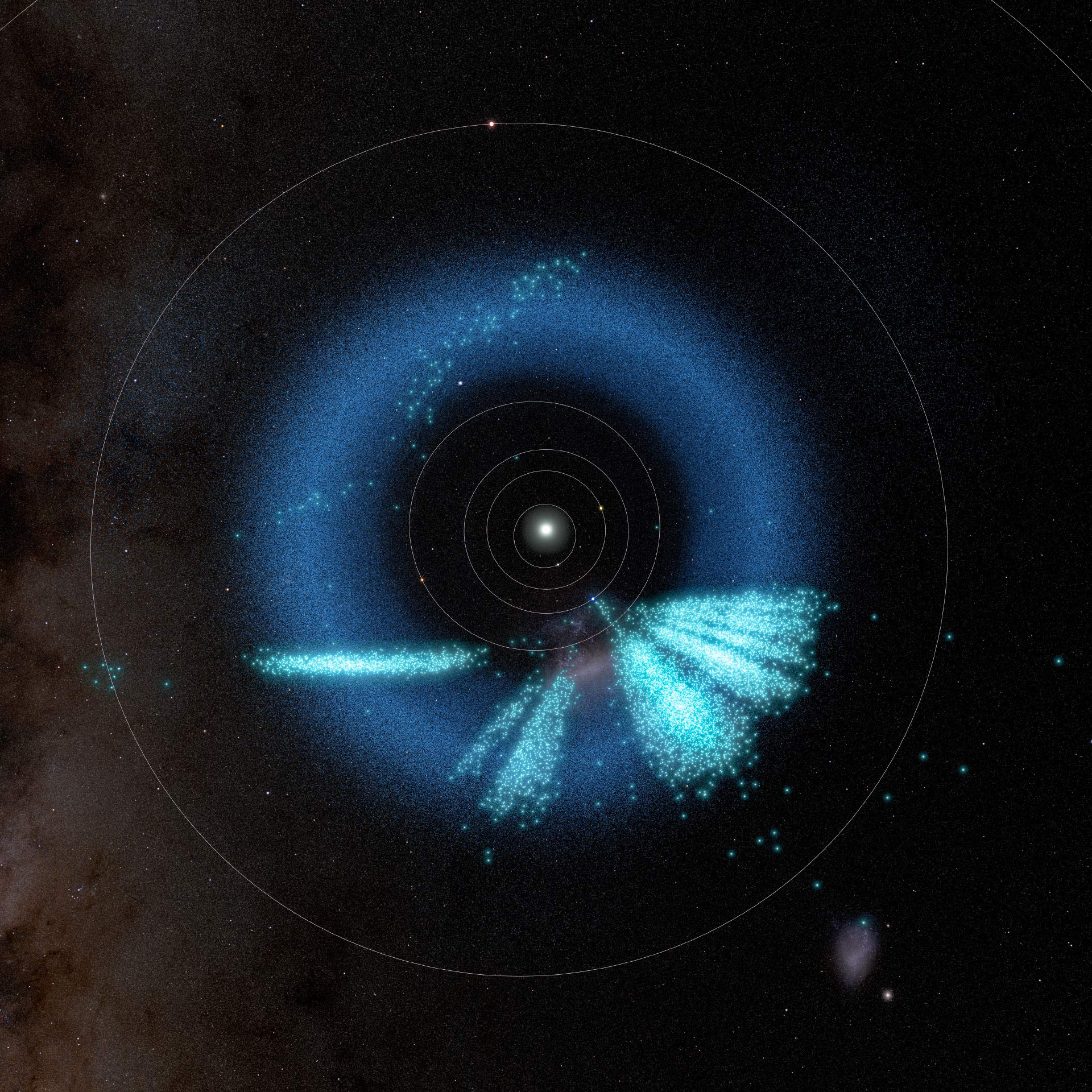
A model of the inner Solar System showing the asteroids discovered by Rubin in light teal; known asteroids are dark blue. Image credit: NSF / DOE / Vera C. Rubin Observatory / NOIRLab / SLAC / AURA / R. Proctor / NASA’s Goddard Space Flight Center Scientific Visualization Studio / ESA / Gaia / DPAC / M. Zamani, NSF’s NOIRLab.
The new dataset from the Vera C. Rubin Observatory comprises approximately one million observations, taken over the span of a month and a half, of over 11,000 new asteroids and more than 80,000 already known asteroids.
The data were submitted to the International Astronomical Union’s Minor Planet Center (MPC).
“This first large submission after Rubin First Look is just the tip of the iceberg and shows that the observatory is ready,” said Rubin Solar System lead scientist Dr. Mario Juric, an astronomer at the University of Washington.
“What used to take years or decades to discover, Rubin will unearth in months.”
“We are beginning to deliver on Rubin’s promise to fundamentally reshape our inventory of the Solar System and open the door to discoveries we haven’t yet imagined.”
Among the newly-identified objects are 33 previously unknown near-Earth objects (NEOs), which are small asteroids and comets whose closest approach to the Sun is less than 1.3 times the distance between Earth and the Sun.
None of the newly discovered NEOs pose a threat to Earth, and the largest is about 500 m wide.
The dataset also contains roughly 380 trans-Neptunian objects (TNOs) — icy bodies orbiting beyond Neptune.
Two of these TNOs — provisionally named 2025 LS2 and 2025 MX348 — have been found to be on extremely large and elongated orbits.
At their most distant points, these two objects reach roughly 1,000 times farther away from the Sun than the Earth is, placing them among the 30 most distant minor planets known.
“Searching for a TNO is like searching for a needle in a field of haystacks — out of millions of flickering sources in the sky, teaching a computer to sift through billions of combinations and identify those that are likely to be distant worlds in our Solar System required novel algorithmic approaches,” said Dr. Matthew Holman, an astrophysicist at the Harvard & Smithsonian’s Center for Astrophysics.
“Objects like these offer a tantalizing probe of the Solar System’s outermost reaches, from telling us how the planets moved early on in the Solar System’s history, to whether a hitherto undiscovered 9th large planet may still be out there,” added Dr. Kevin Napier, also from the Harvard-Smithsonian’s Center for Astrophysics.