The newly-discovered star, SDSS J0715-7334, formed in the halo of the Large Magellanic Cloud and migrated to our Milky Way Galaxy billions of years ago, according to a group of undergraduate students at University of Chicago.
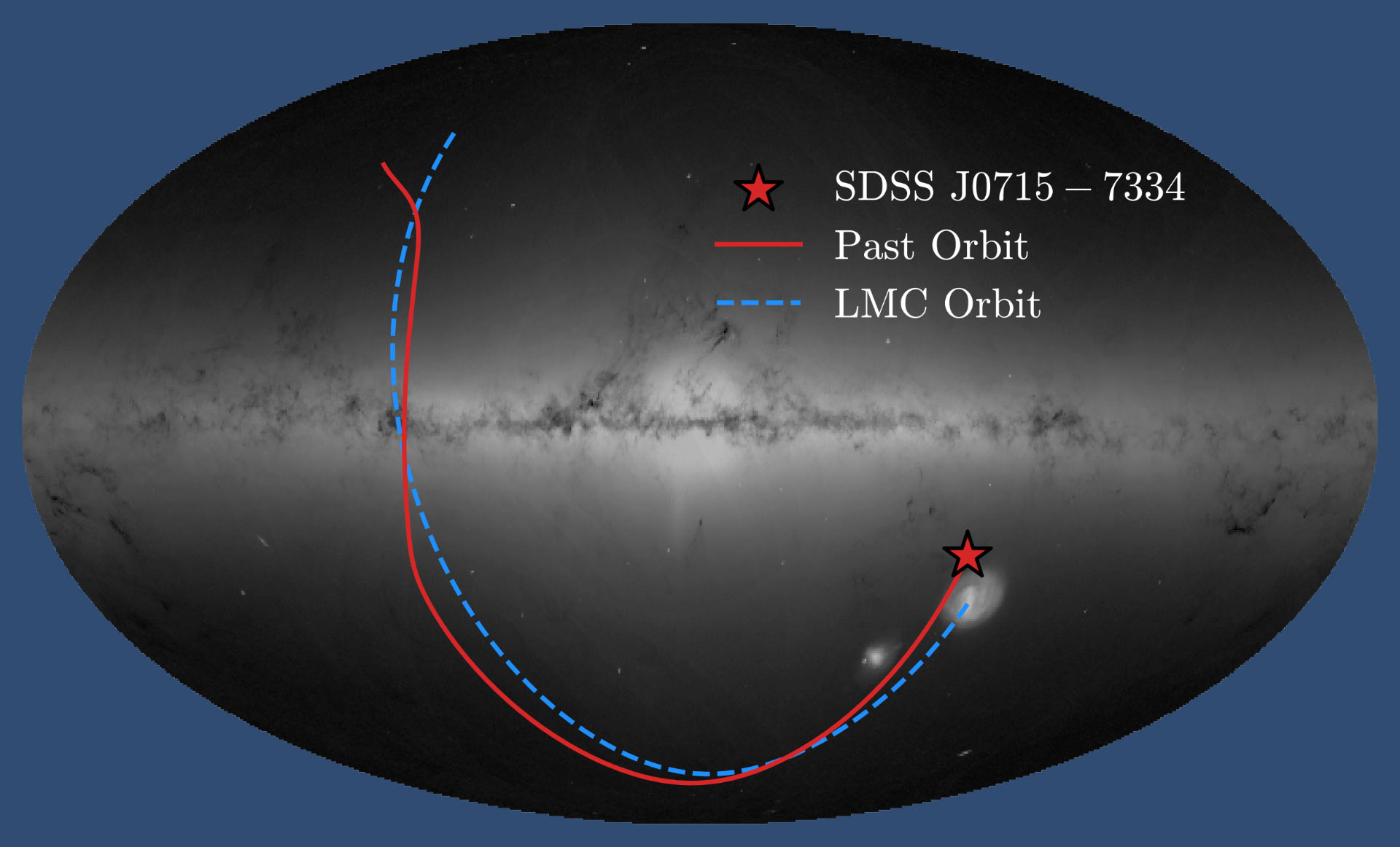
The Milky Way Galaxy with the position of SDSS J0715-7334 marked with a star symbol; the solid red line shows the path the star has taken through our Galaxy; the dashed blue line shows the path expected for a star born in the Large Magellanic Cloud. Image credit: Vedant Chandra / SDSS Collaboration / ESA / Gaia / A. Moitinho, A. F. Silva, M. Barros, C. Barata, University of Lisbon / H. Savietto, Fork Research.
The Big Bang birthed the Universe as a hot murky soup of energetic particles.
Over time, as this material expanded, it began to cool and coalesce into neutral hydrogen gas.
Some patches were denser than others and, after a few hundred million years, their gravity overcame the Universe’s outward trajectory and the material collapsed inward.
This became the first generation of stars, which were formed from just pristine hydrogen and helium.
These stars burned hot and died young, but not before producing new elements in their stellar forges, which were strewn outward into the cosmos by their end-of-life explosions.
And from this material, new stars were born, which now comprised a wider array of elements than their predecessors.
“All of the heavier elements in the Universe, which astronomers call metals, were produced by stellar processes — from fusion reactions occurring within stars to supernovae explosions to collisions between very dense stars,” said University of Chicago’s Professor Alex Ji.
“So, finding a star with very little metal content in it told this group of students that they’d come across something very special.”
With only 0.005% of the metals found in our Sun, SDSSJ 0715-7334 has the lowest metallicity of any star yet observed in the Universe — more than twice as metal-poor as the previous record holder.
Found in data from the Sloan Digital Sky Survey (SDSS), the star is located approximately 80,000 light-years away from Earth.
Analysis of its orbit shows it formed in the Large Magellanic Cloud and migrated into the Milky Way billions of years ago.
“This ancient immigrant gives us an unprecedented look at conditions in the early Universe,” Professor Ji said.
“Big data projects like SDSS make it possible for students to get directly involved in these important discoveries.”
“We analyzed the star for a large swath of elements, and the abundances are quite low for all of them,” said Ha Do, one of the students at the University of Chicago who discovered the star.
The team’s paper was published in the journal Nature Astronomy.
_____
A.P. Ji et al. A nearly pristine star from the Large Magellanic Cloud. Nat Astron, published online April 3, 2026; doi: 10.1038/s41550-026-02816-7