Marine biologists have identified a new species of the shark genus Hemiscyllium in the waters of eastern Papua New Guinea, expanding a remarkable group of reef-dwelling sharks known for using their four fins to ‘walk’ across the seafloor.
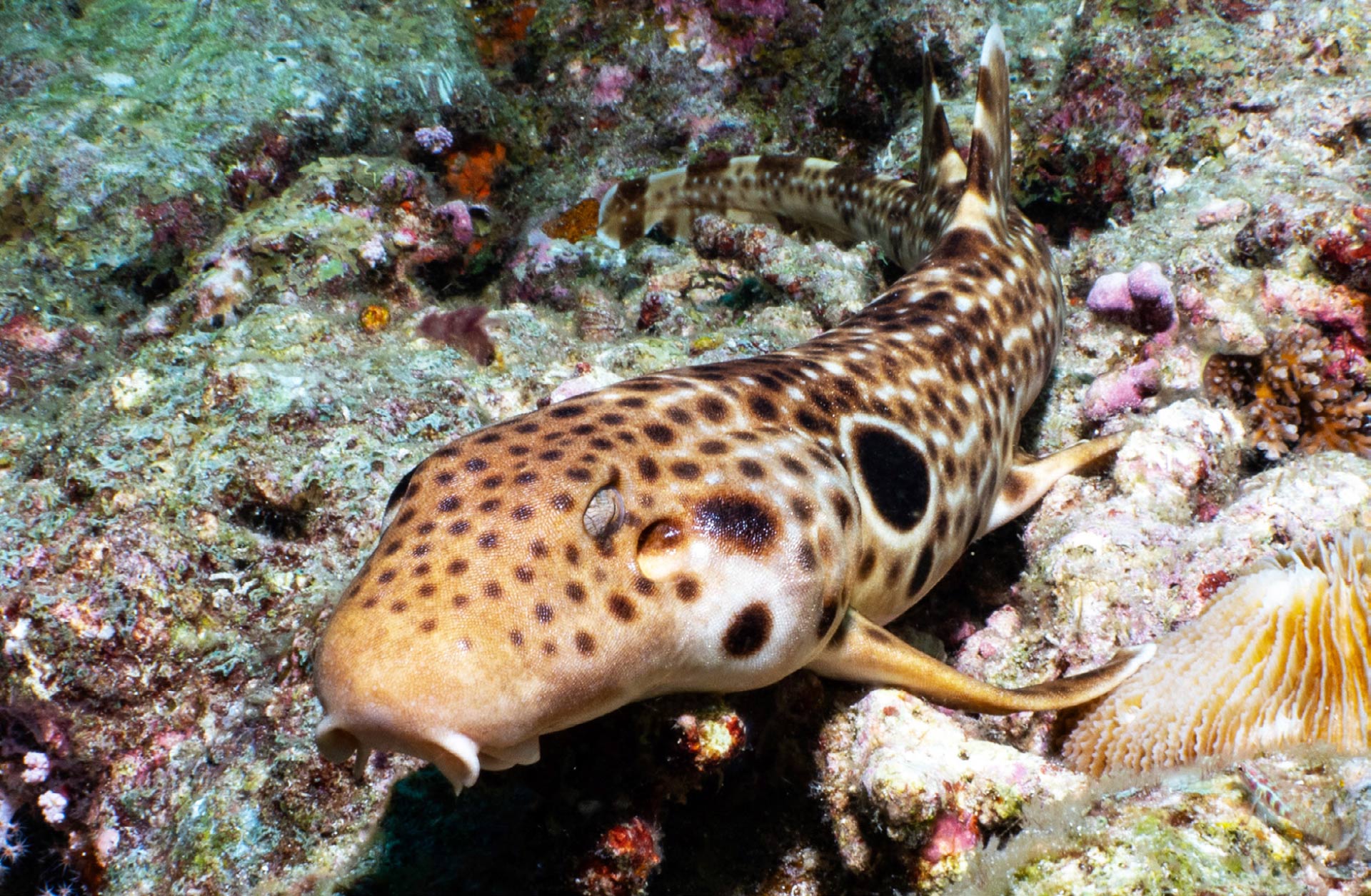
Hemiscyllium dudgeonae, male paratype, Nubwageta, Milne Bay province, Papua New Guinea. Image credit: M.V. Erdmann.
Walking sharks comprise ten similar species of carpet sharks whose identification relies on distinctive color patterns, genetic markers, and geographically restricted distributions.
The genus is endemic to Australia and the island of New Guinea, a region that coincides with the global hotspot for carpet shark diversity that has been shaped by complex tectonic and sea‑level histories.
Walking sharks are small, predominantly nocturnal, benthic sharks that typically reach total lengths of 70-80 cm, with the largest reported at 107 cm.
They are commonly found in shallow coastal habitats, including coral reefs, seagrass beds, and mangroves, usually at depths less than 10 m, but have been recorded as deep as 50 m.
Walking sharks exhibit extremely restricted home ranges of only a few hundred square meters to a few square kilometers due to their limited mobility and benthic lifestyle.
Additionally, these sharks are oviparous, depositing small oval-shaped egg cases on the sea floor, which further restricts their dispersal abilities.
Although knowledge of walking shark distributions has been updated over the past two decades, the species endemic to eastern Papua New Guinea remain poorly known.
In a new study, Dr. Christine Dudgeon from the University of the Sunshine Coast and her colleagues addressed these gaps by investigating the distributions of walking sharks in eastern Papua New Guinea.
“New shark species don’t come along that often, and it’s most definitely the first one named after me,” Dr. Dudgeon said.
The new Hemiscyllium species was discovered during surveys conducted between 2023 and 2025 in Papua New Guinea’s Milne Bay province.
Named the Dudgeon’s epaulette shark (Hemiscyllium dudgeonae), it is distinguished by a unique pattern of brown freckles interspersed with white spots and dashes across its body, along with a prominent eye-like marking behind its head.
Genetic evidence indicated that the new species is closely related to Hemiscyllium michaeli.
The researchers also warn that Hemiscyllium dudgeonae may be highly vulnerable because of its apparently limited distribution.
“We hope to collect more data on our next research trip in October to help the IUCN Red List assess the species as Vulnerable or Endangered with Extinction,” said University of the Sunshine Coast Ph.D. student Jess Blakeway.
The scientists also revised the known distributions of Hemiscyllium michaeli and another Papua New Guinean walking shark species, Hemiscyllium hallstromi.
“Our research also changed the understanding of where walking sharks can be found,” Blakeway said.
“Previously, it was thought that each species had distinct habitat barriers such as rivers or deep water.”
“Now we know that distributions in eastern Papua New Guinea overlap, though species do not co-occur.”
“The new species is the 10th in the Papua New Guinean epaulette genus.”
“Five are already listed as Threatened with Extinction on the IUCN Red List under criterion B, a criterion that only applies to 3% of all sharks.”
The team’s paper was published June 15 in the Journal of the Ocean Science Foundation.
_____
J.-A. Blakeway et al. 2026. A review of walking shark (Hemiscylliidae: Hemiscyllium) distributions in Papua New Guinea and description of a new species. Journal of the Ocean Science Foundation 46: 71-110; doi: 10.5281/zenodo.20575429